Machine learning has become an essential driver of modern campaign optimisation, helping marketers run smarter, faster, and more efficient campaigns across digital channels.
Instead of relying solely on intuition or manual analysis, machine learning models learn from historical customer behavior, interaction patterns, and conversion data to recommend or automate high-impact marketing decisions.
These models analyze large volumes of data—such as clicks, purchases, browsing activity, ad impressions, and customer demographics—to uncover patterns that marketers may not easily spot.
By integrating machine learning into campaign workflows, marketers can predict which customers are most likely to convert, which creatives will perform best, and which channels deserve more budget allocation.
Machine learning also helps in real-time bidding, dynamic content personalization, churn prediction, and lifetime value estimation—all of which significantly enhance campaign ROI.
Tools like recommendation engines, uplift modeling, and multi-armed bandits allow campaigns to adapt automatically to customer responses, ensuring continuous improvement without constant manual intervention.
As digital advertising grows more competitive and customer behavior becomes more complex, machine learning offers a scalable and data-driven mechanism to optimize targeting, messaging, timing, and spend.
From Google Ads’ automated bidding systems to AI-driven email personalization, machine learning has transformed marketing campaigns into intelligent systems capable of learning and evolving with each customer interaction.
AI-Powered Campaign Optimization and Decision Intelligence
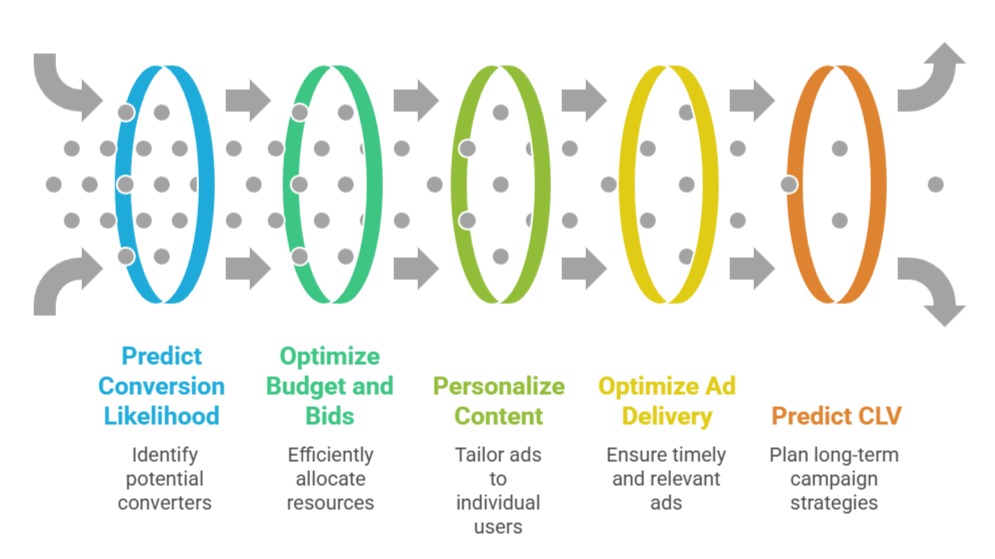
1. Predicting Customer Conversion Likelihood to Improve Targeting
Machine learning models such as logistic regression, gradient boosting, and neural networks help marketers estimate the probability that each customer will click, purchase, subscribe, or respond to a campaign.
These predictions allow brands to prioritize high-intent audiences while avoiding wasted spend on low-probability segments.
By analyzing behavioral signals such as browsing frequency, product interactions, and past engagement, the model develops a deeper understanding of customer patterns.
Marketers can use these insights to design smarter targeting lists, allocate budgets strategically, and tailor messaging for each customer segment.
This leads to higher conversion rates, increased ROI, and more predictable campaign performance across channels.
2. Budget Allocation and Bid Optimization Using Machine Learning
Machine learning models analyze real-time campaign performance metrics—such as cost per click, cost per acquisition, impressions, and conversion data—to recommend optimal budget distribution across channels.
Algorithms like reinforcement learning and automated bidding engines can dynamically adjust bids based on predicted outcomes, ensuring that spend flows toward high-performing segments.
This reduces overspending on low-value audiences while increasing exposure to profitable targets.
Platforms like Google Ads and Meta Ads already use ML-driven bidding, enabling marketers to achieve better campaign efficiency with less manual oversight.
As a result, marketers maintain full control while benefiting from data-driven optimisation.
3. Creative Performance Prediction and Dynamic Content Personalisation
Machine learning helps evaluate how different creatives—images, videos, headlines, CTAs, colours, and formats—perform across customer groups.
By analyzing past creative performance and customer engagement patterns, ML models predict which content variations will resonate most with specific audiences.
This enables dynamic creative optimisation (DCO), where ads automatically change based on user behavior, location, interests, or device type.
Personalized creatives significantly improve relevance, reduce ad fatigue, and boost engagement rates.
Marketers can continuously evolve their creative strategy without relying solely on manual A/B testing, making campaigns more agile and customer-centric.
4. Real-Time Optimisation of Ad Delivery and User Experience
Machine learning systems monitor and update campaign parameters instantly based on user interactions, ensuring campaigns stay aligned with evolving customer behavior.
Real-time models use streaming data—from clicks, views, scrolls, and time-on-page—to adjust targeting, content, and delivery strategies.
This continuous optimisation helps marketers capture customer intent at the exact moment it peaks, such as when a user revisits a product page or abandons a cart.
ML-driven real-time actions enhance personalization, reduce latency in decision-making, and improve customer satisfaction.
These adaptive systems ensure campaigns remain relevant and competitive in fast-moving digital environments.
5. Customer Lifetime Value (CLV) Prediction for Smarter Campaign Planning
Machine learning models analyze purchase history, retention patterns, and behavioral signals to estimate each customer’s long-term revenue potential.
CLV prediction helps marketers separate high-value customers from low-value ones and craft differentiated marketing strategies for each group.
High-CLV customers may receive premium offers or loyalty rewards, while lower-value customers may be targeted with automation-friendly, economical campaigns.
This allows businesses to allocate resources more efficiently and increase profitability by focusing on customers with long-term potential.
CLV-based segmentation also guides retention, upselling, cross-selling, budgeting, and customer experience decisions.
6. Churn Prediction Models to Identify At-Risk Customers
Machine learning allows marketers to detect early signs of customer inactivity or dissatisfaction.
Churn models study patterns such as reduced app usage, lower email engagement, abandoned carts, and fewer website visits.
By identifying customers who are likely to leave, businesses can intervene with retention strategies—discounts, personalized messages, or loyalty programs.
This proactive approach reduces churn rates and helps protect revenue streams.
Predictive churn modelling enhances retention planning and improves the efficiency of customer relationship management systems, ensuring that high-value customers remain engaged with the brand.
7. Uplift Modeling to Identify True Campaign Impact
Uplift modeling is a powerful machine learning technique that predicts which customers will positively change their behavior because of a marketing action.
Unlike traditional response models, uplift models focus on finding customers who will convert only if they receive the campaign message. This allows marketers to avoid wasting resources on customers who would have purchased anyway or those who will never respond.
By segmenting customers into persuadables, sure-things, lost-causes, and do-not-disturbs, uplift modeling improves campaign efficiency and reduces unnecessary spending.
This technique is increasingly used in subscription services, retail promotions, and retention marketing, where measuring true incremental impact is crucial.
As a result, uplift modeling enables marketers to drive higher incremental ROI and more meaningful customer engagement.
8. Multi-Armed Bandit Algorithms for Continuous Campaign Optimization
Multi-armed bandits (MAB) provide an automated way to optimize campaigns without relying on fixed A/B test durations.
These algorithms dynamically allocate traffic to better-performing ads, creatives, or audiences while reducing exposure to low-performing variations.
Unlike traditional A/B tests that wait for full statistical significance, MAB algorithms continuously learn and adjust, allowing campaigns to improve performance in real time.
This reduces wasted impressions and increases the probability of maximizing conversions or engagement.
MAB is especially useful in fast-moving environments such as social media ads, e-commerce promotions, and mobile app marketing, where rapid customer behavior changes make static experiments less effective.
By balancing exploration and exploitation, MAB helps marketers achieve long-term campaign efficiency.
9. Recommendation Systems to Personalize Conversions and Upsell Opportunities
Recommendation engines powered by machine learning help marketers deliver hyper-personalized suggestions based on a customer’s browsing history, purchase patterns, interests, and contextual behavior.
These systems analyze vast datasets to identify which products, content types, or offers are most likely to resonate with each user.
Whether it's recommending related products in e-commerce, suggesting content in media platforms, or promoting relevant add-ons during checkout, recommendations significantly enhance campaign performance.
Personalized recommendations increase customer satisfaction, drive more conversions, and raise average order value.
In marketing campaigns, they also reduce decision fatigue and guide customers through smoother buying journeys.
As personalization becomes essential for customer loyalty, recommendation engines provide a powerful competitive advantage.
10. Sentiment Analysis to Improve Messaging and Creative Strategy
Machine learning–driven sentiment analysis allows marketers to understand customer emotions expressed across social media, reviews, emails, surveys, and support chats.
By identifying positive, negative, and neutral sentiments, models help marketers adjust campaign messaging, refine tone, and select more emotionally resonant creatives.
Sentiment trends also reveal how customers feel about new product launches, ad campaigns, or brand announcements.
This helps marketers optimize communication strategies and avoid messages that may trigger negative reactions.
Integrating sentiment insights into live campaigns enables marketers to switch creatives, shift targeting, or launch corrective marketing actions quickly.
As emotional connection becomes crucial in brand loyalty, sentiment analysis provides a data-backed way to craft more impactful campaigns.
11. Lookalike Modeling to Expand High-Quality Target Audiences
Lookalike modeling uses machine learning to identify new audiences who share characteristics with existing high-value customers.
These models analyze demographics, purchase history, online behavior, and engagement data to find prospects similar to top converters, loyal buyers, or high-CLV users.
Platforms like Meta Ads, Google Ads, and DSPs use ML-driven lookalike tools to help advertisers expand reach without compromising on targeting accuracy.
This approach reduces acquisition costs, increases relevance, and drives faster scaling of digital campaigns.
Lookalike modeling is especially beneficial for brands entering new markets, launching new products, or scaling e-commerce operations.
With precise modeling, marketers can grow campaigns while maintaining strong performance and healthy ROI.
12. Automated Campaign Optimization Through Marketing AI Platforms
Modern marketing platforms integrate machine learning to automate decisions such as selecting audience segments, choosing ad placements, scheduling sends, and determining creative combinations.
Tools like Google Performance Max, Meta Advantage+, and programmatic DSPs use ML to optimize campaigns across multiple channels simultaneously.
These systems continuously learn from performance data—clicks, leads, conversions, engagement metrics—and adjust strategies with minimal manual input.
Automation reduces operational overhead, improves speed, and frees marketers to focus on strategic planning.
Machine learning ensures campaigns stay optimized even with large datasets, frequent creative changes, and multi-channel complexity. This approach has become essential as marketing teams scale.

Class Sessions
Sales Campaign

We have a sales campaign on our promoted courses and products. You can purchase 1 products at a discounted price up to 15% discount.