Linear and multiple regression are foundational predictive modelling techniques widely used in marketing analytics to estimate relationships between variables and forecast future outcomes.
In sales forecasting, regression models help quantify how different factors—such as price changes, ad spend, competitor activity, or seasonality—impact overall revenue.
For campaign forecasting, regression allows marketers to understand how individual marketing inputs (e.g., impressions, clicks, budget, channel mix) influence conversions, engagement, or ROI.
Simple linear regression examines the relationship between one predictor and one outcome variable, making it ideal for straightforward scenarios like linking ad spend to sales.
Multiple regression expands this approach by incorporating multiple predictors simultaneously, offering a more realistic and comprehensive view of complex marketing behaviour.
For example, a multiple regression model might analyze how social media spend, email frequency, discount rate, and traffic sources collectively influence weekly sales.
These models help marketers make data-driven decisions by identifying key performance drivers, quantifying their influence, and estimating future outcomes based on planned marketing activities.
With today’s digital marketing landscape generating high volumes of structured and unstructured data, regression analysis has become more powerful and accessible thanks to Python, R, Excel, Google Sheets, and cloud-based analytics platforms.
By applying regression effectively, marketing teams can better plan campaigns, optimize budgets, reduce uncertainty, and improve overall forecasting accuracy.
Regression-Based Predictive Modeling in Marketing
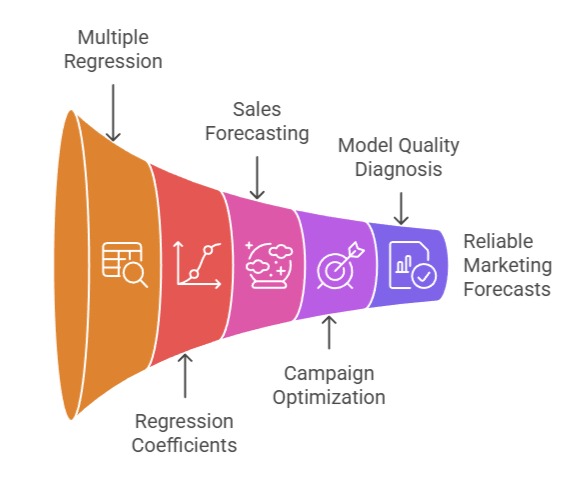
1. Understanding the Core Concept of Linear Regression
Linear regression focuses on predicting a numerical outcome using a single independent variable, making it a simple yet powerful model for marketing forecasts.
It assumes that the relationship between variables is linear—meaning changes in one factor result in proportional changes in the outcome.
For example, marketers may analyze how each additional dollar spent on advertising translates into expected sales uplift.
This technique provides both a prediction and an understanding of how strong or weak the relationship is.
Linear regression is often used as the starting point before introducing more predictors.
It also helps marketers visualize the trend using straight-line graphs that make insights easy to interpret. This simplicity makes it suitable for quick, preliminary forecasting.
2. Multiple Regression for More Accurate and Realistic Forecasting
Multiple regression involves using several independent variables to predict a single outcome, making it far more accurate for complex marketing environments.
Sales and campaign performance are rarely influenced by a single factor; instead, they depend on multiple elements like budget allocation, audience size, seasonal shifts, competitor actions, and creative quality.
By incorporating multiple variables, this model provides a multi-dimensional understanding of what drives results.
It also allows marketers to identify which predictors have the strongest impact and which ones contribute very little.
Multiple regression generates coefficients that quantify how each variable affects the outcome while controlling for others.
This method leads to more realistic forecasts and better strategic planning.
3. Using Regression Coefficients to Understand Marketing Impact
Regression coefficients represent how much the predicted outcome changes when one variable increases while all others stay constant.
In marketing, this helps determine how different actions influence sales or campaign performance.
For example, a coefficient might show that increasing email frequency by one unit leads to a 5% lift in conversions.
Coefficients also reveal whether the relationship is positive or negative, offering deeper insights into what helps or harms performance.
They help marketers prioritize activities by identifying the most influential predictors.
Additionally, standardized coefficients help compare variables on different scales. Understanding coefficients turns raw numbers into meaningful strategic insights.
4. Forecasting Sales Using Regression Models
Regression is widely used for sales forecasting because it captures both historical patterns and the influence of external drivers.
By inputting planned marketing activities—such as upcoming discounts or expected ad spend—marketers can generate predictions for future sales periods.
These forecasts help teams plan inventory, staffing, and promotional strategies more accurately.
Regression also identifies peak seasons, growth trends, and risk areas. In omnichannel retail, combining variables like store traffic, web visits, and email campaigns can significantly improve accuracy.
When regularly updated with new data, regression models adjust to changing market behavior and deliver increasingly reliable forecasts.
5. Campaign Performance Forecasting and Optimization
Regression models help marketers predict key campaign outcomes such as conversions, CTR, engagement, or ROI.
By understanding how variables like budget allocation, audience segments, creative format, or frequency influence performance, teams can optimize campaigns before launch.
This allows marketing managers to simulate "what-if" scenarios—such as predicting results if spend is increased on certain channels.
Regression also helps allocate budgets efficiently by identifying which channels produce the highest marginal returns.
When combined with A/B testing data, models can refine forecasts further.
These insights support better planning, reduced waste, and higher campaign profitability.
6. Diagnosing Model Quality Using Statistical Metrics
Evaluating a regression model involves analyzing metrics such as R², Adjusted R², RMSE, and p-values to ensure accuracy and reliability.
R² measures how much variation in the outcome is explained by the predictors, giving a sense of model strength.
RMSE indicates how far predictions deviate from actual results, helping assess precision. P-values show which variables are statistically significant and worth keeping.
Visual tools such as residual plots help detect issues like non-linearity or outliers.
Assessing model quality ensures predictions are trustworthy and not based on misleading patterns.
7. Handling Multicollinearity and Data Challenges
Multiple regression can suffer from multicollinearity—where predictors are highly correlated—leading to unstable coefficients.
This is common in marketing datasets where variables like impressions, clicks, and spend are often interrelated.
Detecting multicollinearity using VIF (Variance Inflation Factor) ensures the model remains reliable.
Other challenges include missing values, outliers, and inconsistent data sources.
Preprocessing, feature engineering, and careful variable selection are essential for building robust models. Addressing these issues improves model stability and forecasting accuracy.
8. Using Tools Like Excel, Python, and Google Sheets for Regression
Modern regression modelling is accessible through tools that marketers already use.
Excel and Google Sheets offer built-in regression functions for quick analysis, making them useful for non-technical users.
Python and R provide more advanced capabilities such as handling large datasets, automation, and visualization.
Python libraries like scikit-learn and statsmodels make it easy to build, validate, and interpret regression models.
Cloud platforms like Google Colab and AWS further simplify computing needs. These tools enable marketers to run regression analysis efficiently without needing deep programming expertise.
9. Feature Engineering to Improve Regression Forecasts
Feature engineering involves creating new variables from existing data to improve model performance.
In marketing regression models, this might include calculating variables like customer lifetime value, recency-frequency-monetary (RFM) scores, promotional intensity indexes, or seasonality flags.
These engineered features often capture deeper behavioral patterns that raw data does not reveal.
For example, adding “weekend vs weekday” indicators can greatly improve ecommerce sales predictions.
Marketers can also create interaction terms—like Ad Spend × Season—to model combined effects.
Properly engineered features help increase model accuracy and reveal nuanced relationships that support better forecasting and decision-making.
10. Incorporating Seasonality and Trend Components
Sales forecasting frequently requires understanding seasonal fluctuations, holiday spikes, and long-term trends.
Adjusting regression models to include time-based variables—such as month, quarter, or year—helps capture these predictable patterns.
Seasonality indicators help explain why sales peak during certain months or drop during off-seasons, ensuring predictions are more realistic.
Trend variables identify long-term growth or decline in sales over time.
By incorporating both components, marketers can produce more stable and reliable forecasts that account for real-world behavior. This prevents underestimating or overestimating sales during cyclical periods.
11. Using Dummy Variables for Categorical Marketing Factors
Regression models require categorical variables—like regions, campaign types, audience segments, and device types—to be converted into numerical dummies.
Dummy variables allow the model to quantify differences between categories while retaining the regression framework.
For example, marketers can compare how different regions contribute differently to sales or how various campaign types influence conversions.
Creating accurate and meaningful dummy variables ensures the model interprets categorical differences effectively.
This becomes essential for multi-channel and multi-segment marketing strategies. Dummy coding enables better insights into qualitative marketing decisions.
12. Applying Logistic Regression for Classification-Based Forecasting
Though technically not linear regression, logistic regression operates on similar principles and is valuable for forecasting binary marketing outcomes.
Examples include predicting whether a customer will convert, churn, click an ad, or respond to a promotion.
Instead of forecasting continuous values, logistic regression predicts probabilities, making it ideal for decision-making thresholds.
The model helps marketers run targeted campaigns, allocate resources efficiently, and design personalized strategies.
It also integrates well with A/B testing results to predict segment-level responses. Logistic regression expands the toolkit for practical campaign forecasting.