Predictive modelling is a core component of modern data-driven decision-making and lies at the heart of predictive analytics.
It involves using historical data to build mathematical models that can forecast future outcomes, identify patterns, and quantify the likelihood of specific events.
In marketing, predictive modelling helps businesses anticipate customer behaviour—such as purchase intent, churn probability, product demand, or campaign responsiveness—enabling companies to optimize strategies proactively instead of reacting after results occur.
The modelling process typically includes key steps such as defining the business problem, preparing and exploring the dataset, selecting suitable algorithms, training and validating the model, and finally generating predictions that guide real-world business decisions.
Predictive models range from simple linear regressions to advanced machine learning techniques like decision trees, random forests, and gradient boosting.
With increasing availability of digital marketing data—user behaviour logs, CRM databases, social media activity, and ad interaction metrics—predictive modelling has become essential for marketing teams to personalize communication, allocate budgets more effectively, and improve customer lifetime value.
As tools like Python, R, and cloud-based analytics platforms become more accessible, marketers are empowered to build, interpret, and apply predictive models without needing deep expertise in complex statistical theory.
Marketing Predictive Modeling: Concepts and Applications
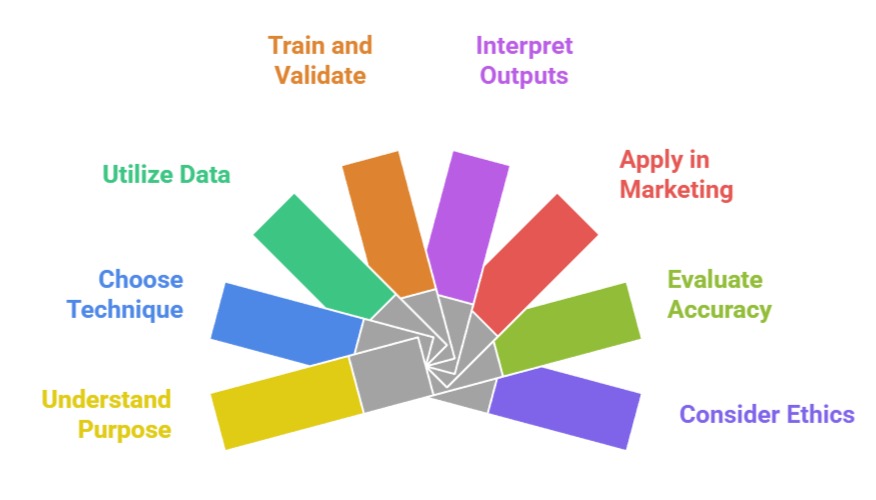
1. Understanding the Purpose of Predictive Models
Predictive models aim to forecast outcomes using patterns found in historical data, making them essential for marketing teams who want to anticipate customer actions.
These models help reduce uncertainty by offering data-backed insights that support faster and more accurate decision-making.
For example, predicting which customers are likely to churn allows teams to design targeted retention campaigns.
Predictive models also clarify which factors influence customer behaviour most, improving strategic planning.
In addition, businesses can use these models to optimize pricing, product recommendations, and ad budgets.
Ultimately, the purpose is not just predicting outcomes but enabling smarter, more efficient marketing operations.
2. Types of Predictive Modelling Techniques
Predictive modelling includes various techniques such as regression models, classification models, time-series forecasting, and clustering-based predictions.
Regression models estimate continuous outcomes like sales volume or customer spending. Classification models categorize outcomes, such as whether a customer will convert or not.
Time-series forecasting is used to predict trends over time, making it useful for seasonal demand planning.
More advanced techniques like random forests and gradient boosting increase accuracy by learning complex patterns.
Choosing the right modelling technique depends on the marketing use case and the nature of the data available.
3. Role of Data in Predictive Modelling
Data quality directly determines the performance of a predictive model, making data collection, cleaning, and preparation crucial steps.
Models rely on features—variables representing customer attributes or behaviours—that must be accurate, relevant, and updated.
Missing values, duplicates, and incorrect entries can distort predictions, so preprocessing is essential.
Marketers also need to incorporate different data sources such as web analytics, CRM logs, and ad campaign data.
The more comprehensive the dataset, the better the model captures customer behaviour patterns.
Ultimately, predictive modelling success is built on strong, reliable data foundations.
4. Model Training, Testing, and Validation
Predictive modelling involves splitting data into training and testing sets to ensure the model learns patterns without memorizing them.
The training set teaches the model, while the testing set measures how well it performs on unseen data.
Validation methods—like cross-validation—help prevent overfitting, ensuring the model remains robust across different scenarios.
Performance metrics such as accuracy, RMSE, precision, and recall indicate how reliable the model is.
This process ensures the final model can make consistent and generalizable predictions in real-world marketing contexts.
5. Interpreting Predictive Model Outputs
Understanding model outputs is critical for applying predictions effectively in marketing decision-making.
Regression models provide coefficients that show how each feature influences the predicted value.
Classification models output probabilities that describe how likely an event is to occur, such as a customer responding to an ad.
Visualizations like ROC curves, lift charts, and feature importance plots help marketers interpret model behaviour.
Clear interpretation ensures the insights translated into actions are meaningful and reliable.
Without interpretation, predictions remain numbers instead of strategic value.
6. Use Cases of Predictive Modelling in Marketing
Predictive models support a wide range of marketing applications such as forecasting sales, predicting churn, optimizing ad spend, and segmenting customers.
By anticipating which channels will perform best, marketing teams can allocate budgets more efficiently.
Models also support personalization by predicting the best product recommendations for each customer.
Additionally, predictive analytics enhances lead scoring, enabling teams to identify high-value leads more accurately.
These use cases not only improve marketing efficiency but also boost customer satisfaction through more relevant engagement.
7. Importance of Model Evaluation and Accuracy Metrics
Model evaluation ensures the predictive model performs as expected before using it for real-world decisions.
Metrics like RMSE, R² score, accuracy, recall, F1 score, and AUC help assess performance depending on the type of problem.
Evaluating models prevents costly decision-making errors caused by unreliable predictions.
Over time, evaluating and refining the model ensures it adapts to changes in customer behaviour and market conditions.
This continuous improvement process increases confidence in the insights generated and builds a stronger analytical culture within the marketing team.
8. Ethical and Practical Considerations in Predictive Modelling
Predictive modelling must account for ethical factors such as transparency, fairness, and responsible use of data.
Models can inadvertently introduce bias if historical data reflects unequal treatment or skewed representation.
Marketers must ensure customer data is used with clear consent and in compliance with privacy regulations.
It is also important to avoid over-reliance on automated predictions and always incorporate human judgment.
Ethical modelling builds customer trust and supports long-term brand credibility.