Data collection and cleaning are foundational steps in marketing analytics because they ensure that all insights, reports, and decisions are based on accurate and reliable information.
Modern marketing generates data from numerous channels—websites, social media, email campaigns, CRM systems, advertising platforms, and offline customer interactions.
However, raw marketing data is often scattered, incomplete, duplicated, and messy.
If this data is not collected properly and cleaned thoroughly, it can lead to misleading insights, incorrect segmentation, wrong budget allocation, and poor campaign decisions.
Therefore, a structured and efficient data collection and cleaning process allows marketers to transform raw information into high-quality datasets ready for analysis and strategic planning.
Foundations of Marketing Data Quality and Preparation
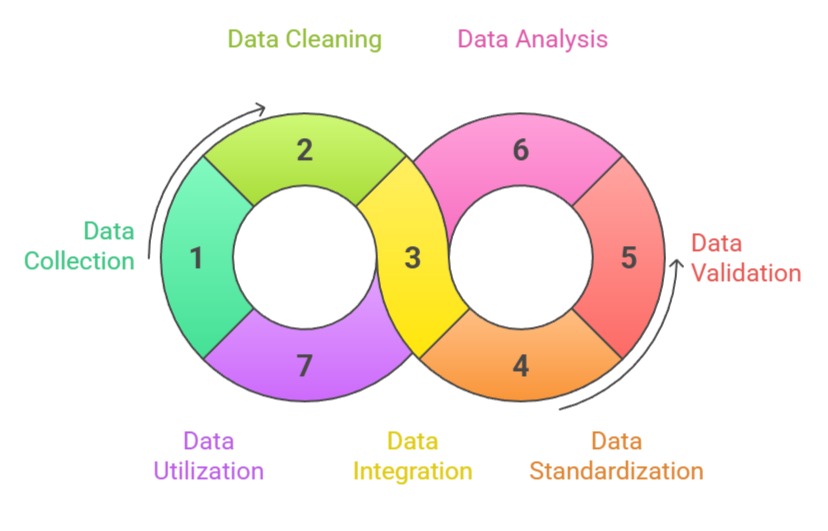
1. Data Collection for Marketing Data
Data collection in marketing involves gathering information from all customer touchpoints to understand their behavior, preferences, and interactions with the brand.
This process includes collecting web activity data (such as clicks, page visits, and browsing paths), social media engagement, email performance analytics, purchase history, feedback, and lead information.
Data may come from both internal systems like CRM and external tools such as Google Analytics, Meta Ads Manager, HubSpot, and survey platforms.
To collect high-quality data, marketers must define clear objectives—whether they need data for customer segmentation, campaign analysis, trend forecasting, or performance measurement.
Proper data collection also requires integrating multiple sources into a unified dataset so marketers can see the complete customer journey across channels.
This helps create a holistic and consistent view of customer behavior, which is essential for building effective marketing strategies.
2. Importance of Data Cleaning in Marketing
Data cleaning ensures that the collected data is accurate, consistent, complete, and free from errors or biases.
In marketing, datasets often contain missing information, duplicate entries, outdated contacts, inconsistent formats, or values recorded incorrectly.
For instance, customer names may be spelled differently across systems, email addresses may be invalid, demographic fields may be empty, or transactions may be logged multiple times.
Without cleaning these issues, marketers risk making decisions based on flawed or misleading information.
Data cleaning improves the reliability of customer profiles, enhances segmentation accuracy, and increases the effectiveness of marketing automation.
It also ensures that customer behavior patterns, campaign results, and performance reports reflect reality.
Clean and organized data gives marketers confidence that the insights they extract are trustworthy and actionable.
3. Key Steps in Cleaning Marketing Data
Cleaning marketing data typically involves several systematic steps to improve data quality and usability.
The process begins with removing duplicates, as repeated entries can distort customer counts and inflate engagement metrics.
Next, analysts handle missing values by either filling them using statistical methods or removing incomplete rows depending on the situation.
Another important step is standardizing formats, such as ensuring consistency in date formats, phone numbers, country codes, and text fields.
Outlier detection is also crucial because unusual or extreme values—such as unrealistic purchase amounts or impossible age values—can skew analysis results.
Marketers must also correct data inconsistencies, such as multiple spellings of the same city or variations in product names.
Finally, data cleaning includes validating data accuracy by cross-checking entries with reliable sources or rules.
These steps ensure that the dataset is consistent, well-structured, and ready for deeper analysis.
4. Tools and Techniques for Data Cleaning in Marketing
Marketing analysts use a variety of tools to automate and simplify the data cleaning process.
Popular tools like Pandas in Python, Excel, Power Query, and Google Data Studio help in filtering, merging, transforming, and formatting data effectively.
Python’s Pandas library is especially powerful for handling large marketing datasets from CRM, ad platforms, or website analytics, because it can process millions of rows efficiently and apply cleaning operations with minimal code.
Marketers also apply techniques such as data normalization, string matching, regular expressions, and logic-based rules to correct messy data.
For identifying invalid or duplicate contacts in CRM databases, marketers use automated cleaning tools like HubSpot cleaner apps or CRM validation scripts.
Using these tools improves data accuracy and reduces manual work, enabling marketers to focus more on insights and decision-making rather than fixing raw data.
5. Benefits of Clean and Well-Organized Marketing Data
When marketing data is collected and cleaned properly, it brings significant benefits to campaign performance, customer experience, and business decision-making.
Clean data enhances the accuracy of customer segmentation, allowing marketers to target the right audience with personalized messages.
It also improves the performance of machine-learning models used for predicting customer churn, forecasting sales, or assessing lead quality.
Reliable data enables marketers to measure campaign effectiveness correctly and allocate budgets more efficiently.
Clean datasets also reduce operational errors—such as sending duplicate emails, targeting invalid leads, or making incorrect assumptions about customer behavior.
Ultimately, high-quality data improves trust in analytics insights and increases the impact of marketing strategies across channels.
6. Understanding Different Types of Marketing Data
Marketing data comes in various forms, and understanding these categories helps create better strategies.
Behavioral data includes actions like clicks, browsing paths, and time spent on pages.
Transactional data covers purchases, revenue, and order history, giving insights into sales patterns.
Demographic data includes age, gender, location, and income, which is essential for segmentation.
Engagement data shows interaction patterns with emails, ads, or social media posts.
Each type of data provides a different angle on the customer journey, and combining them leads to more accurate customer insights and personalized campaigns.
7. Ensuring Data Accuracy During Collection
Data accuracy begins at the point of collection, which means marketers must set up tracking systems correctly to avoid errors.
This includes proper placement of analytics tags, using UTM parameters, and verifying CRM fields before launching campaigns.
When data is captured accurately from the beginning, the cleaning workload reduces significantly and insights become more reliable.
Marketers should also frequently audit data sources to remove invalid tracking links, broken tags, or outdated data fields.
Even small collection errors can compound over time and skew KPIs like conversion rate or ROI.
Ensuring accuracy at the source creates a strong foundation for the entire marketing analytics pipeline.
8. Handling Missing Marketing Data
Missing data is a common issue in marketing, especially in lead forms, surveys, CRM systems, and website analytics.
To manage this, analysts can use strategies such as imputation, where missing values are filled using averages, medians, or predicted values based on similar customers.
Sometimes, missing values must be removed entirely if they cannot be reliably estimated.
Marketers must understand why the data is missing—whether due to user behavior, technical issues, or form design.
Analyzing missing data patterns can also reveal insights, such as which fields users don’t want to fill or where conversions drop off.
Properly handling missing values ensures consistent and trustworthy datasets.
9. Dealing with Outliers in Marketing Data
Outliers are extreme values that do not fit normal patterns—like a sudden spike in website traffic or an unusually high purchase amount.
Outliers may indicate errors, fraud, or special events such as promotions or seasonal sales.
Analysts must investigate whether an outlier is meaningful or needs correction.
Incorrect outliers can distort metrics like average order value or customer lifetime value, leading to misleading conclusions.
Tools such as box plots, z-scores, or clustering algorithms help identify these anomalies.
Correcting or understanding outliers ensures that the data represents true customer behavior and not accidental noise.
10. Integrating Data from Multiple Marketing Platforms
Marketing data comes from multiple channels—Google Ads, Facebook Ads, email tools, CRM, POS systems, and more.
Integrating these diverse sources into a unified dataset is crucial for understanding a customer’s full journey.
This process often involves merging datasets using unique identifiers like email ID, user ID, or device ID.
However, inconsistencies such as different naming conventions or field structures must be resolved during cleaning.
Integration ensures marketers can track attribution correctly and analyze cross-channel performance.
A well-integrated dataset enables deeper insights and more accurate reporting.
11. Standardizing Marketing Data Formats
Marketing datasets often contain inconsistent formats—for example, dates written as “12/03/25,” “2025-03-12,” or “March 12, 2025.” Similarly, product names, phone numbers, and countries can appear in multiple variations.
Standardization involves converting all values into a consistent format to improve comparability and accuracy.
When data is standardized, sorting, filtering, and analysis become more stable and meaningful.
This is especially important for global marketing teams where regions follow different standards.
Standardizing the dataset eliminates confusion and ensures clarity across all analysis tasks and automated processes.
12. Using Data Validation Rules in CRM and Marketing Tools
Data validation rules help prevent errors at the time of data entry.
For example, CRM systems can enforce rules like mandatory email format, numeric-only fields for phone numbers, dropdown choices for locations, or auto-filled fields for campaign sources.
These rules reduce the chances of incorrect or incomplete entries, keeping the CRM database clean from the beginning.
Validation rules also improve the accuracy of lead scoring and segmentation.
By ensuring that data entry follows predefined standards, marketers minimize data cleaning efforts later and maintain high-quality customer records.
13. Identifying and Removing Duplicate Customer Records
Duplicate entries are common in marketing databases when leads sign up multiple times, use different emails, or when data is imported from multiple sources.
Duplicate records can lead to inflated lead numbers, incorrect segmentation, and repeated messages sent to the same customer.
Cleaning involves identifying duplicates using email matching, fuzzy logic, or unique identifiers.
Sometimes duplicates need to be merged rather than deleted to preserve important data.
Removing duplicates enhances customer experience and ensures accurate reporting, saving marketing teams from costly mistakes.
14. Creating a Data Dictionary for Marketing Teams
A data dictionary is a structured document that defines every field in the marketing dataset—its meaning, format, source, and acceptable values.
It ensures that all team members understand what each data point represents, reducing confusion and mistakes during analysis.
For example, “conversion” may mean form submission in one campaign and purchase in another, so it must be defined clearly.
Data dictionaries also help new team members onboard faster and maintain consistency across marketing and analytics teams.
This improves communication and prevents misinterpretation of important metrics.
15. Automating Data Cleaning Pipelines
Automation plays a major role in handling large volumes of marketing data that update daily.
Tools like Python scripts, ETL pipelines, and workflow automation platforms (e.g., Zapier, Make, Airbyte) can clean and unify data automatically.
This includes scheduled tasks such as removing duplicates, filling missing values, standardizing fields, or reformatting columns.
Automated cleaning pipelines reduce human effort and minimize errors caused by manual processing. It also ensures that dashboards and reports always run on the latest, cleanest data.
Automation increases efficiency and improves the speed of marketing decision-making.