Time series forecasting plays a crucial role in modern marketing strategy, especially when planning campaigns, managing budgets, and predicting customer demand.
Unlike simple trend analysis, time series forecasting examines historical data across time—daily, weekly, monthly, or seasonal patterns—to predict future behavior with greater accuracy.
Marketing teams rely heavily on forecasting to anticipate sales peaks, understand seasonal demand fluctuations, estimate lead volume, and plan ad spends across channels.
Techniques such as moving averages, exponential smoothing, ARIMA, Prophet, and machine learning–based recurrent neural networks (RNNs) help identify hidden temporal patterns in data.
These models consider trends, seasonality, cyclic behavior, special events, and external variables like market shifts or holidays.
With accurate forecasts, marketers can determine when to launch promotions, scale up inventory, increase ad budget, or introduce new campaigns.
In digital marketing, time series forecasting also predicts website traffic, email open rates, ad impressions, CPC variations, and expected conversions.
This enables proactive decision-making rather than reacting to performance fluctuations.
The ability to forecast future conditions allows companies to optimize resources, reduce waste, and ensure campaigns perform smoothly even during volatile market periods.
As consumer behavior becomes more dynamic and omnichannel data grows, time series forecasting has become an essential capability for every marketing strategist.
Advanced Time Series Methods for Marketing Intelligence
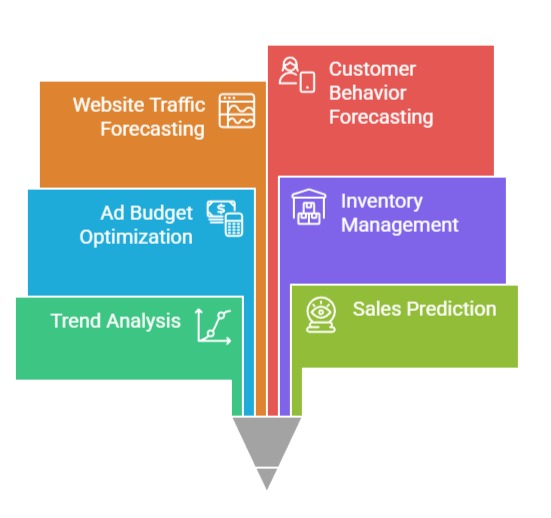
1. Understanding Trend, Seasonality, and Cyclic Patterns in Marketing
Time series forecasting helps marketers identify long-term trends such as increasing customer interest, declining product demand, or gradual shifts in channel usage.
Seasonal patterns such as holiday peaks, weekend engagement behavior, or quarterly sales cycles are detected through systematic temporal analysis.
Cyclic patterns caused by market conditions, economic shifts, or recurring events also play a key role in campaign planning.
By understanding these components, marketers can align campaigns with time periods that naturally generate high activity.
This ensures increased campaign effectiveness, better timing, and optimized budget allocation when customer intent is highest.
2. Predicting Future Sales and Lead Volumes for Campaign Scheduling
Forecasting models analyze historical sales and lead generation data to predict expected volumes in upcoming weeks or months.
This helps marketers determine when demand will rise or fall and design campaigns accordingly.
For Example, a predicted spike in demand may justify running aggressive promotional campaigns or increasing digital ad spend.
Conversely, expected low-demand periods may require cost-efficient nurturing campaigns.
Forecasted lead volumes also help marketing teams prepare CRM workflows, plan email sequences, and optimize customer engagement strategies in advance.
This proactive approach improves campaign readiness and efficiency.
3. Optimizing Ad Budget Allocation Using Forecasted Performance Metrics
Time series models can predict future CPM, CPC, CTR, and conversion rates based on past campaign behavior.
These forecasts allow marketers to allocate budgets intelligently across channels instead of relying on guesswork.
For instance, if CPC is expected to increase during peak competition periods, marketers can shift spend to alternative channels or optimize creative strategies.
Predicting performance fluctuations also helps avoid overspending during low-engagement periods.
Accurate forecasting ensures ad budgets are used where they deliver maximum return, improving overall marketing profitability.
4. Preparing Inventory and Supply Chain for Promotional Campaigns
For businesses running product-based campaigns, time series forecasting is essential for inventory and supply chain planning.
Forecasts reveal when customer demand will peak, allowing companies to stock inventory adequately before launching promotions.
Poor forecasting can lead to stockouts during promotions, resulting in lost revenue and poor customer experience.
Conversely, overestimating demand may result in excess inventory and increased storage costs.
Integrating time series forecasts with campaign planning ensures smooth operations, better customer satisfaction, and greater revenue from product launches and seasonal promotions.
5. Predicting Website Traffic and Digital Engagement for Capacity Planning
Time series forecasting is commonly used to estimate future website traffic, app usage, and email engagement patterns.
This helps organizations prepare marketing infrastructure—such as servers, CRM capacity, or customer service resources—before running large-scale campaigns.
For example, forecasted traffic spikes during product launches help avoid website crashes or delays.
Predicting engagement also allows teams to schedule campaigns at optimal times, ensuring emails are opened and ads are seen when customers are most active.
This leads to smoother campaign execution and superior customer experience.
6. Forecasting Customer Behavior Shifts for Strategic Campaign Design
With customer preferences constantly evolving, forecasting helps identify behavior changes early.
Models detect patterns such as declining engagement, shifting product interests, or preference for specific channels.
These insights allow marketers to redesign campaign strategies before performance drops.
Forecasts also help assess how external factors—holidays, competitor actions, or market conditions might influence customer behavior.
Early detection of behavioral shifts ensures campaigns remain relevant, timely, and aligned with customer expectations.
7. Using External Variables (Exogenous Factors) to Improve Forecast Accuracy
Time series forecasting in marketing becomes significantly more accurate when external factors—such as economic indicators, competitor pricing, weather conditions, holidays, or social trends—are included in the model.
These are known as exogenous variables, and models like ARIMAX, SARIMAX, and Facebook Prophet can incorporate them to refine predictions.
For example, festivals can boost retail sales, while weather may influence food delivery or travel-related campaigns.
Incorporating these factors helps marketers understand why demand fluctuates and anticipate sudden changes more effectively.
This leads to better campaign timing, resource allocation, and budget planning, especially in industries sensitive to external events.
8. Leveraging Forecasts for Multi-Channel Campaign Synchronization
Forecasting ensures that campaigns across multiple channels—email, social media, paid ads, SMS, and offline media—are coordinated and aligned with expected customer activity.
Time series insights can reveal when customers are most active on specific channels, enabling marketers to schedule communications simultaneously for maximum impact.
For instance, knowing when website traffic peaks can help synchronize email blasts and retargeting ads.
This alignment creates a cohesive customer experience and improves engagement rates across touchpoints.
Multi-channel synchronization using forecasting strengthens brand visibility and boosts overall campaign effectiveness.
9. Detecting Anomalies and Performance Drops for Early Intervention
Advanced time series models help identify anomalies—unexpected spikes or drops in traffic, conversions, impressions, or sales.
These irregularities may indicate technical issues, market disruptions, emerging trends, or campaign execution problems.
Anomaly detection enables marketers to take corrective action quickly, such as adjusting budgets, modifying creatives, or investigating technical errors.
By catching deviations early, marketers reduce revenue loss and maintain steady campaign performance.
This proactive monitoring is essential in fast-moving markets where even short disruptions can lead to significant impact.
10. Applying Machine Learning–Based Time Series Models for Higher Accuracy
While traditional models like ARIMA work well, machine learning models such as LSTM networks, Random Forest regressors, Gradient Boosting, and hybrid models offer superior accuracy for complex marketing data.
These models can handle non-linear patterns, large feature sets, and multiple time-dependent variables, making them ideal for digital marketing environments.
They also adapt quickly to new data, making continuous forecasting more reliable.
For high-frequency forecasting tasks—such as hourly traffic predictions or real-time bidding performance—ML-based models provide significant competitive advantage and help marketers plan with precision.
11. Scenario Forecasting to Support Strategic Decision-Making
Scenario forecasting allows marketers to simulate different future conditions—best case, worst case, and most likely scenarios.
This helps marketing teams prepare for various outcomes such as budget reductions, sudden market growth, or seasonal downturns.
Scenario analysis is especially useful when planning major campaigns, forecasting demand for product launches, or evaluating investment decisions.
It enables marketers to build flexible plans, allocate resources wisely, and mitigate risks before launching large-scale campaigns.
Scenario forecasting strengthens long-term strategy and enhances resilience in uncertain market environments.
12. Forecasting for Seasonal Promotions and Event-Based Campaigns
Marketing teams often run event-driven campaigns such as festival sales, year-end promotions, back-to-school offers, or product launches.
Time series forecasting helps estimate expected demand, customer engagement, and sales volumes around these events.
By analyzing past event performance and recognizing seasonal spikes, marketers can schedule promotions at the ideal time and avoid overlap with competitor campaigns.
Forecasting also guides inventory planning, staffing requirements, and media spend distribution during peak seasons.
This ensures campaigns run smoothly, deliver higher ROI, and capitalize fully on high-demand periods.

Class Sessions
Sales Campaign

We have a sales campaign on our promoted courses and products. You can purchase 1 products at a discounted price up to 15% discount.