Clustering is one of the most widely used unsupervised machine learning techniques in marketing analytics, designed to group customers based on shared behaviors, attributes, or preferences.
Unlike supervised models that rely on labeled data, clustering algorithms automatically identify patterns within marketing datasets and divide customers into meaningful segments without prior instructions.
This ability makes clustering extremely valuable in situations where marketers want to discover natural groupings such as high-value buyers, discount-sensitive shoppers, or highly engaged users.
With the rise of digital platforms and customer data generation, businesses now have access to vast datasets—including purchase history, browsing behavior, demographic data, lifestyle preferences, and channel interactions.
Clustering helps make sense of this complexity by revealing hidden structures that are not visible through simple descriptive methods.
These segments become the foundation for targeted marketing, personalized communication, improved product recommendations, and more efficient campaign planning.
Clustering techniques such as K-Means, Hierarchical Clustering, and DBSCAN are commonly used today in CRM systems, e-commerce, retail analytics, and online advertising platforms.
By applying clustering, marketers gain deeper customer insights, uncover new opportunities, and future-proof their customer strategies through data-driven segmentation.
Its importance has increased significantly with the shift toward personalization, automation, and AI-driven marketing.
Customer Segmentation Using Clustering Algorithms
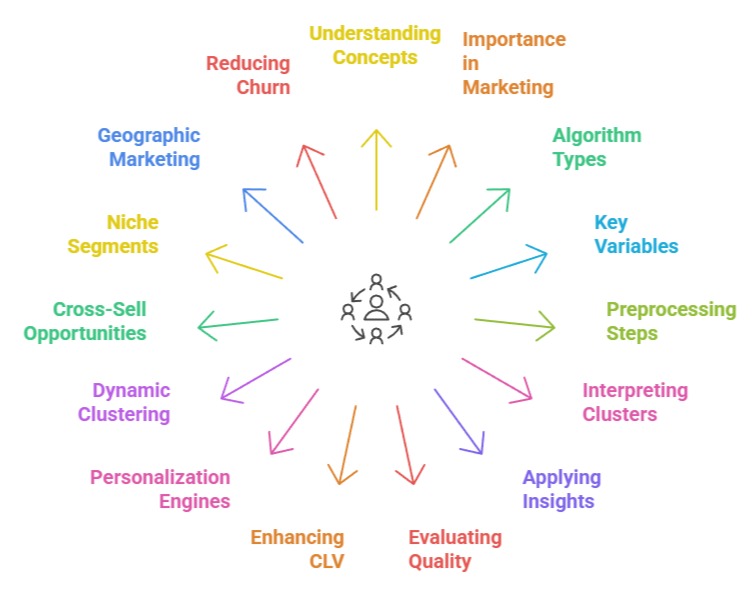
1. Understanding the Concept of Clustering
Clustering involves grouping customers into segments where individuals within a cluster share similar characteristics while being distinctly different from those in other clusters.
This similarity could be based on purchasing behavior, demographic patterns, website engagement, or psychographic indicators. The goal is to uncover natural clusters that already exist in the data but are not immediately visible.
Clustering is powerful because it does not assume any predefined categories; instead, it discovers them by analyzing patterns in large datasets.
This makes it ideal for exploring new customer behaviors or emerging market trends. In practice, clustering gives marketers a data-driven starting point for segmentation strategies.
2. Importance of Clustering in Modern Marketing
Clustering helps marketers move beyond generic segmentation like age or location and instead identify more sophisticated, behavior-based groups.
This approach supports highly personalized marketing strategies, which are essential in today’s competitive environment.
For Example, clustering can differentiate between customers who purchase occasionally and those who buy frequently but only during sales.
These insights help marketers customize promotions, messaging, and retention campaigns.
Clustering also improves ROI by ensuring that resources are directed toward the right customer groups.
Additionally, it supports product development, pricing optimization, and customer experience enhancements by revealing underlying behavioral trends.
3. Types of Clustering Algorithms Used in Marketing
Several clustering techniques exist, each offering unique strengths depending on the marketing problem. K-Means clustering is the most common and works well for large datasets with clear group boundaries.
Hierarchical clustering helps visualize how customer groups form at different similarity levels through dendrograms.
DBSCAN is excellent for detecting unusual behavior or identifying niche customer segments, especially when data has noise or irregular patterns.
Marketers choose algorithms based on their goals, dataset size, and the nature of customer behavior.
Understanding these methods enables more accurate segmentation and better marketing decision-making.
4. Key Variables Used for Customer Clustering
Clustering depends heavily on selecting the right variables that represent meaningful customer behavior.
Common variables include RFM metrics (Recency, Frequency, Monetary value), demographic features, web behavior data, product affinity scores, and engagement metrics such as clicks or session duration.
Choosing impactful variables allows the algorithm to form segments that reflect real business patterns.
Poor variable selection can produce weak or irrelevant clusters, so marketers must carefully preprocess and standardize their inputs.
With modern tools, marketers can integrate omnichannel data to create richer profiles. Proper variable selection ensures segmentation outputs that marketers can confidently use.
5. Preprocessing Steps Before Clustering
Customer data often contains inconsistencies such as missing values, outliers, or varying scales across features.
Before clustering, marketers must clean and standardize the data to ensure meaningful cluster formation. Normalization or scaling is essential because clustering algorithms like K-Means are sensitive to feature magnitudes.
Removing noise and aggregating transactional data helps the algorithm detect true underlying structure.
Dimensionality reduction techniques like PCA can simplify large, complex datasets while preserving essential patterns.
Proper preprocessing ensures stability, accuracy, and interpretability of the segmentation results. This step often determines the success of the entire clustering effort.
6. Interpreting and Profiling Clusters for Marketing Use
Once clusters are generated, marketers need to interpret them by analyzing characteristics that define each segment.
This involves comparing average values, identifying dominant behaviors, and naming segments based on common traits (e.g., “Loyal High Spenders,” “Price-Sensitive Browsers,” “New but Active Users”). Profiling helps marketers translate statistical clusters into actionable business insights.
This step is crucial because clustering alone does not provide value until segments are clearly understood.
Proper profiling supports strategic decisions like personalized messaging, campaign targeting, and customer retention planning. Effective interpretation transforms raw data segments into meaningful marketing personas.
7. Applying Clustering Insights to Real Marketing Strategies
Clustering outputs guide a wide range of marketing applications, from targeted email campaigns to product bundling strategies.
For Example, premium customers can receive exclusive offers, while dormant customers can be targeted with reactivation campaigns.
E-commerce platforms use clustering to personalize homepages, recommend products, or optimize pricing for specific user groups.
Advertising platforms use segment-based lookalike audiences to improve targeting efficiency.
Clustering also helps businesses reduce churn by identifying at-risk segments early.
Ultimately, applying clustering insights ensures marketing actions are precise, efficient, and customer-centric.
8. Evaluating Cluster Quality and Model Performance
To ensure segmentation is meaningful, marketers must assess cluster quality using metrics such as Silhouette Score, Dunn Index, or Elbow Method.
These metrics help determine the optimal number of clusters and evaluate how distinct and cohesive each group is.
Poor-quality clusters may overlap significantly or fail to differentiate customer behaviors.
Regular evaluation is essential, especially as customer behavior evolves over time.
This allows marketers to refresh segments periodically and avoid outdated assumptions. A strong evaluation process ensures ongoing relevance and accuracy in marketing strategies.
9. Using Clustering for Predictive Customer Lifetime Value (CLV) Enhancement
Clustering plays an essential role in improving Customer Lifetime Value predictions by grouping customers with similar spending patterns and engagement behaviors.
These segments help marketers identify which groups are more likely to generate high long-term value.
For instance, clusters representing frequent purchasers or high-margin buyers can be targeted with loyalty programs, VIP rewards, or retention-focused campaigns.
Integrating clustering with CLV models also enables better prioritization of marketing budgets, ensuring resources focus on profitable segments.
This approach aligns marketing investments with long-term business goals rather than short-term conversions. As a result, companies can build sustainable, revenue-rich customer relationships.
10. Combining Clustering with Personalization Engines
Modern personalization platforms use clustering as a foundation to deliver tailored content across email, ads, apps, and websites.
By understanding segment-specific behaviors—such as browsing interests or preferred product categories—algorithms can customize recommendations for each group.
Clustering helps streamline this personalization by reducing noise and simplifying complex customer data into actionable profiles.
When integrated with real-time systems like recommendation engines or CDPs, these clusters can dynamically update based on new interactions.
This allows marketers to deliver highly relevant experiences at scale. The combination ensures synchronized, consistent personalization across all customer touchpoints.
11. Dynamic and Real-Time Clustering for Evolving Customer Behavior
Customer behavior changes rapidly due to seasonality, competition, or shifts in preferences.
Real-time clustering methods allow businesses to continuously update customer segments using streaming data from digital platforms.
Techniques like incremental K-Means or online clustering models process live data without needing full retraining.
This enables brands to adjust campaigns, bids, and recommendations instantly based on the latest customer signals.
For fast-paced industries like e-commerce, travel, or media, real-time segmentation provides a competitive advantage by ensuring marketing actions always reflect current behavior.
It also supports agile decision-making and rapid experiment-driven optimization.
12. Using Clustering to Identify Cross-Sell and Upsell Opportunities
Clustering algorithms help businesses uncover patterns in customer purchasing habits that can guide effective cross-sell and upsell strategies.
For example, customers grouped based on complementary purchases may be ideal candidates for bundle offers or upgraded options.
These patterns are often difficult to detect manually but become clear through clustering-based customer profiling.
Companies can use such insights to design product bundles, add-on promotions, or tiered subscription plans tailored to each cluster.
This strategy raises average order value and deepens product engagement. Over time, it leads to more personalized product journeys and higher revenue per customer.
13. Detecting Niche or High-Value Microsegments with Clustering
Clustering can reveal niche, previously unnoticed customer groups that represent unique opportunities for targeted marketing.
These microsegments might include premium product lovers, eco-conscious buyers, or customers loyal to a specific brand category. Although small in size, such groups often have strong loyalty or higher spending potential.
Identifying and nurturing these microsegments gives brands a competitive edge by offering hyper-personalized experiences.
Marketers can craft messaging specifically tailored to each niche, improving relevance and conversion rates. This leads to differentiated brand positioning and enhanced customer satisfaction.
14. Integrating Clustering with Geographic and Location-Based Marketing
Location data combined with clustering helps marketers create geographically relevant customer segments.
By grouping customers based on regional behaviors, store visit patterns, or city-level purchase trends, brands can tailor promotions more effectively.
For instance, customers in urban clusters may prefer express delivery, while those in suburban or rural clusters may value price discounts or in-store experiences.
Geo-clustering supports local inventory planning, regional advertising, and geo-targeted digital campaigns.
This ensures marketing efforts align with cultural, economic, or environmental differences across regions. The approach improves campaign precision and boosts localized engagement.
15. Role of Clustering in Reducing Churn and Enhancing Retention Strategies
Clustering helps identify groups of customers who exhibit early signs of disengagement or churn.
By analyzing behavioral indicators like declining purchase frequency, reduced session time, or decreasing email engagement, specific “at-risk” clusters emerge.
Marketers can then design retention strategies such as win-back campaigns, reactivation offers, or personalized reminders for these segments.
Clustering also helps distinguish between temporary inactivity and long-term churn risk.
This enables smarter intervention and reduces unnecessary marketing costs.
Through early detection and proactive engagement, clustering significantly strengthens customer lifetime value and retention performance.