Marketing today is increasingly data-driven, and organizations rely on diverse types of data to understand customers, design targeted campaigns, and evaluate business performance.
As marketing channels, customer behaviors, and technologies evolve, so does the variety and volume of data available.
A solid understanding of marketing data types and their sources helps businesses build better strategies, forecast market trends, and personalize customer interactions effectively.
Below is a more detailed breakdown of the different types of marketing data and the sources from which they are collected.
Types of Marketing Data
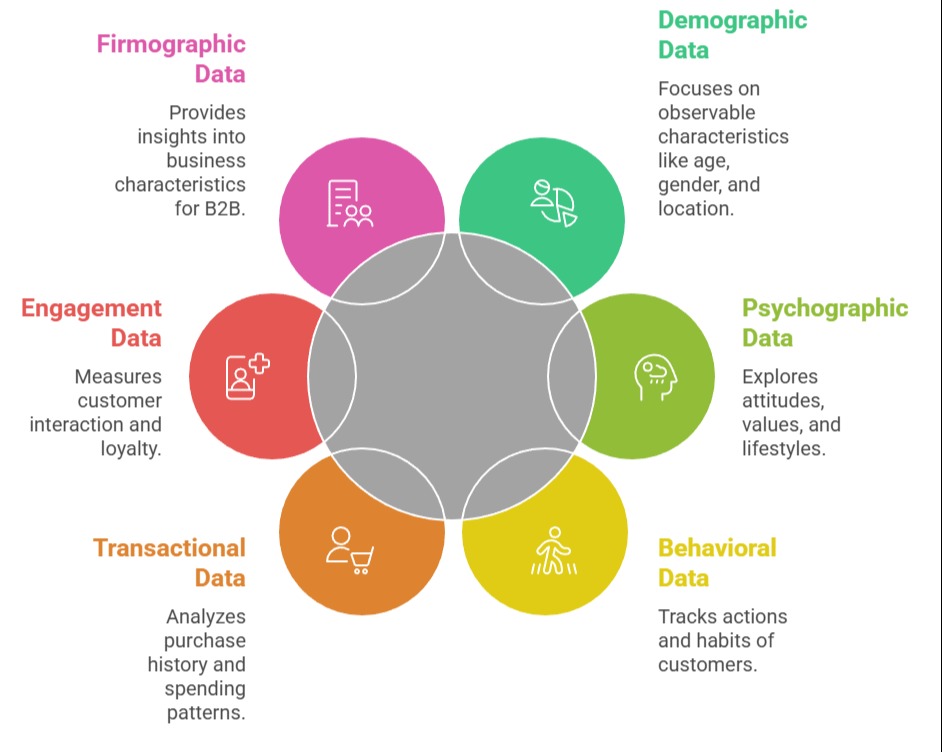
Marketing data can be categorized into different types based on what it reveals about customers, their behavior, and their relationship with a brand.
Understanding these data types helps marketers build accurate segments, personalize campaigns, and make strategic decisions with greater precision.
1. Demographic Data
Demographic data forms the backbone of customer understanding because it describes who the customer is in quantifiable terms.
This includes age, gender, geographic location, education level, profession, income group, and family status.
Marketers use demographic data to segment audiences into groups that are easier to target with relevant messaging.
For example, a luxury brand would focus on higher-income households, while a kids’ product would target families with young children.
Demographic insights also help businesses identify which customer groups respond best to specific products or campaigns, making it easier to optimize targeting and resource allocation.
2. Psychographic Data
Psychographic data dives into customers’ internal motivations—what they value, how they think, and why they buy.
This includes lifestyle, interests, personal values, beliefs, attitudes, hobbies, personality traits, and emotional drivers.
Psychographics help marketers craft content that resonates deeply because it aligns with a customer’s mindset rather than just their characteristics.
For example, two customers of the same age and income may respond differently if one values sustainability and the other values luxury.
This type of data supports powerful brand storytelling, emotional marketing, and tailored content strategies designed to influence decision-making at a psychological level.
3. Behavioral Data
Behavioral data reveals how customers interact with a brand in real time and across different channels.
It includes browsing history, clicked ads, products viewed, frequency of website visits, email interactions, past purchases, time spent on pages, abandoned carts, and loyalty program activity.
This data type is crucial for predicting future behavior and automating personalized experiences.
For example, if a user frequently browses shoes but doesn’t buy, the brand can send a targeted discount or recommendation.
Behavioral insights help marketers understand customer intent, refine user journeys, and design campaigns that respond dynamically to customer actions.
4. Transactional Data
Transactional data details every purchasing activity a customer engages in.
This includes the type of product purchased, purchase amount, purchase date and time, payment method, subscription details, returns/refunds, and discount usage.
Transactional data provides a true picture of customer value and spending patterns.
Marketers use it to calculate customer lifetime value (CLV), identify high-value customers, and detect trends in purchasing behavior.
It also supports financial forecasting, inventory planning, and cross-selling or upselling strategies by revealing what customers tend to buy together or repeatedly.
5. Engagement Data
Engagement data measures how customers respond to marketing messages across emails, ads, social media posts, websites, and apps.
It includes likes, shares, comments, views, impressions, click-through rates, watch time, and repeat interactions.
This data helps marketers understand what content resonates, what fails to attract attention, and which channels are most effective for specific segments.
Engagement insights guide content creation, ad optimization, and communication strategies by showing how well the audience interacts with the brand’s digital presence.
6. Firmographic Data (B2B)
For B2B companies, firmographic data is as important as demographic data.
It includes company industry, size, revenue, number of employees, decision-maker roles, region of operation, and business structure.
This data helps marketers identify potential business clients, assess their purchasing power, and tailor sales pitches accordingly.
Firmographic segmentation enables companies to prioritize high-value leads and deliver customized communications to different business types.
Sources of Marketing Data
Marketing data comes from multiple digital and offline touchpoints, each revealing how customers discover, interact with, and respond to a brand.
Together, these sources help marketers make informed decisions, personalize strategies, and improve performance across the entire customer journey.
1. Website Analytics Tools
Website analytics tools such as Google Analytics, Adobe Analytics, and Hotjar collect detailed data on how users behave on a website.
They track metrics like page visits, bounce rate, traffic sources, navigation paths, and conversion funnels.
These tools help marketers understand which pages attract the most attention, where users drop off, and which marketing channels drive the best traffic.
Heatmaps and user-session recordings provide visual insights into how users interact with page elements.
2. Social Media Platforms
Social media platforms are major sources of customer insights.
Platforms like Facebook, Instagram, YouTube, LinkedIn, TikTok, and X (formerly Twitter) provide data on user demographics, content engagement, follower growth, ad performance, and customer sentiment.
Brands can also track trends, hashtags, and public conversations to understand audience preferences and market moods.
Social listening tools further analyze emotional tone and themes in customer comments, which help marketers adapt messaging and measure brand perception.
3. CRM Systems (Customer Relationship Management)
CRM systems such as Salesforce, HubSpot, and Zoho act as central hubs for managing customer interactions.
They collect data from email interactions, sales calls, service tickets, follow-ups, purchases, and lead behavior.
CRMs help marketers maintain detailed customer histories and segment audiences for personalized outreach.
They play a crucial role in customer retention, lead nurturing, and building long-term relationships through targeted communication.
4. E-Commerce Platforms and POS Systems
Online retail platforms like Shopify, Amazon, Magento, and Flipkart generate large volumes of transactional and behavioral data.
They track purchase patterns, product preferences, cart abandonment, repeat orders, and customer loyalty.
In physical stores, Point-of-Sale (POS) systems collect data on sales, inventory movements, and customer purchase frequency.
Together, these data sources help businesses analyze which products sell best, identify high-value customers, and optimize pricing and promotions.
5. Surveys, Feedback, and Review Platforms
Direct customer feedback provides qualitative insights that quantitative data cannot capture.
Surveys, feedback forms, product reviews, and Net Promoter Score (NPS) surveys reveal customer satisfaction levels, expectations, and common problems.
Platforms like SurveyMonkey, Google Forms, Trustpilot, and Yelp provide structured and unstructured feedback.
This information is essential for improving customer experience, refining products, and addressing pain points proactively.
6. Email Marketing Tools
Email platforms like Mailchimp, SendGrid, Constant Contact, and Klaviyo collect engagement data such as open rates, click-through rates, bounce rates, and subscriber behavior.
They help marketers understand which email campaigns work, what messaging formats perform best, and how customers interact with newsletters or promotional emails.
Email data is vital for segmentation, lead nurturing, and retention strategies.
7. Third-Party Data Providers
Third-party data providers such as Nielsen, Experian, Statista, and GlobalData supply large-scale demographic, economic, competitive, and industry-specific data.
This helps companies benchmark performance against the market and identify emerging economic or consumer trends.
Third-party insights are especially useful when a company wants broader context beyond its internal data.
8. Mobile Apps and Tracking Technologies
Mobile apps provide highly granular data such as user location, in-app behavior, session duration, device type, and push notification interaction.
Tracking tools like cookies, pixels, and SDKs help marketers understand user behavior across multiple platforms.
This data supports retargeting campaigns, personalized ads, and app-based product recommendations.
9. Customer Support Systems
Data from customer support channels—chatbots, call centers, email support, and ticketing tools—provides insights into common issues, frequently asked questions, and overall sentiment.
This information helps marketing teams refine messaging, adjust product descriptions, and identify improvement opportunities in the customer experience.
Support data is also helpful in understanding customer intent and churn signals.

Class Sessions
Sales Campaign

We have a sales campaign on our promoted courses and products. You can purchase 1 products at a discounted price up to 15% discount.