Connection management is an essential aspect of backend development that ensures efficient and reliable communication between applications and databases.
Opening and closing database connections for every request is costly and can quickly exhaust database resources.
Connection pooling solves this by maintaining a pool of reusable connections, allowing applications to handle high traffic efficiently.
Tools like PgBouncer are commonly used to manage and optimize PostgreSQL connections.
Connection Pooling Fundamentals
Connection pooling reuses existing database connections instead of creating and tearing down new ones for every request, dramatically improving performance and resource efficiency.
This technique is essential for high-traffic apps, preventing the overhead of TCP handshakes and authentication on each query.
Why Pooling Matters in Backend Apps
Databases like PostgreSQL limit concurrent connections (default 100), but web apps can generate thousands per second.
Pooling acts as a smart middleman, queuing requests and multiplexing them over fewer physical connections.
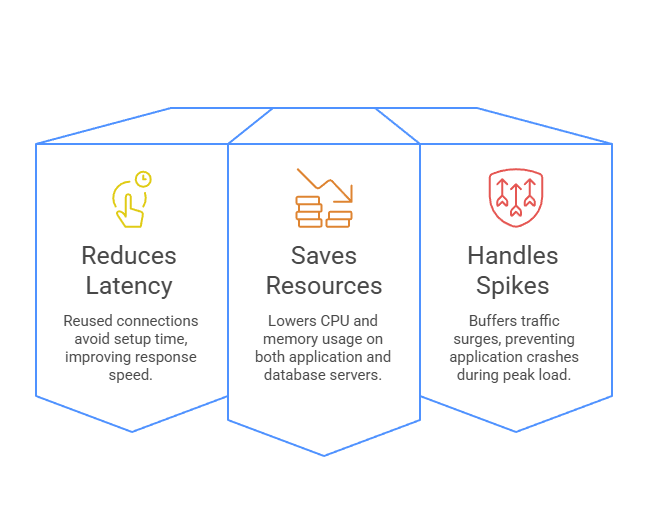 For example, a Flask API without pooling might open 500 connections during peak hours, hitting limits. With pooling, it maintains just 20-50, queuing the rest.
How Connection Pools Work
A pool maintains a set of open connections, lending them to requests and reclaiming them when done. Key configs include pool size (max connections), timeout (idle eviction), and mode (session vs. transaction).
Lifecycle in Steps
1. App requests a connection from the pool.
2. Pool checks for an idle connection; if none, waits or creates one (up to max size).
3. Query executes; connection returns to pool after use.
4. Idle connections get periodically validated (e.g., via ping) to detect staleness.
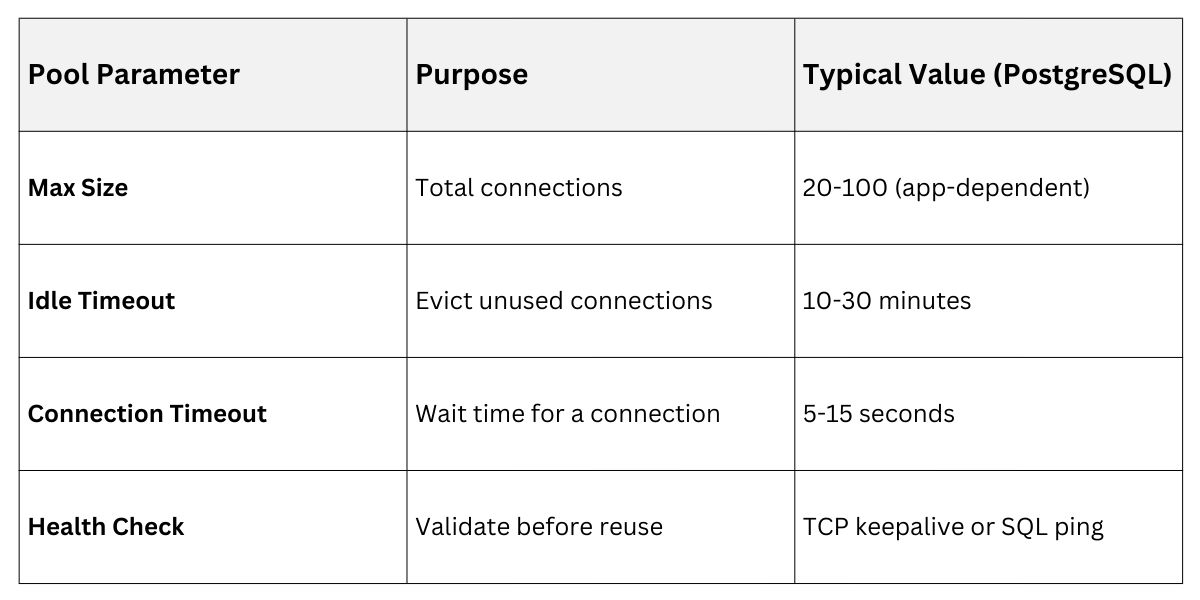
PgBouncer: Lightweight PostgreSQL Pooling
PgBouncer is a battle-tested, open-source connection pooler for PostgreSQL, praised for its low overhead (under 1MB RAM) and high throughput (millions of queries/sec).
As of version 1.18 (2024 release), it supports advanced stats via Prometheus export and better TLS handling—ideal for cloud-native setups like Kubernetes.
Setting Up PgBouncer
Install via package managers (e.g., apt install pgbouncer on Ubuntu) or Docker. Configure in pgbouncer.ini:
[databases]

mydb = host=localhost port=5432 dbname=appdb


[pgbouncer]

pool_mode = transaction  ; Or session/transaction/statement

max_client_conn = 1000

default_pool_size = 20

reserve_pool_size = 5
Practical Example: Point your app's connection string to postgres://user:pass@pgbouncer-host:6432/mydb instead of the DB directly.
PgBouncer Modes and Best Practices
Choose modes based on workload:
1. Transaction mode (default): Fastest, resets connection per transaction—great for ORMs.
2. Session mode: Preserves session state (e.g., SET search_path); use for complex transactions.
3. Statement mode: Pools at query level; highest multiplexing but ORM-incompatible.
Best Practices
1. Monitor with SHOW POOLS; via PgBouncer's admin console.
2. Set server_idle_timeout = 600 to match DB settings.
3. Scale horizontally: Run multiple PgBouncer instances behind a load balancer.
4. Integrate with PgBadger for query analysis.
In a real FastAPI app, PgBouncer cut response times by 40% during load tests with 1000 RPS.
ORMs and Built-in Connection Management
ORMs (Object-Relational Mappers) like SQLAlchemy, Prisma, and Sequelize handle connection pooling natively, abstracting SQL into objects while optimizing under the hood.
They eliminate boilerplate, reduce errors, and include smart pooling—perfect for rapid backend development without sacrificing performance.
SQLAlchemy: Python's Powerhouse ORM
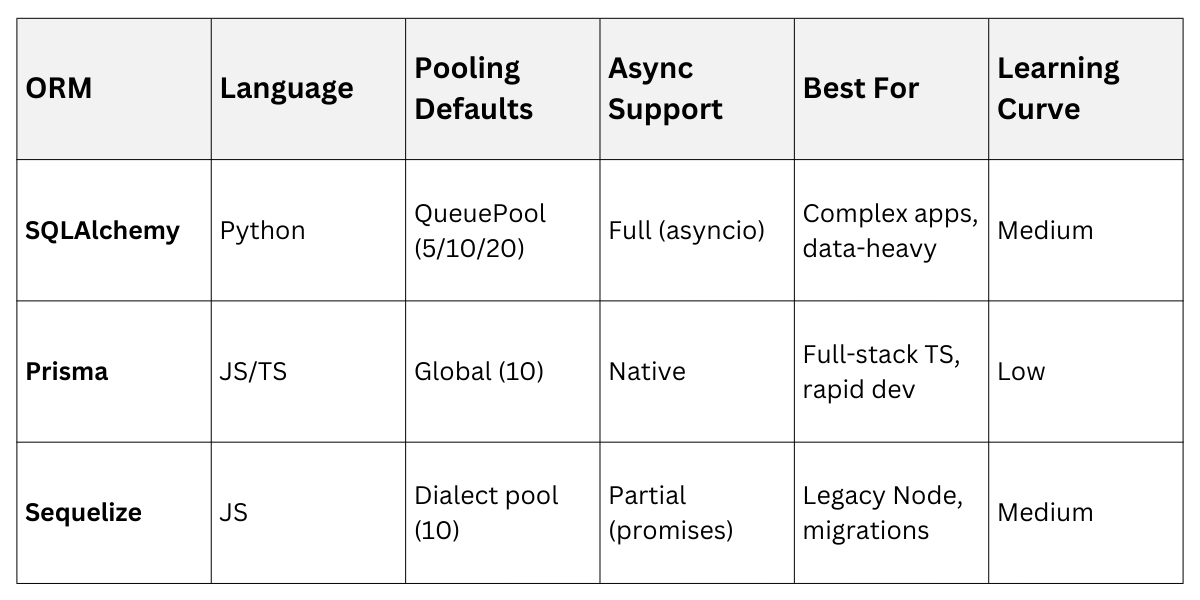
SQLAlchemy (v2.0+, 2024) excels in Python backends (Flask/Django/FastAPI) with asyncio support via asyncpg and dynamic pooling.
Its QueuePool defaults to 5/10/20 (min/max/overflow) connections, auto-validating with pre-ping.
Key Features
1. Scoped sessions: Thread-safe pooling per request.
2. Engine dispose: Cleans up on app shutdown.
3. Migrations: via Alembic.
Example setup:
from sqlalchemy import create_engine

from sqlalchemy.orm import sessionmaker


engine = create_engine("postgresql://user:pass@host/db", pool_size=20, max_overflow=10)

SessionLocal = sessionmaker(bind=engine)
Best Practice: Use dependency injection in FastAPI for per-request sessions, preventing leaks.
Prisma: Modern ORM for Node.js/TypeScript
Prisma (v5.14+, late 2025) shines in full-stack JS/TS apps with its schema-first approach and built-in pooling via the Prisma Client.
It uses a global connection pool (default 10 connections), with query batching and middleware for caching.
Advantages:
1. Type-safe queries from Prisma schema.
2. Push-to-DB schema sync.
3. Native PostgreSQL, MySQL, SQLite support.
Example:
generator client { provider = "prisma-client-js" }

datasource db { provider = "postgresql" url = env("DATABASE_URL") }const prisma = new PrismaClient({ datasources: { db: { url: process.env.DATABASE_URL } } });Tune via connection_limit=50 in DATABASE_URL. Ideal for Next.js APIs—reduced DB calls by 60% in benchmarks.
Sequelize: Mature JS ORM with Flexibility
Sequelize (v6.37+, 2024) offers robust pooling for Node.js, with Dialect-specific pools (e.g., pg-pool for PostgreSQL).
Defaults to 10 connections, with acquire/release timeouts and idle eviction.
Setup Example:
const { Sequelize } = require('sequelize');

const sequelize = new Sequelize('postgres://user:pass@host:5432/db', {

  pool: { max: 20, min: 0, acquire: 30000, idle: 10000 }

});
Migration and Features
1. Define models with associations.
2. Use sequelize.sync() or Umzug for migrations.
3. Enable query logging for debugging.
Pro Tip: Combine with PgBouncer for ultimate scaling—Sequelize handles app-level pooling, PgBouncer DB-level.
ORM Comparison Table
 Integrating Pooling with ORMs
Layer PgBouncer in front of ORMs for hybrid power: ORMs manage app logic, PgBouncer scales DB access.
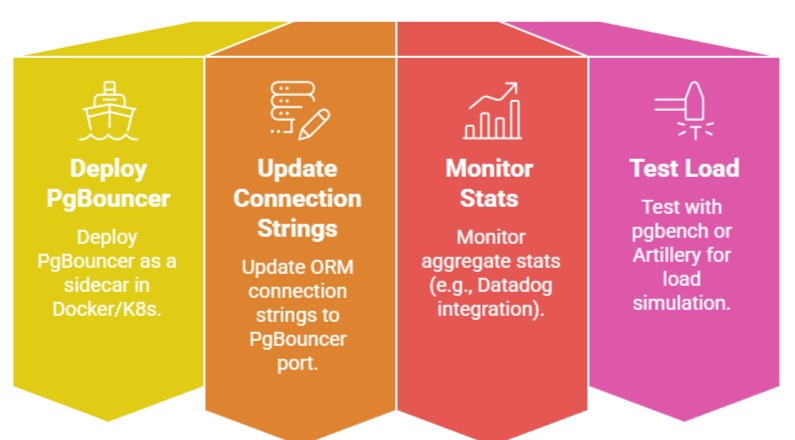
Common Pitfall: Long-lived transactions exhaust pools—use short queries.

Class Sessions
Sales Campaign

We have a sales campaign on our promoted courses and products. You can purchase 1 products at a discounted price up to 15% discount.