Databases are a foundational component of backend development, responsible for storing, organizing, and managing application data in a reliable and efficient way.
Every modern application—whether a web platform, mobile app, or enterprise system—depends on a database to handle user information, transactions, configurations, and analytics.
Understanding how databases work is essential for building scalable, secure, and high-performance backend systems.
Relational databases use structured tables, fixed schemas, and SQL to enforce data integrity and relationships, making them ideal for applications that require strong consistency and complex queries.
Database Types
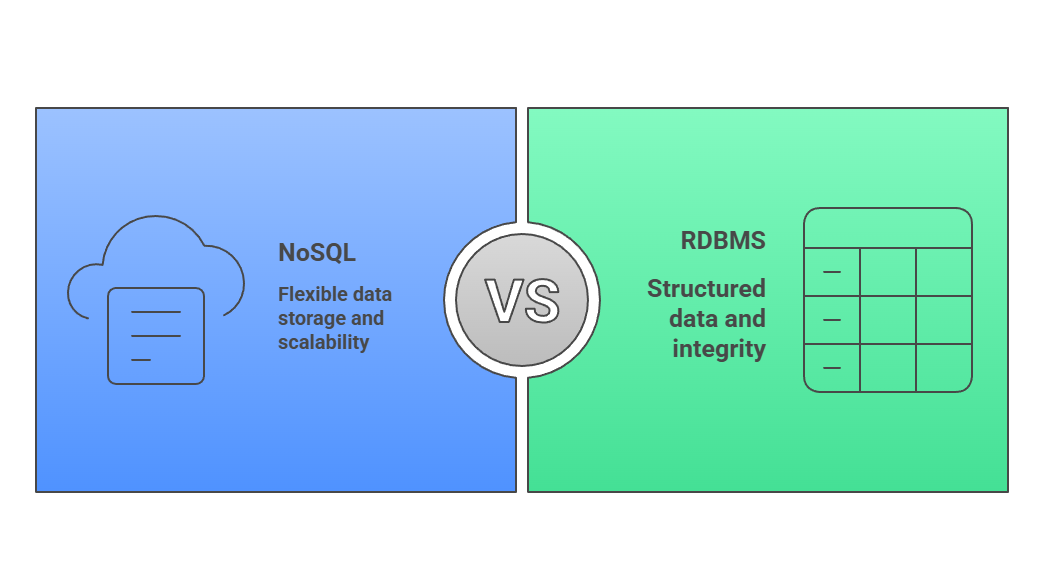 RDBMS (Relational Database Management Systems) and NoSQL. RDBMS excel in structured data with fixed schemas, while NoSQL handles flexible, unstructured data at massive scale—perfect for modern web apps.
RDBMS like MySQL or PostgreSQL organize data into tables with rows and columns, enforcing relationships via keys. They're ideal for apps needing complex queries, such as a JavaScript dashboard pulling related user orders and profiles.
Key Features of RDBMS
1. Structured Schema: Data fits predefined tables, ensuring consistency.
2. SQL Language: Use queries like SELECT * FROM users WHERE age > 18 for precise data retrieval.
NoSQL databases, like MongoDB (document-based) or Redis (key-value), ditch rigid schemas for speed and scalability. They're great for JavaScript-heavy apps storing JSON-like objects, such as real-time chat messages.
RDBMS Vs NO SQL
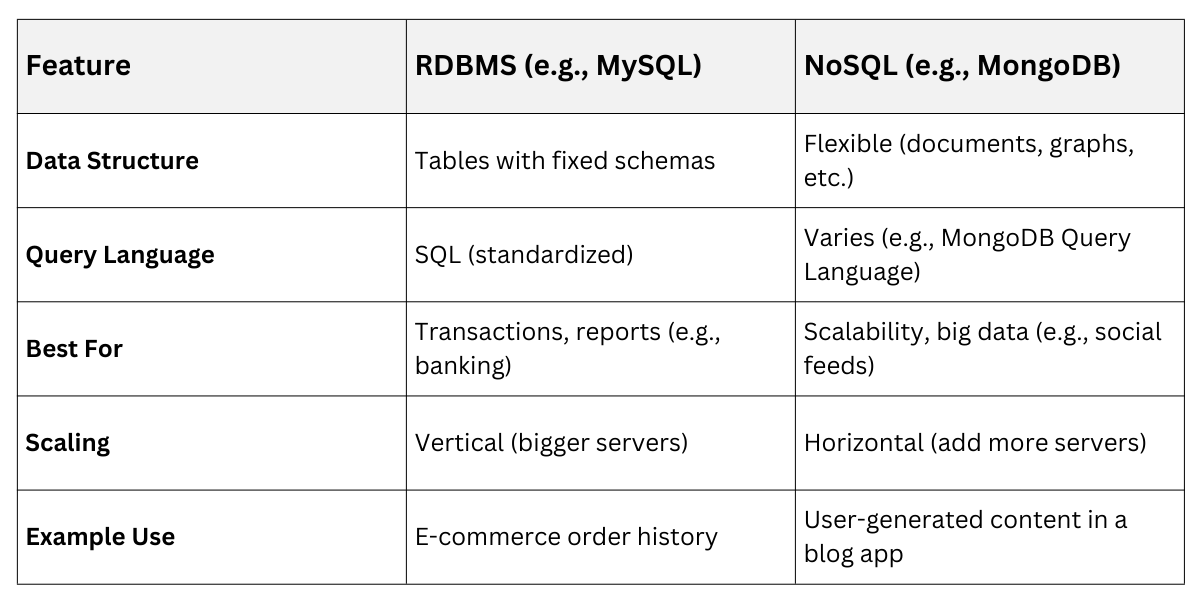
Practical Tip: In your web projects, pair PostgreSQL with Node.js for relational data or MongoDB with Express.js for flexible frontend data feeds.
ACID Properties
ACID stands for Atomicity, Consistency, Isolation, and Durability—core guarantees that make databases reliable for mission-critical web apps. These properties ensure transactions (like updating a user's cart) either fully succeed or fully fail, preventing data corruption.
Think of ACID as a safety net: when your JavaScript app submits a form to add an item to a database, ACID keeps everything in sync.
Breaking Down ACID
Follow these properties in action during a bank transfer simulation:
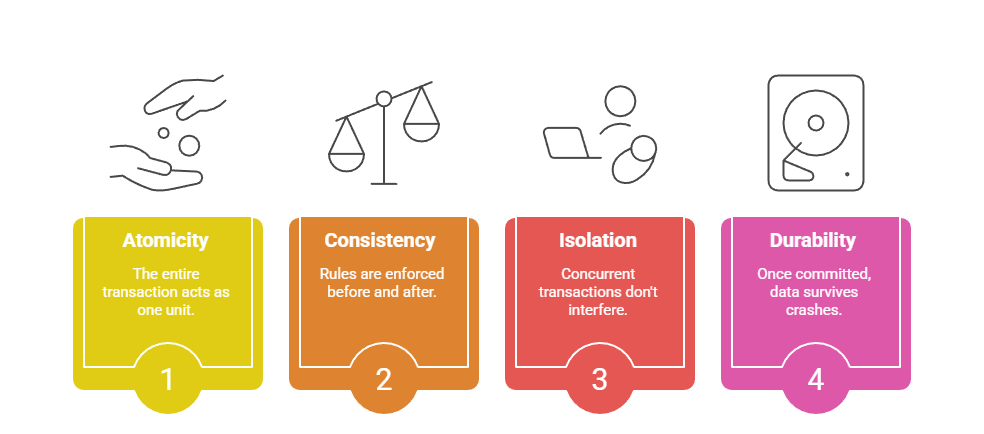
Example in Web Dev: In a JavaScript shopping app using MySQL, ACID ensures that when a user checks out, inventory decreases and payment records update atomically—no half-empty stock glitches.
RDBMS shine here, but some NoSQL (like MongoDB with multi-document transactions) now support ACID too, per recent standards.
CAP Theorem
The CAP theorem, proposed by Eric Brewer, states that distributed databases can only guarantee two of three: Consistency (all nodes show same data), Availability (every request gets a response), and Partition Tolerance (system works despite network splits). Web apps at scale face this trade-off daily.
In simple terms, CAP forces choices: prioritize fast responses (like social media) or perfect accuracy (like finance)?
CAP in Practice
Visualize it with this table for common databases:
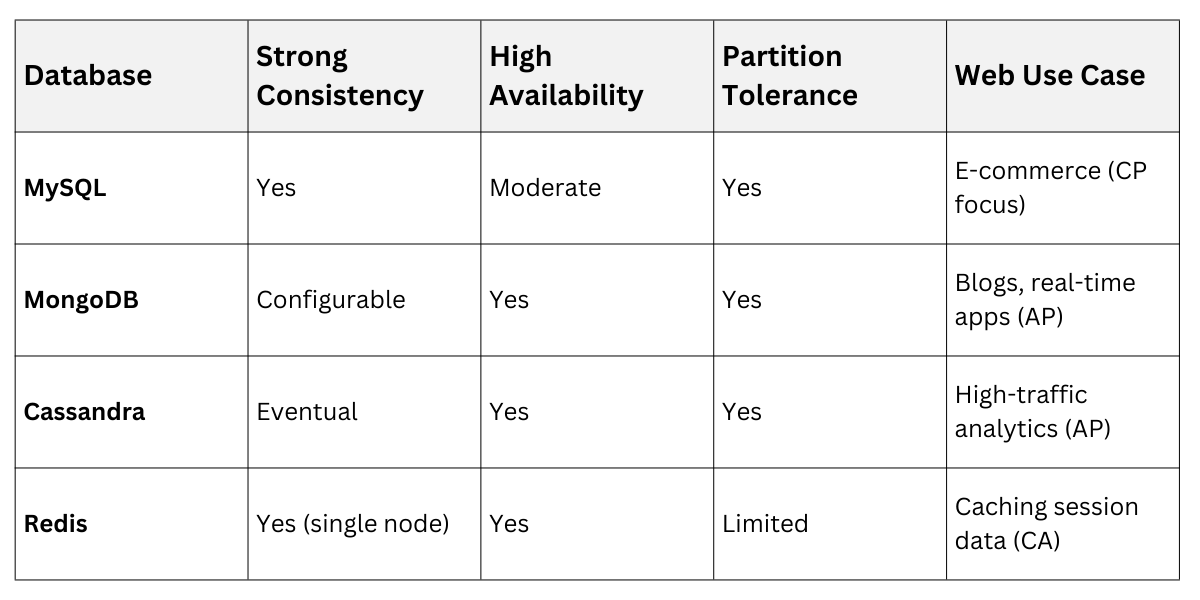
1. CP Systems (Consistency + Partition Tolerance): Accept downtime for accuracy, e.g., banking apps.
2. AP Systems (Availability + Partition Tolerance): Eventual consistency, e.g., Twitter feeds showing latest tweets fast.
3. CA Systems: Rare in distributed setups; fine for single-server prototypes.
Pro Tip for JS Devs: Use CP for user auth in your full-stack app; switch to AP for non-critical feeds synced via WebSockets.
Modern databases like CockroachDB blend CAP options with cloud-native features, following best practices from AWS and Google Cloud.