In multi-user backend environments, multiple transactions often access the same data at the same time. Locking mechanisms are used by databases to control concurrent access and maintain data consistency.
By placing locks on rows, tables, or resources, the database ensures that conflicting operations do not interfere with each other.
However, excessive or poorly managed locking can reduce performance and lead to deadlocks, where two or more transactions wait indefinitely for each other to release locks.
Deadlock prevention and handling strategies are essential to keep backend systems responsive. Databases use techniques such as lock ordering, timeouts, and deadlock detection to identify and resolve these situations automatically.
Locking Mechanisms in Databases
Locks are temporary holds on database resources (rows, tables, pages) during transactions, serialized access to avoid conflicts.
They balance concurrency (multiple ops at once) with isolation (ops don't interfere), a core challenge in multi-user backends.
Types of Locks
Databases use granular locks—from row-level for precision to table-level for bulk ops—following standards like SQL:2016 and engine-specific implementations (e.g., PostgreSQL's MVCC with locks).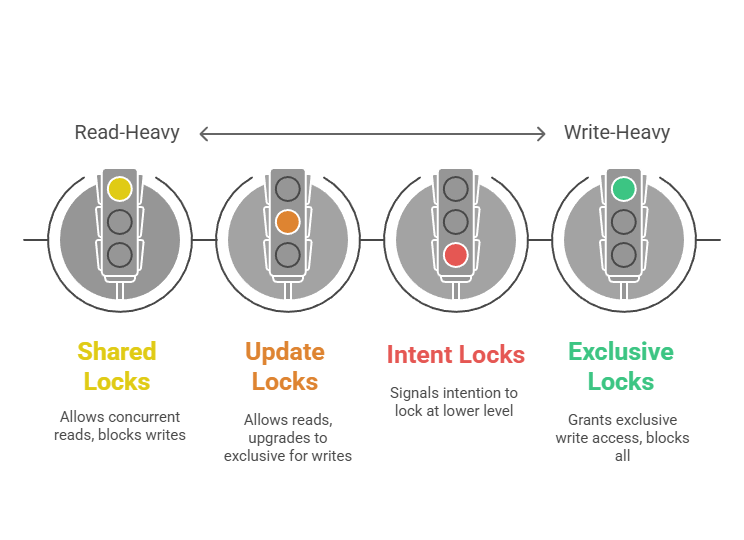 Lock Granularity and Escalation
Granularity defines lock scope: finer (row-level) boosts concurrency but increases overhead; coarser (table-level) simplifies but risks bottlenecks.
Row-level locks shine in high-concurrency apps, like social feeds updating likes independently. Table-level locks suit schema changes or bulk ETL in data pipelines.
1. Choose granularity: via isolation levels (READ COMMITTED for row locks; SERIALIZABLE for stricter).
2. Monitor escalation: Prolonged row locks may auto-escalate to table locks (e.g., SQL Server threshold).
3. Use tools: like pg_locks in PostgreSQL to query active locks in production.
Example: A multi-tenant SaaS backend locks only affected customer rows during billing, avoiding global halts.
Deadlock Fundamentals
A deadlock occurs when two+ transactions cyclically wait for each other's locks, stalling indefinitely—like Transaction A holding Resource 1 (waiting for 2) and B holding 2 (waiting for 1).
Anatomy of a Deadlock
Deadlocks arise from the Coffman conditions: mutual exclusion, hold-and-wait, no preemption, and circular wait. Modern DBMS detect them via wait-graph algorithms, rolling back a victim transaction.
Visualize in a Banking App
Transaction A: Lock AccountX, wait for AccountY

Transaction B: Lock AccountY, wait for AccountX

→ Cycle detected; DBMS aborts A or B (based on cost).
Detection Methods
1. Wait-For Graph: Nodes = transactions/resources; edges = waits. Cycle = deadlock.
2. Timeout-Based: Simpler but less precise (e.g., lock timeout = 5s in MySQL innodb_lock_wait_timeout).
Industry Stats: Deadlocks spike 10-20% under high load; PostgreSQL resolves ~95% via automatic detection.
Common Deadlock Scenarios in Backends
In multi-user environments, patterns emerge from poor query design or ORM misuse.
.png)
Real-World Example: Django's ORM in an e-commerce checkout—Order.objects.select_for_update() without ordering fields risks deadlocks on unsorted fetches.
Deadlock Prevention Strategies
Prevention breaks Coffman conditions proactively, prioritizing availability over perfect isolation. Best practices draw from ANSI SQL and engine docs (e.g., PostgreSQL 17's improved lock queues).
Static Prevention Techniques
Order resources universally to eliminate circular waits.
1. Lock Ordering: Always acquire locks in fixed sequence (e.g., Customers before Orders by ID).
2. Timeout and Retry: Set short timeouts; wrap in retry loops with exponential backoff.
# FastAPI example with SQLAlchemy

@retry(stop_max_attempt_number=3, wait_exponential_multiplier=100)

def transfer_funds(from_acct, to_acct, amount):

    with session.begin():

        from_acct = session.query(Account).filter(id=from_acct).with_for_update().one()

        to_acct = session.query(Account).filter(id=to_acct).with_for_update().one()  # Ordered by ID

        # Transfer logic
Resource Minimization: Shorten transactions; commit early.
Isolation Tuning: Use READ COMMITTED over SERIALIZABLE unless required.
Dynamic Avoidance and Recovery
Leverage DBMS features for runtime handling.
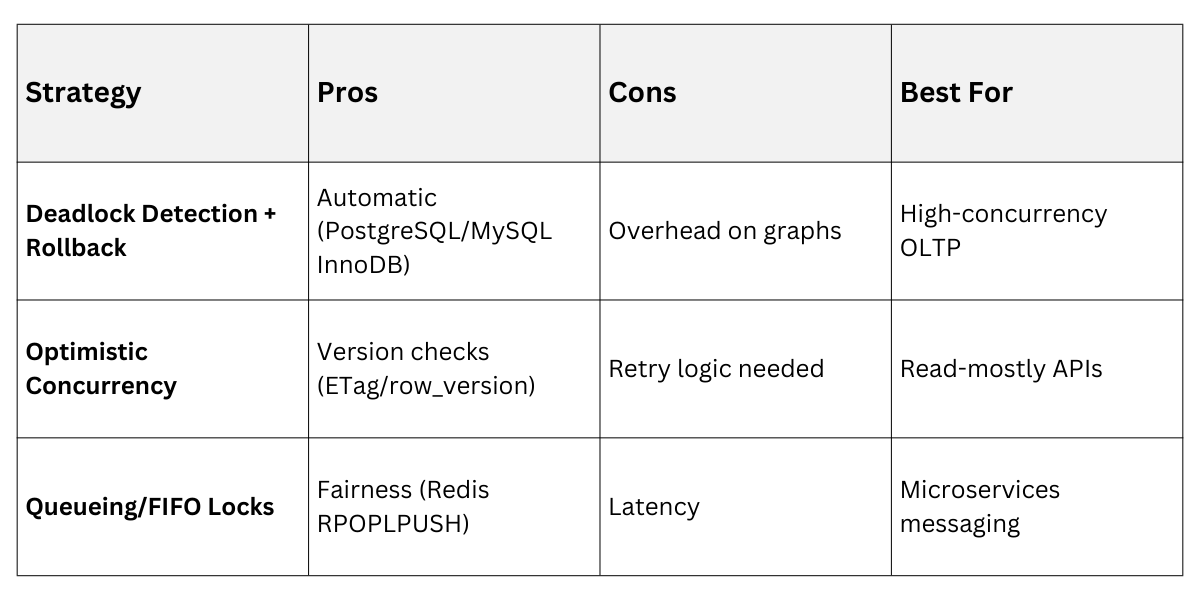 Advanced Practice: In Kubernetes-orchestrated backends, use advisory locks (pg_advisory_xact_lock) for distributed coordination without DB locks.
Monitoring Tools
1. PostgreSQL: EXPLAIN ANALYZE + pg_stat_activity.
2. MySQL: SHOW ENGINE INNODB STATUS.
3. ORM: SQLAlchemy's echo=True for lock traces.
Case Study: Uber's Postgres sharding reduced deadlocks 70% via consistent lock hierarchies and NOWAIT clauses (SELECT ... FOR UPDATE NOWAIT—fail fast, retry).
Best Practices for Backend Developers
Integrate these into your workflow for resilient systems.
1. Profile with load testers (pgbench, JMeter) to simulate multi-user contention.
2. Adopt two-phase locking (2PL): Acquire all locks first (growing phase), release post-commit (shrinking).
3. Hybrid with queues (Kafka/RabbitMQ) for non-critical writes.

Class Sessions
Sales Campaign

We have a sales campaign on our promoted courses and products. You can purchase 1 products at a discounted price up to 15% discount.