Ethical use of data and artificial intelligence (AI) in Business Intelligence (BI) is crucial to maintaining trust, fairness, privacy, and compliance while leveraging data for innovation and competitive advantage.
As AI and data-driven decision-making increasingly influence business strategies, organizations must align their practices with ethical principles to prevent harm, bias, and discrimination.
Adopting responsible and transparent approaches ensures AI and data practices respect human rights and societal values, fostering long-term success and stakeholder confidence.
Core Ethical Concerns in Data and AI
Addressing ethical risks in AI and data management is essential for fairness, accountability, and security. Important concerns include:
1. Bias and Fairness: AI models trained on biased or unrepresentative data risk perpetuating discrimination in decisions like hiring, lending, or customer targeting. Careful dataset curation, testing, and bias mitigation are essential.
2. Privacy and Consent: Collecting and processing personal data must comply with laws (e.g., GDPR, CCPA) and respect individual autonomy by obtaining informed consent and minimizing data exposure.
3. Transparency and Explainability: Stakeholders need clear explanations of AI decision logic and data usage to build trust and enable accountability. Black-box models pose challenges here.
4. Accountability and Oversight: Organizations must establish governance mechanisms to audit AI systems, assign responsibility for outcomes, and enable human oversight to avoid harms.
5. Security: Protecting data and AI systems from cyber threats safeguards integrity and confidentiality.
Guiding Principles for Ethical Use
To foster trust and minimize harm, AI systems must adhere to essential ethical standards. Central principles include:
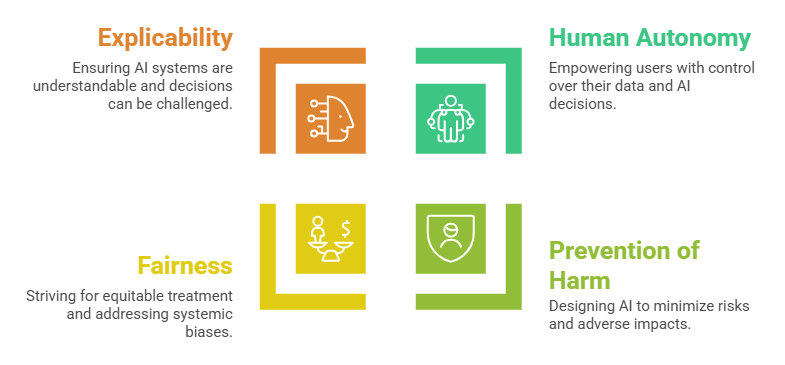
Practical Steps to Foster Ethical BI and AI
To mitigate bias and protect privacy, practical approaches are essential in AI and BI development. These include:
1. Diverse and Representative Data: Use inclusive datasets reflecting varied demographics and scenarios to improve fairness.
2. Regular Bias Audits: Continuously test AI models for bias and retrain or adjust as needed.
3. Transparent Documentation: Maintain comprehensive records of data sources, model design, training processes, and decision frameworks.
4. Stakeholder Engagement: Involve diverse internal and external perspectives in AI development and governance.
5. Ethical AI Policies: Develop and enforce organizational codes of conduct addressing responsible AI and data usage.
6. Education and Awareness: Train employees and leadership on ethical challenges and best practices.
7. Privacy-Enhancing Technologies: Employ anonymization, data masking, and secure multi-party computation where appropriate.
Business Value of Ethics in BI and AI
Ethical practices in data and AI adoption bring competitive advantages, including:
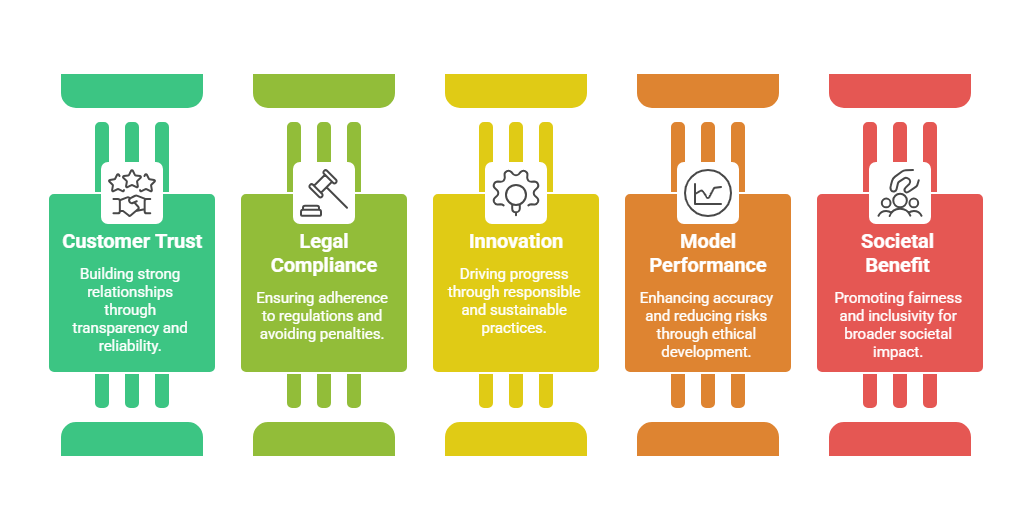
Ethics is not an inhibitor but a foundation for robust, resilient, and respected BI and AI systems.