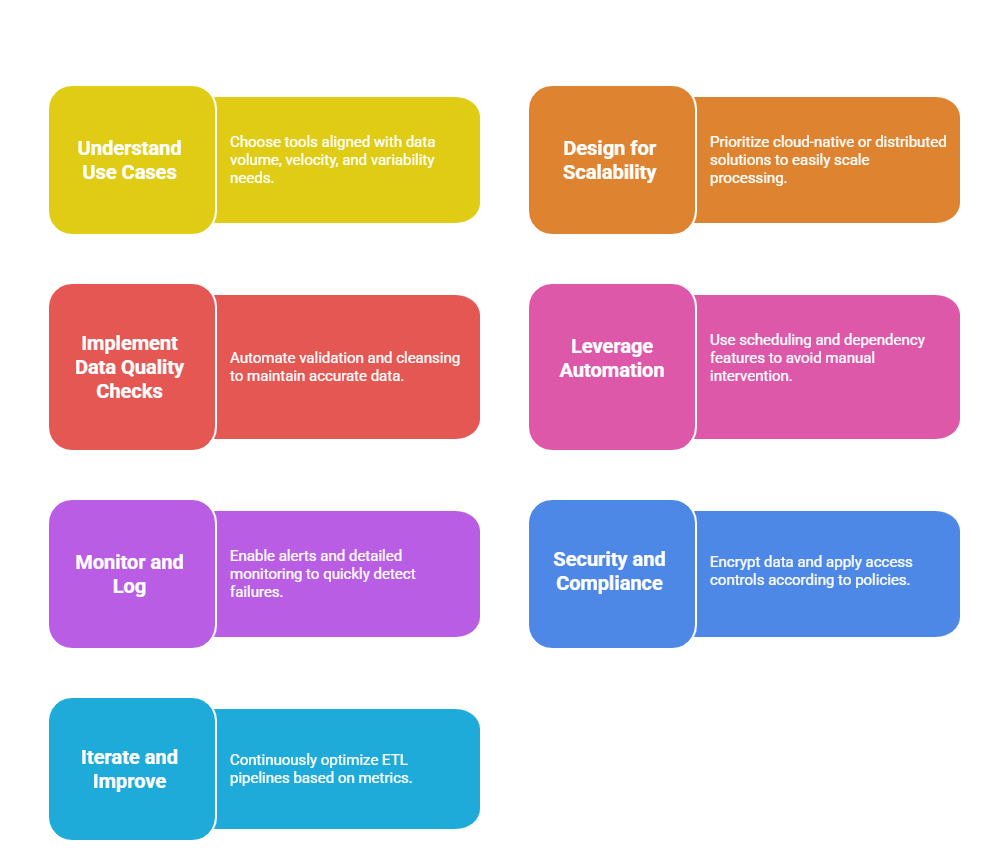
In Business Intelligence (BI), ETL (Extract, Transform, Load) tools and technologies form the backbone of data integration and preparation processes. Selecting the right ETL tools and following best practices are essential to ensure that data pipelines are efficient, scalable, reliable, and maintainable.
ETL Concepts
ETL tools manage complex workflows that extract data from multiple heterogeneous sources, transform that data to meet business rules and quality standards, and load it into analytical repositories like data warehouses and data marts. Modern ETL tools provide:
1. Connectivity: Robust connectors to various source systems such as databases, applications, cloud storage, APIs, and streaming platforms.
2. Transformation Capabilities: Graphical or script-based interfaces for data cleansing, enrichment, filtering, aggregation, and business rule application.
3. Orchestration: Scheduling, dependency management, and workflow automation to ensure reliable and repeatable data pipelines.
4. Monitoring and Logging: Real-time pipeline monitoring, error detection, alerting, and audit logging for compliance and troubleshooting.
5. Scalability and Performance: Support for batch and real-time data processing, parallelism, and resource optimization.
Key ETL Tools and Technologies
The landscape of ETL tools has evolved from traditional on-premises software to cloud-native, serverless, and open-source solutions. Here are prominent categories and examples:
1. Traditional Enterprise ETL Tools
Informatica PowerCenter: Industry-leading comprehensive tool offering extensive connectors, metadata management, and strong governance features for large enterprises.
IBM DataStage: Enterprise-class parallel ETL tool with advanced data integration and transformation for complex environments.
2. Cloud-Native ETL Platforms
AWS Glue: Serverless ETL service tightly integrated with the AWS ecosystem, supporting automatic schema discovery and job scheduling.
Microsoft Azure Data Factory (ADF): Visually designed ETL pipelines with hybrid data integration for cloud and on-premises sources.
Google Cloud Dataflow: Unified stream and batch processing with real-time analytics capabilities.
3. Open-Source and Lightweight Tools
Apache NiFi: Supports data routing, transformation, and system mediation with a powerful flow-based programming model.
Apache Airflow: A Workflow orchestration platform popular for automating complex dependencies in ETL pipelines.
Talend Open Studio: Offers an open-source ETL tool with a drag-and-drop interface and integration with cloud systems.
4. ELT (Extract, Load, Transform) in Cloud Data Warehouses
Modern cloud warehouses like Snowflake, BigQuery, and Redshift favor ELT architectures where transformation happens post-load, leveraging the warehouse's compute resources. Tools like dbt (Data Build Tool) enable such transformations through modular SQL scripts and version control.
Best Practices for ETL with Tools and Technologies
To maximize ETL effectiveness, organizations should follow these best practices: