Machine Learning (ML) is a transformative technology in the realm of Business Intelligence (BI), empowering organizations to analyze vast data sets and uncover insights beyond traditional methods. Unlike traditional BI, which is primarily descriptive and diagnostic by nature, ML introduces predictive and prescriptive capabilities.
It leverages algorithms that learn patterns from historical data and automatically improve over time without explicit programming for each scenario. This ability to detect complex patterns, forecast outcomes, and recommend actions makes ML a key enabler for next-generation BI systems that are faster, more accurate, and more scalable.
Core Concepts of Machine Learning in BI
Machine learning in BI relies on several core principles that govern how data is analyzed and decisions are automated. The following concepts form the foundation of ML-driven intelligence.
1. Supervised Learning: Algorithms train on labeled datasets (input-output pairs) to learn a function that maps inputs to outputs, used for classification and regression tasks.
2. Unsupervised Learning: Techniques like clustering analyze unlabeled data to discover intrinsic structures and relationships without predefined targets.
3. Reinforcement Learning: An autonomous system learns optimal actions through trial and error by receiving feedback from its environment; less common in BI but growing in operations optimization.
4. Feature Engineering: The process of selecting, transforming, and creating relevant variables to improve ML model accuracy and interpretability.
5. Model Training and Validation: ML models are trained using training data and evaluated on validation or test data to prevent overfitting and ensure generalization.
Applications of ML in Business Intelligence
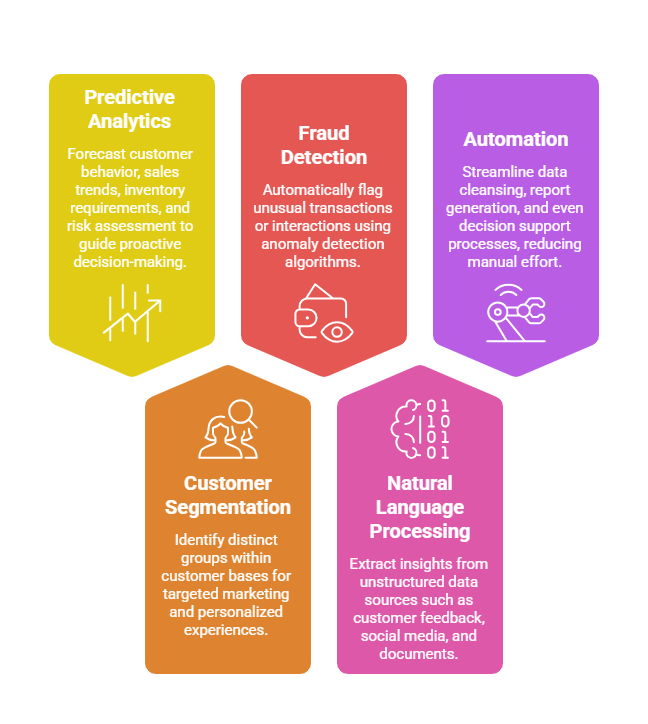
ML transforms BI from descriptive reporting into a proactive, insight-driven strategy. Consider these primary applications where ML plays a critical role:
Benefits and Challenges
ML enhances BI by enabling deeper insights and automation, but challenges include data quality issues, the need for specialized expertise, interpretability of complex models, and ethical considerations around bias and transparency.
Effective implementation requires integrating ML workflows into BI platforms, promoting data governance, and ensuring continuous model monitoring and updating.