Data modeling is a foundational aspect of Business Intelligence (BI) that involves designing the structure and organization of data to facilitate effective storage, retrieval, and analysis. Different modeling techniques serve different purposes and environments, influencing the scalability, flexibility, and usability of BI systems.
Relational Data Modeling
Relational modeling organizes data into tables (relations) composed of rows and columns, representing entities and their attributes. Each table uses primary keys to uniquely identify records and foreign keys to establish relationships among tables.
Structure: Normalized forms (usually third normal form) reduce redundancy and ensure data integrity by decomposing data into related tables.
Relationships: Models support one-to-one, one-to-many, and many-to-many relationships, often requiring join tables.
Use Case: Ideal for operational systems where transaction processing and data consistency are critical.
Advantages: Strong data integrity, flexibility in querying, and widespread tool support.
Example: Customer, Orders, and Products tables in an e-commerce database are linked relationally.
Dimensional Data Modeling
Dimensional modeling is designed to optimize data for query performance and business analysis rather than transaction processing. It organizes data into fact tables and dimension tables, often using star or snowflake schemas.
1. Fact Tables: Contain measurable, quantitative data (e.g., sales amounts) with foreign keys linking to dimensions.
2. Dimension Tables: Contain descriptive attributes (e.g., customer name, product category) that provide context to facts.
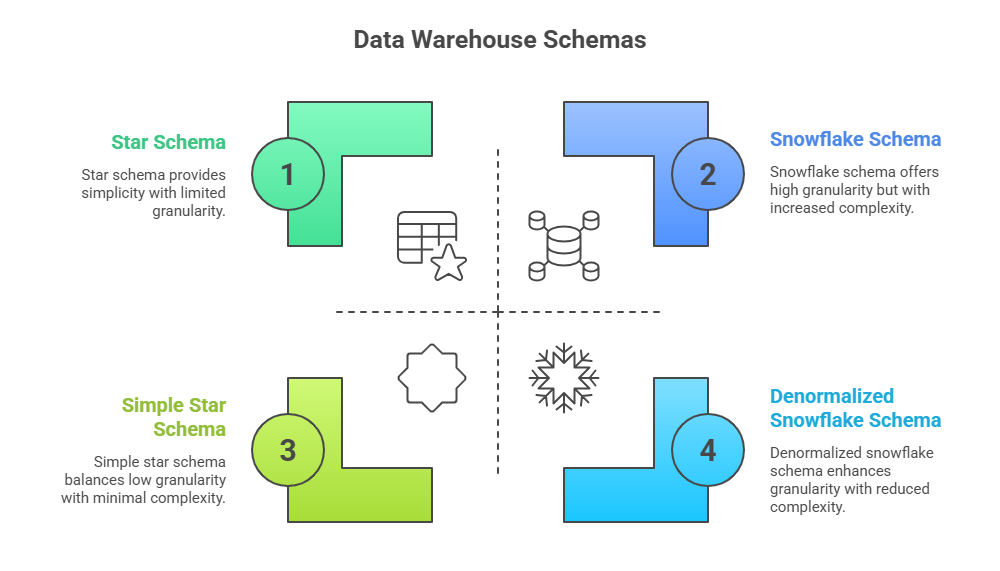
Use Case: Ideal for data warehouses and data marts focused on fast, ad hoc analytical queries.
Advantages: Enhanced query performance, intuitive structure for business users, and supports drill-down analysis.
Data Vault Modeling
Data vault modeling is a hybrid approach combining normalization with flexibility and scalability. It separates business keys, relationships, and descriptive data into three types of tables: hubs, links, and satellites.
Hubs: Store unique business keys representing core business entities (e.g., Customer ID).
Links: Capture relationships between hubs, often many-to-many.
Satellites: Contain descriptive attributes and track historical changes, enabling auditing and temporal analysis.
Philosophy: Stores "all the data, all the time," including non-conforming or "bad" data for full auditability.
Use Case: Suited for large enterprise data warehouses requiring agility, scalability, and long-term historical tracking.
Advantages: High adaptability to changes, parallel loading capabilities, and support for enterprise-level data integration.