In database management and Business Intelligence (BI), indexing, partitioning, and performance tuning are critical techniques to ensure that data operations execute efficiently and systems handle growing data volumes without degrading performance. These strategies improve query response times, optimize resource usage, and maintain system stability under high workloads.
Indexing: Accelerating Data Retrieval
Indexing is a data structure technique used to speed up the retrieval of rows from a database table based on key column values without scanning the entire table.
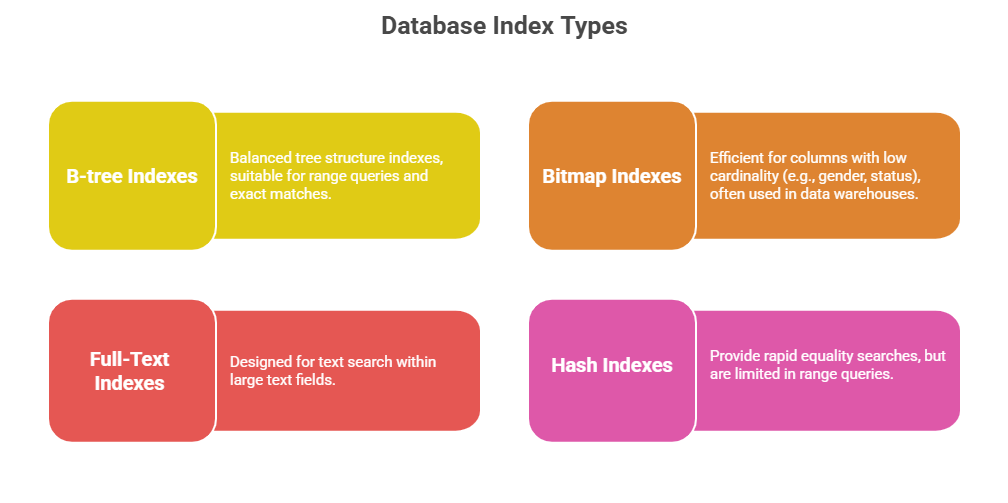
Considerations:
1. Index columns are frequently used in JOINs, WHERE clauses, and ORDER BY statements.
2. Avoid over-indexing, which increases storage and slows down INSERT/UPDATE/DELETE operations.
3. Use composite indexes for queries involving multiple columns, but optimize order based on selectivity.
Partitioning: Managing Large Tables for Scalability
Partitioning divides a large table or index into smaller, manageable segments, enabling efficient query processing and maintenance.
Partition Types:
1. Range Partitioning: Divides data based on ranges of values (e.g., date ranges).
2. List Partitioning: Divides based on discrete lists of values (e.g., regions, departments).
3. Hash Partitioning: Data is distributed based on a hash function to balance loads evenly.
Benefits:
1. Improves query performance by scanning only relevant partitions.
2. Facilitates easier maintenance, such as backup, restore, or archiving on individual partitions.
3. Enhances parallel processing and reduces contention.
Design Tips: Designing effective database partitions requires selecting partition keys that align with the most common query filters to ensure fast and efficient data retrieval. It’s also important to avoid creating an excessive number of partitions, as this can increase administrative complexity and overhead. For optimal performance, partitioning should be complemented with well-structured indexing strategies, allowing both techniques to work together to enhance query speed and overall system efficiency.
Performance Tuning: Optimizing Query and System Efficiency
Performance tuning involves monitoring, diagnosing, and adjusting database components to improve responsiveness and throughput.
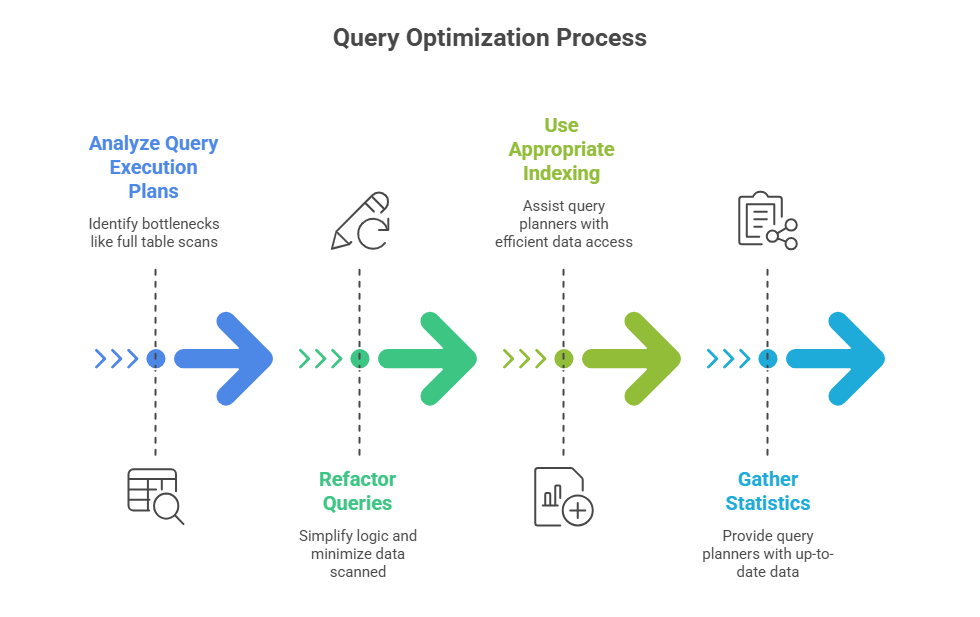
Resource Management: It involves tuning memory allocation, CPU usage, and disk I/O settings according to workload demands to ensure smooth and efficient system performance. Additionally, implementing load balancing and connection pooling helps distribute workloads evenly and enhance responsiveness in multi-user environments.
Database Configuration: It involves fine-tuning parameters like cache size, parallel execution settings, and autovacuum (in PostgreSQL) to achieve optimal performance. It should be complemented with continuous monitoring and alerting tools to track system health and quickly address performance issues.
Best Practices:
1. Regularly update database statistics for accurate query planning.
2. Schedule maintenance tasks like index rebuilding and database vacuuming appropriately.
3. Collaborate between developers and DBAs throughout the development lifecycle to ensure efficient code and data models.