AWS CloudFormation is an infrastructure as code (IaC) service that simplifies the process of provisioning and managing AWS resources. With CloudFormation, users can define the desired state of their infrastructure using templates written in JSON or YAML.
These templates describe all the AWS resources needed for an application or service, enabling consistent and repeatable deployments.
CloudFormation takes care of creating, updating, and deleting resources in a controlled and predictable fashion, helping reduce manual errors and deployment complexity.
Key Concepts of AWS CloudFormation
Understanding the fundamental components of CloudFormation is essential for automating and standardizing AWS deployments. Below are the core elements that define how CloudFormation structures, manages, and reuses resources.
1. Templates: JSON or YAML files that specify the AWS resources and their configurations.
2. Stacks: Collections of resources defined by a CloudFormation template, managed as a single unit.
3. StackSets: Extend CloudFormation’s functionality to deploy stacks across multiple AWS accounts and regions.
4. Resources: The AWS services and components defined within a template (e.g., EC2 instances, S3 buckets).
5. Parameters: Inputs that customize template behavior at runtime.
6. Outputs: Values from the deployed stack accessible for later use or cross-stack references.
Benefits of Using CloudFormation
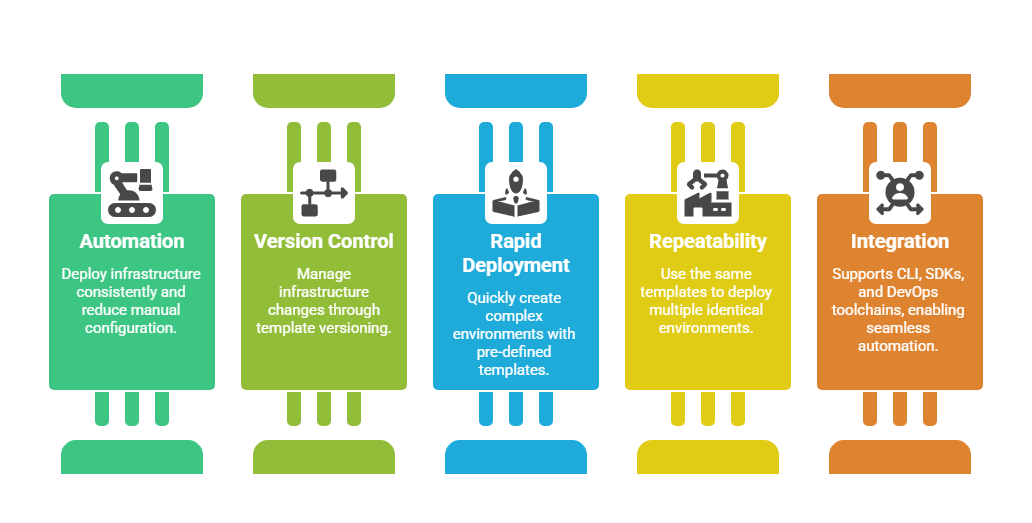
How CloudFormation Works
To deploy infrastructure, users upload templates to CloudFormation via the Management Console, CLI, or APIs. CloudFormation then provisions resources in the correct order, handling dependencies and rollback on failures.
Users can update templates to modify existing stacks, and CloudFormation manages all changes securely.