Fault tolerance is a critical design goal in cloud architecture, aiming to ensure that applications and services remain available despite failures of individual components or entire data centers.
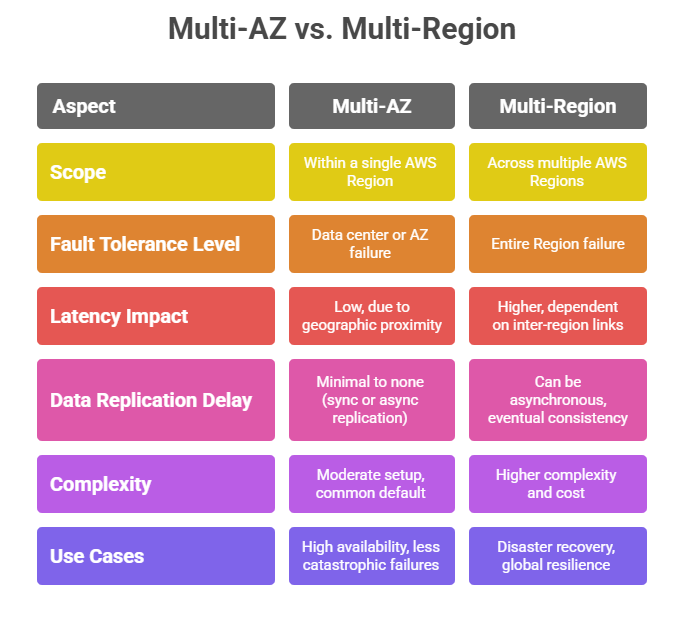
AWS provides native capabilities to build fault-tolerant systems using Multi-Availability Zone (Multi-AZ) and Multi-Region deployments, allowing infrastructure and applications to withstand failures, recover quickly, and minimize downtime.
Multi-Availability Zone (Multi-AZ) Deployments
An Availability Zone (AZ) is a distinct data center within an AWS Region separated by geographic distance, power, cooling, and networking to isolate failures. Multi-AZ architecture leverages multiple AZs to provide high availability and fault tolerance.
Key Characteristics:
1. Each AZ consists of one or more discrete data centers.
2. Multi-AZ deployments replicate compute and data resources across at least two AZs within the same region
3. Failover mechanisms redirect traffic automatically to healthy AZs if one AZ experiences issues.
4. Services like Amazon RDS, Elastic Load Balancers (ELB), and Auto Scaling natively support Multi-AZ deployment.
Benefits:
1. Minimized risk of localized failures affecting overall application availability.
2. Seamless failover with minimal service disruption.
3. Improved disaster recovery readiness within a region.
Typical Use Cases:
1. Highly available relational databases with RDS Multi-AZ.
2. Web applications are distributed across AZs behind load balancers.
3. Enterprise workloads require continuous uptime.
Multi-Region Deployments
Multi-Region deployment goes a step further by distributing resources across geographically separate AWS Regions.
This configuration protects against the unlikely scenario of an entire region outage due to natural disasters, network failures, or other catastrophic events.
Key Characteristics:
1. Multiple independent geographic regions hosting redundant copies of application resources and data.
2. Data replication across regions can be achieved using AWS services like Amazon S3 Cross-Region Replication or Amazon Aurora Global Database.
3. Traffic management through Amazon Route 53 with latency-based routing or health checks.
4. Requires thoughtful design for data consistency, latency, and compliance with data residency rules.
Benefits:
1. Protection from region-wide failures and disasters.
2. Enhanced global responsiveness by serving users from their closest region.
3. Compliance with data sovereignty requirements.
Typical Use Cases:
1.,Global applications require low latency for geographically dispersed users.
2. Mission-critical applications need catastrophic fault tolerance.
3. Regulatory requirements dictate cross-border data redundancy.
Best Practices for Fault-Tolerant Design
Fault-tolerant architectures are critical for achieving high availability and disaster resilience. Below are essential design principles that help systems withstand failures and recover seamlessly.
1. Redundancy: Always deploy resources across multiple AZs to avoid single points of failure.
2. Automated Failover: Utilize managed services supporting automated failover (e.g., RDS Multi-AZ, ELB).
3. Global Traffic Management: Use Route 53 DNS policies for intelligent routing between regions.
4. Data Replication Strategy: Choose appropriate replication techniques, balancing consistency and latency.
5. Testing and Validation: Regularly test failover processes and disaster recovery procedures.