Elastic Load Balancing (ELB) is an AWS service designed to distribute incoming application or network traffic across multiple targets such as EC2 instances, containers, or IP addresses.
This distribution increases fault tolerance and improves application availability and scalability.
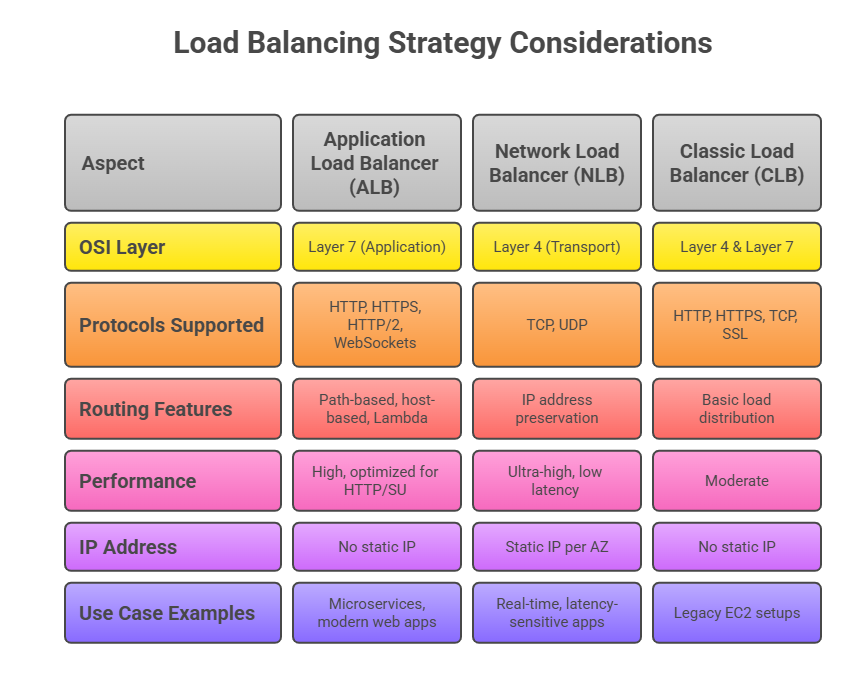
AWS offers several types of load balancers—Application Load Balancer (ALB), Network Load Balancer (NLB), and Classic Load Balancer (CLB)—each optimized for different traffic patterns and use cases.
Application Load Balancer (ALB)
The ALB operates at Layer 7 (Application Layer) of the OSI model, enabling advanced request routing based on the content of HTTP/HTTPS traffic.
Key Features:
1. Supports path-based routing (e.g., /api routes to a different backend than /images).
2. Host-based routing (traffic directed by domain name to different target groups).
3. Native support for HTTP/2 and WebSockets improves performance for modern web applications.
4. Can route requests to multiple ports on a single EC2 instance for containerized or microservices architectures.
5. Integration with Lambda functions as targets for serverless applications.
6. Always enables cross-zone load balancing for even distribution across AZs.
Typical Use Cases:
1. Web applications require flexible and intelligent routing.
2. Microservices and containerised application architectures.
3. Applications leveraging modern protocols like HTTP/2 or WebSockets.
Network Load Balancer (NLB)
NLB works at Layer 4 (Transport Layer), routing TCP/UDP traffic with ultra-low latency and high throughput.
Key Features:
1. Handles millions of requests per second while maintaining high performance.
2. Preserves the source IP address, supporting applications needing IP-based authorization.
3. Provides a static IP per availability zone and supports Elastic IP association.
4. Optimized for sudden and volatile traffic patterns.
5. Cross-zone load balancing is customizable.
Typical Use Cases:
1. Real-time applications like gaming, IoT, and financial trading require predictable ultra-low latency.
2. Applications using protocols other than HTTP/S, like TCP or UDP.
3. High-throughput and volatile workloads demanding fault tolerance.
Classic Load Balancer (CLB)
The Classic Load Balancer is the original AWS load balancing solution that supports basic load balancing at both Layer 4 and Layer 7.
Key Features:
1. Routes HTTP(S) traffic to multiple EC2 instances and supports sticky sessions.
2. Supports SSL termination, TCP load balancing.
3. Provides basic health checks and load distribution functionality.
4. Does not natively support advanced routing features like path-based or host-based routing.
Typical Use Cases:
1. Legacy applications are still running on EC2-Classic or EC2-VPC without requiring advanced routing.
2. Simpler applications need basic load balancing without complex routing.

Class Sessions
Sales Campaign

We have a sales campaign on our promoted courses and products. You can purchase 1 products at a discounted price up to 15% discount.