AWS offers a comprehensive suite of database services designed to address varied application needs, including relational and non-relational workloads. Among the most prominent are Amazon Relational Database Service (RDS), Amazon DynamoDB, and Amazon Aurora.
These fully managed services provide scalability, high availability, security, and ease of use, enabling developers and database administrators to focus on applications without managing underlying infrastructure.
Amazon RDS (Relational Database Service)
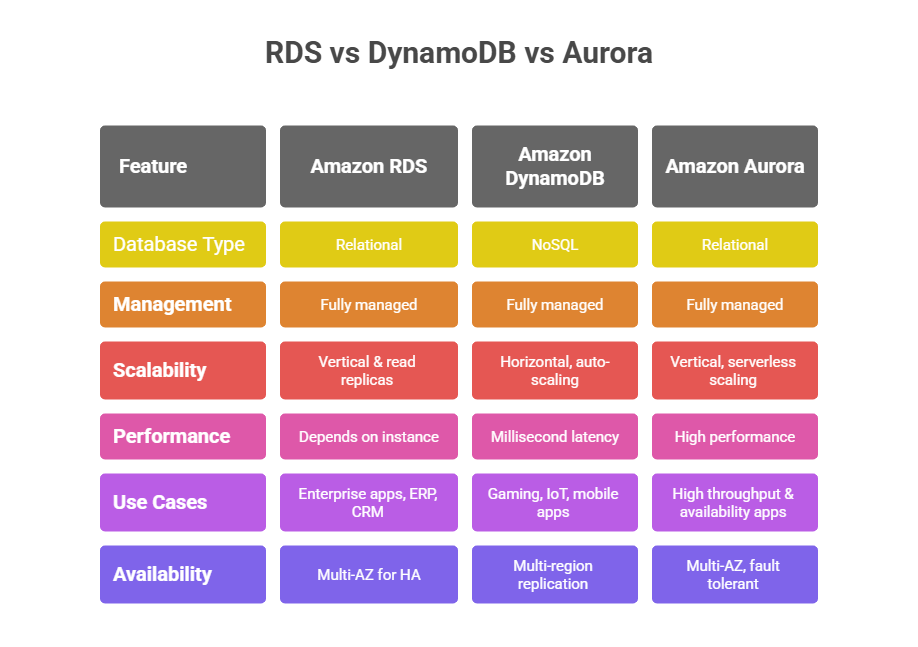
Amazon RDS is a managed relational database service supporting widely used database engines such as MySQL, PostgreSQL, Oracle, MariaDB, and Microsoft SQL Server. It simplifies database management by automating tasks like backup, patching, scaling, and replication.
Key Features:
1. Automated backups and snapshots with point-in-time recovery.
2. Multi-AZ deployments for high availability and failover support.
3. Read replicas for workload scaling and improved read performance.
4. Seamless integration with AWS monitoring and security services.
5. Supports vertical and horizontal scaling of database instances.
Use Cases:
1. Traditional enterprise applications require strong data consistency and complex queries.
2. E-commerce platforms and customer relationship management (CRM) systems.
3. Web applications need reliable, managed SQL databases.
Amazon DynamoDB
DynamoDB is a fully managed NoSQL database service offering fast and predictable performance with seamless scalability. It stores data as key-value and document structures, making it ideal for applications with variable schema or requiring low-latency access at scale.
Key Features:
1. Millisecond latency at any scale, supporting over 10 trillion requests per day.
2. Built-in security, backup, restore, and in-memory caching with DAX (DynamoDB Accelerator).
3. Supports triggers and streams for event-driven architectures.
4. Serverless architecture requires no infrastructure management.
Use Cases:
1. Mobile, web, gaming, ad tech, and IoT applications require rapid response times.
2. Session management, real-time bidding, and leaderboards.
3. Use cases needing flexible data models and dynamic scaling.
Amazon Aurora
Aurora is a MySQL- and PostgreSQL-compatible relational database that delivers enterprise-grade performance and availability at a fraction of traditional commercial database costs. Fully managed through RDS, Aurora offers features exceeding standard open-source databases.
Key Features:
1. Up to five times faster than MySQL, three times faster than PostgreSQL.
2. Fault-tolerant, distributed architecture replicating six copies of data across three AZs.
3. Serverless configurations for automatic and on-demand scaling.
4. Integration with advanced analytics and machine learning services.
Use Cases:
1. High-transaction enterprise applications that require exceptional availability.
2. SaaS platforms and financial systems need high throughput and automated scaling.
3. Applications requiring advanced replication and backup options with minimal administrative effort.

Class Sessions
Sales Campaign

We have a sales campaign on our promoted courses and products. You can purchase 1 products at a discounted price up to 15% discount.