When an audit uncovers discrepancies, these are formally documented as audit findings, which can be categorized as nonconformities, observations, or opportunities for improvement.
Nonconformities indicate processes or outputs that do not meet specified requirements and require immediate corrective action. Observations and improvement opportunities suggest potential enhancements but do not necessarily disrupt compliance.
Steps in Managing Audit Findings and Corrective Actions
A structured process for managing audit findings strengthens accountability and continual improvement. The following points outline the essential stages of this process.
1. Documenting Findings: The auditor prepares a detailed report outlining the nature, location, and extent of nonconformities or issues. Clarity and factual accuracy in documentation ensure management understands the problem scope.
2. Root Cause Analysis: The organization investigates the underlying causes of each finding using techniques like the "5 Whys," cause and effect diagrams, or failure mode effects analysis (FMEA). Identifying root causes is critical for effective corrective actions.
3. Developing Corrective Action Plans: Based on the analysis, a corrective action plan is created specifying what actions will be taken, by whom, within what timeframe, and how effectiveness will be measured.
4. Implementation: Assigned personnel execute the corrective actions such as revising procedures, retraining staff, upgrading equipment, or enhancing controls.
5. Verification: The effectiveness of corrective actions is verified through follow-up audits, monitoring, or testing to ensure the issue is resolved satisfactorily.
6. Documentation and Communication: Records of findings, action plans, implementation, and verification are maintained, facilitating traceability and demonstrating compliance during subsequent audits.
7. Continuous Improvement: Lessons learned from audit findings feed into management reviews and QMS updates, fostering an ongoing culture of quality enhancement.
Pros of Effective Audit Finding Management
Strong audit finding management turns nonconformities into opportunities for enhancement. Below are some notable pros of maintaining an effective management approach.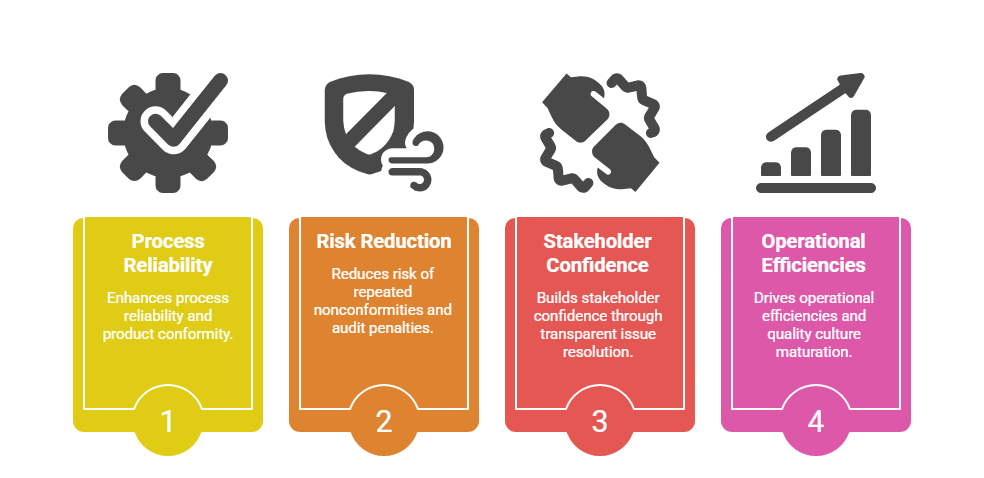

Class Sessions
Sales Campaign

We have a sales campaign on our promoted courses and products. You can purchase 1 products at a discounted price up to 15% discount.