Integrating risk management with a Quality Management System (QMS) is a fundamental requirement and a key feature of ISO 9001:2015.
This integration enables organizations to proactively identify, assess, and mitigate risks while also recognizing and pursuing opportunities that could drive improvements.
Rather than treating risk management as a separate or reactive activity, ISO 9001 embeds risk-based thinking throughout the entire QMS framework, ensuring it is part of strategic planning, operational control, and continual improvement processes.
Risk in ISO 9001 is defined as the “effect of uncertainty on an expected result,” which means it can be both a potential threat and a potential opportunity.
The standard requires organizations to systematically determine risks and opportunities related to quality outcomes, customer satisfaction, and regulatory compliance.
This involves a structured process beginning with understanding internal and external issues, evaluating their impact on organizational objectives, and developing action plans to address them.
Integration of risk management applies to every relevant clause, including leadership commitment, process control, performance monitoring, nonconformity handling, and management review.
Benefits of integrating risk management with a QMS include enhanced preparedness for uncertainties, improved decision-making based on factual analysis, and greater resilience in business operations.
Risk-based thinking helps prevent nonconformities before they occur, reduces reactive firefighting, and supports innovation by encouraging the exploration of opportunities.
It also aligns with the organization’s continuous improvement ethos, ensuring that risk assessments and controls evolve with changing circumstances and business environments.
The integration demands clear communication, training, and documentation, fostering a risk-aware culture that permeates all organizational levels.
Risk Management Integration Practices
Below are key practices for embedding risk-based thinking effectively.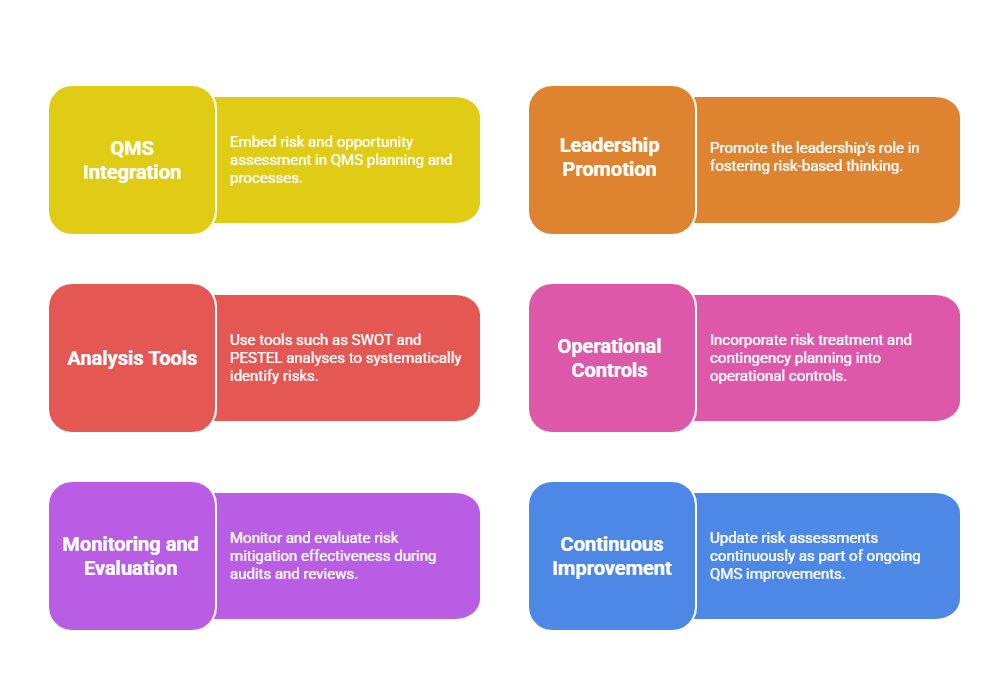 By fully integrating risk management into the QMS, organizations not only safeguard quality and compliance objectives but also drive sustainable performance and strategic advantage.

Class Sessions
Sales Campaign

We have a sales campaign on our promoted courses and products. You can purchase 1 products at a discounted price up to 15% discount.