The Plan-Do-Check-Act (PDCA) cycle is a foundational model in Quality Management Systems (QMS), especially within ISO 9001 frameworks.
It was popularized by Dr. W. Edwards Deming and is used by organizations worldwide as a simple, systematic method for driving ongoing process improvement.
The cycle helps guide teams through a logical sequence of steps that promote consistent quality outcomes, enable learning from experience, and ensure responsiveness to change.
Stages of the PDCA Cycle
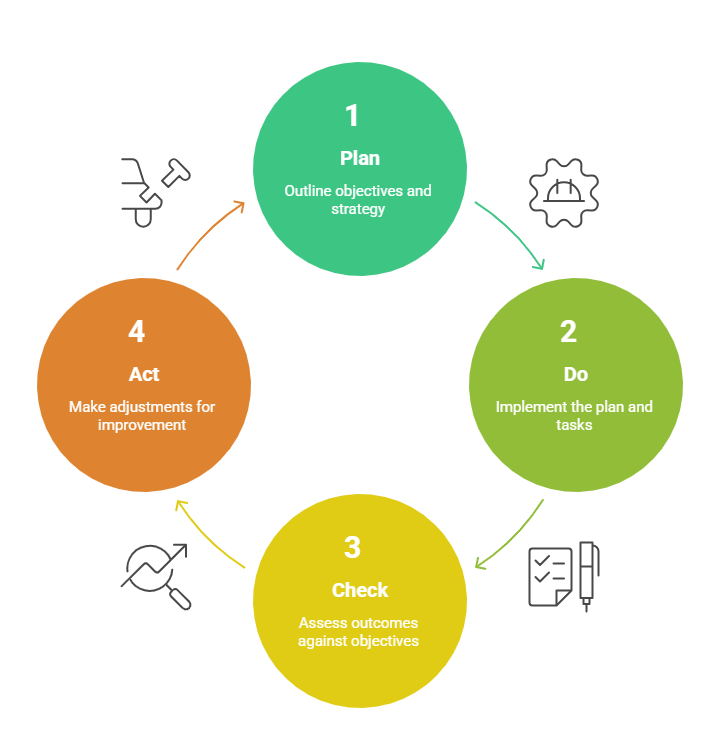
Understanding the PDCA methodology helps organizations plan strategically, execute efficiently, and improve continuously. Below are the main stages that define this cycle.
Plan
In this first stage, organizations establish objectives and processes needed to meet specified outcomes.
Planning involves understanding the organization's context, stakeholder requirements, identifying risks and opportunities, and defining quality objectives.
Careful planning also includes organizing resources and setting up documented procedures that help everyone know their roles and what is expected.
Do
This is the implementation phase, where planned processes and activities are executed. During this stage, teams mobilize resources, operate new or improved processes, train personnel, and maintain records as evidence of conformity.
Data collection starts here to monitor the effectiveness of what has been implemented.
Check
The check phase focuses on evaluating results through monitoring, measurement, and internal audits. Performance is compared against objectives and expected outcomes set in the planning phase.
Any discrepancies, nonconformities, or gaps are identified, and their causes are analyzed so lessons can be learned for the future. Management reviews also occur here to assess overall system effectiveness.
Act
Finally, the organization acts on findings from the check phase. This can mean implementing corrective actions to resolve problems, refining processes, or making preventive changes.
The goal is to achieve continuous improvement by updating plans and starting the cycle again, which further elevates quality, efficiency, and compliance over time.
Through active use of the PDCA cycle, organizations foster adaptation, learning, and a proactive approach to risk and opportunity, all of which are crucial for maintaining robust QMS performance within ISO 9001 and beyond.

Class Sessions
Sales Campaign

We have a sales campaign on our promoted courses and products. You can purchase 1 products at a discounted price up to 15% discount.