Process mapping, procedures, and policies are foundational elements in an effective ISO 9001 Quality Management System (QMS). They provide a structured framework that describes how activities are performed, monitored, and improved to meet quality objectives.
The clarity and documentation of these elements enable organizations to maintain consistency, enhance communication, support training, and promote continuous improvement.
Process Mapping
Process mapping involves visually representing the sequence of activities, decisions, inputs, and outputs within key organizational processes. It provides a high-level overview that helps stakeholders understand how different functions interact to deliver products or services.
While ISO 9001:2015 does not explicitly require process maps, they serve as an invaluable tool for analyzing workflows, identifying inefficiencies, and aligning processes with QMS requirements.
Steps to Create Effective Process Maps Include:
1. Identifying the process boundaries, inputs, and outputs.
2. Mapping each step in the process flow with clear descriptions.
3. Including decision points and interactions between departments.
4. Marking responsibilities, timelines, tools, and metrics.
5. Reviewing and updating the maps regularly to reflect improvements.
Procedures
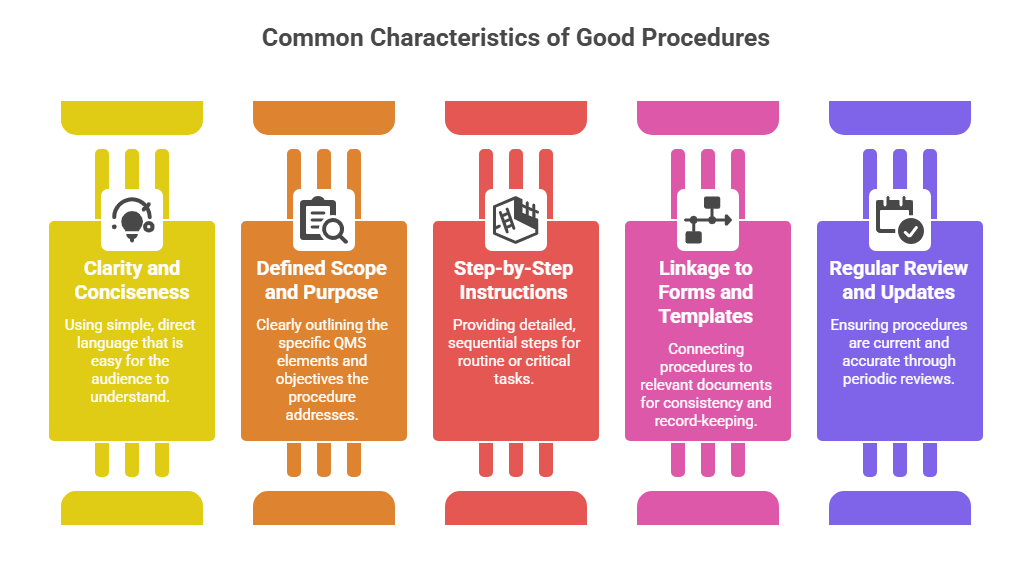
Procedures are detailed documents that describe how specific activities or processes should be carried out to ensure consistency and compliance. They translate high-level policies into actionable steps, clarifying roles, responsibilities, controls, and criteria for performance.
Policies
Policies are formal declarations of intent reflecting an organization's commitment to quality and guiding principles. A quality policy, for instance, outlines the organization’s objectives regarding customer satisfaction, compliance, and continuous improvement, setting the tone for the entire QMS.
An Effective Quality Policy Should:
1. Be aligned with organizational goals and context.
2. Be communicated and understood across the organization.
3. Provide a framework for setting measurable quality objectives.
4. Be periodically reviewed and updated by leadership.
By integrating process mapping, clear procedures, and well-defined policies, organizations create a transparent and controlled environment. This supports efficient operations, reduces errors, facilitates training, and helps demonstrate compliance during ISO 9001 audits.

Class Sessions
Sales Campaign

We have a sales campaign on our promoted courses and products. You can purchase 1 products at a discounted price up to 15% discount.