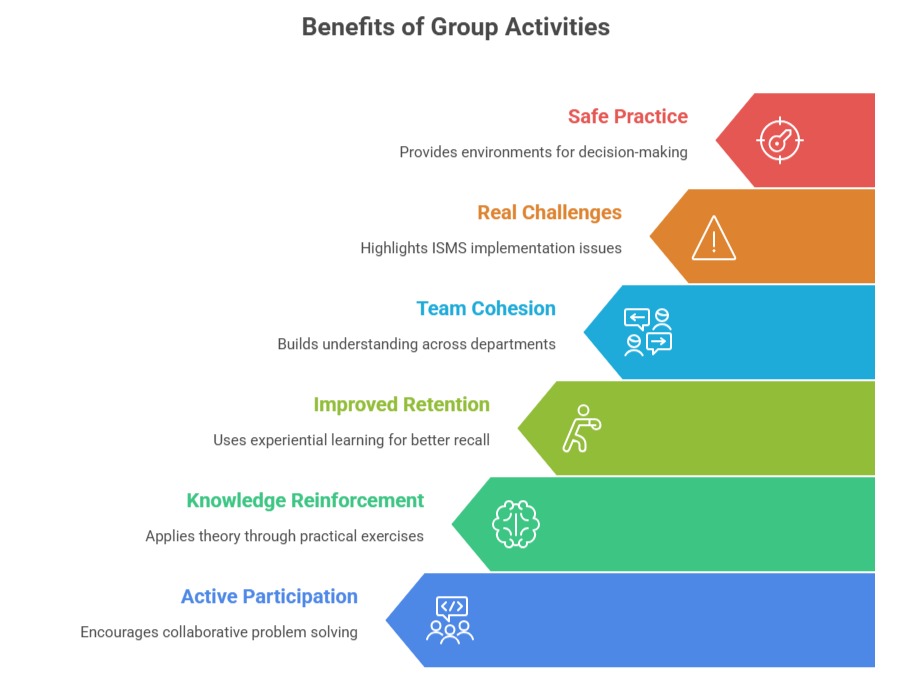
Group activities such as role-play, exercises, and workshops are highly effective methods to enhance learning and engagement during ISO/IEC 27001 training.
These interactive sessions foster practical understanding by simulating real-world scenarios, encouraging teamwork, and reinforcing key concepts such as risk management, incident response, internal audits, and compliance requirements.
Group dynamics support knowledge sharing, critical thinking, and skill-building in a collaborative environment, which is essential for the successful implementation and maintenance of an Information Security Management System (ISMS).
Types of Group Activities
| Type of Group Activity | Description |
| Role-Play Exercises | Participants take on roles such as auditor, risk owner, or incident responder to simulate real-world situations like conducting internal audits or managing security incidents. This helps develop decision-making, communication, and practical understanding. |
| Scenario-Based Exercises | Groups analyze hypothetical or real incident scenarios to identify risks, determine controls, and plan appropriate responses. This enhances comprehension of ISO 27001 processes such as risk assessment, treatment, and incident management. |
| Workshops | Facilitated sessions designed for brainstorming, process mapping, or policy drafting. These are ideal for collaboratively developing risk treatment plans, defining ISMS scope, or reviewing control implementations. |
| Quizzes and Group Discussions | Interactive sessions that encourage participation and reinforce learning by reviewing ISO 27001 requirements, terminology, best practices, and common challenges. |
Best Practices for Conducting ISO 27001 Group Activities
The following points highlight best practices for conducting them successfully.
1. Define clear objectives and outcomes aligned with training goals.
2. Use realistic scenarios relevant to participants’ roles and industry.
3. Facilitate balanced participation and encourage open communication.
4. Debrief sessions with feedback to consolidate learning points.5.
5. Integrate role-plays and exercises regularly throughout training programs to maintain engagement.

Class Sessions
Sales Campaign

We have a sales campaign on our promoted courses and products. You can purchase 1 products at a discounted price up to 15% discount.