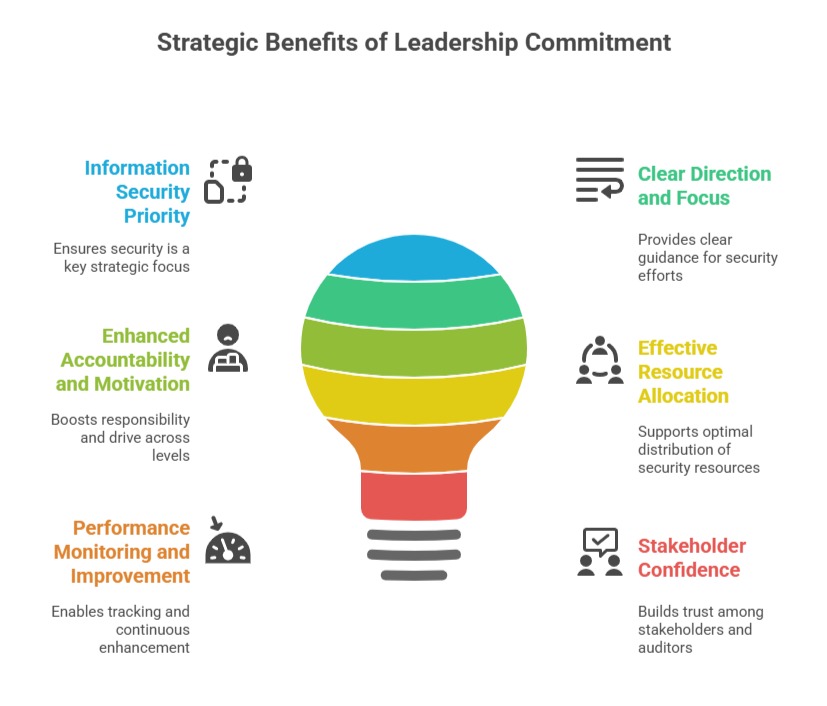
Leadership commitment is a cornerstone of a successful Information Security Management System (ISMS) as outlined in ISO/IEC 27001, particularly under Clause 5.1.
The involvement and genuine support of top management ensure that information security initiatives align with organizational goals and are effectively integrated into business operations.
Setting clear and realistic information security objectives is equally vital, establishing measurable targets that direct ISMS efforts and enable assessment of performance and continual improvement.
Importance of Leadership Commitment
Leadership commitment means top management visibly and materially endorses the ISMS, giving it priority alongside other business functions. Their responsibilities include:
1. Establishing and approving the information security policy to set direction and principles.
2. Ensuring ISMS objectives are compatible with the organization’s strategic goals.
3. Providing adequate resources—financial, human, and technological—to support ISMS activities.
4. Integrating ISMS requirements into business processes rather than treating security as an isolated task.
5. the importance of information security throughout the organization to foster a security-aware culture.
6. Taking accountability for the ISMS achieving its intended outcomes.
7. Supporting and empowering roles responsible for ISMS tasks, including training and guidance.
8. Promoting continual improvement by encouraging feedback, audits, and corrective actions.
Without active leadership involvement, ISMS implementations risk becoming box-ticking exercises that fail to deliver meaningful security enhancements.
Setting Information Security Objectives
Clear objectives translate leadership’s vision into operational targets for information security. These objectives should be:
| Criterion | Description |
| Aligned | Objectives must align with the organization’s strategic direction and information security policy. |
| Specific and Measurable | Clearly define what is to be achieved, how success will be measured, and within what timeframe. |
| Realistic and Achievable | Ensure objectives are attainable based on available resources and organizational capabilities. |
| Communicated and Understood | Share objectives with all relevant personnel to promote awareness and collective contribution. |
| Reviewed Regularly | Monitor, evaluate, and update objectives to reflect changes in risks, business priorities, or regulatory requirements. |
Examples of information security objectives include reducing the number of security incidents, achieving compliance with regulatory standards, improving staff training completion rates, or enhancing incident response times.

Class Sessions
Sales Campaign

We have a sales campaign on our promoted courses and products. You can purchase 1 products at a discounted price up to 15% discount.