Developing an Information Security Management System (ISMS) policy and planning for risk assessment and treatment are critical initial steps in establishing an effective information security framework aligned with ISO/IEC 27001 requirements.
The ISMS policy provides a formal commitment from top management that conveys the organization's information security vision, scope, and direction.
Meanwhile, the planning phase, encompassing risk identification, analysis, and treatment, defines how the organization approaches potential threats to maintain confidentiality, integrity, and availability of information assets.
ISMS Policy Development Requirements
According to ISO/IEC 27001 Clause 5.2, top management is responsible for establishing an information security policy that:
| Requirement | Description |
| Suitable to the Organization’s Purpose | The policy must align with the organization’s goals, values, and overall business context. |
| Framework for Setting Objectives | Provides direction for establishing clear, measurable information security objectives to protect information assets |
| Commitment to Fulfilling Applicable Requirements | Ensures compliance with legal, regulatory, contractual, and other relevant obligations. |
| Commitment to Continual Improvement | Demonstrates the organization’s intent to enhance the ISMS continuously and improve its effectiveness. |
| Documented and Accessible | The policy must be formally documented, communicated within the organization, and made available to relevant stakeholders. |
The policy serves as a foundational document, setting expectations, responsibilities, and principles that underpin all ISMS activities.
Planning Phase: Risk Assessment and Treatment
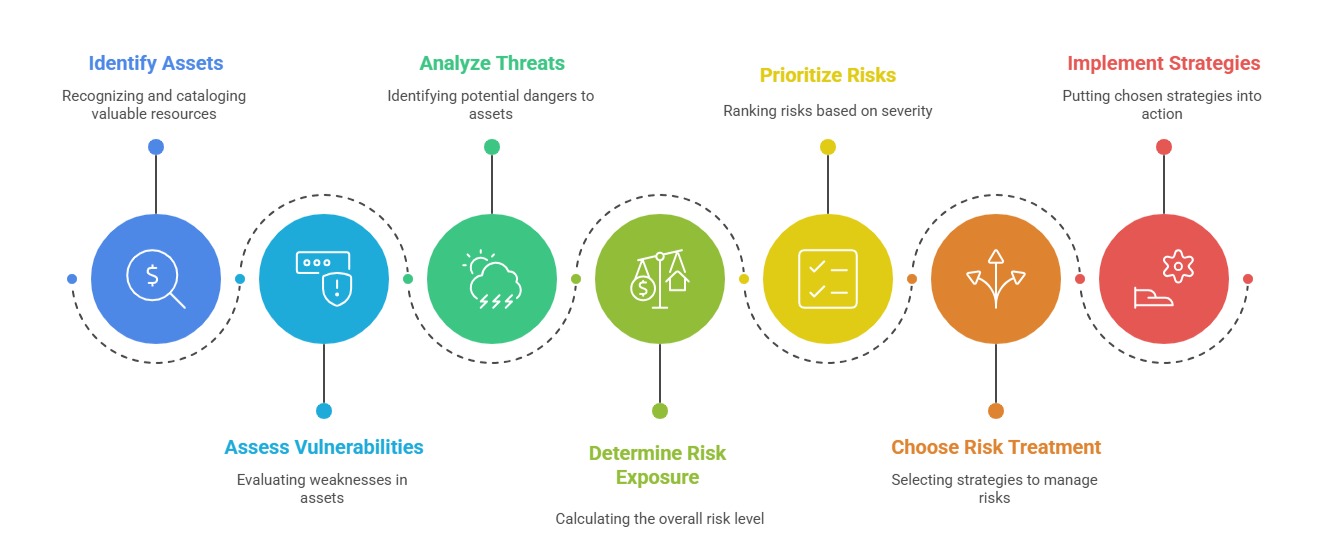
The planning phase focuses on proactively managing security risks to information assets through structured processes:
1. Risk Assessment: This involves identifying assets, their vulnerabilities, and potential threats. Next, the likelihood and impact of each risk scenario are analyzed to determine the organization's risk exposure. This systematic evaluation helps prioritize risks based on severity and business impact.
2. Risk Treatment Options: Once risks are assessed, the organization decides how to address each risk through one or more of the following strategies:
Risk avoidance: Eliminating the activities that generate risk.
Risk reduction: Implementing controls to minimize risk to acceptable levels.
Risk sharing or transfer: Outsourcing or insuring the risk.
Risk acceptance: Acknowledging and accepting the risk without additional controls when appropriate.
The organization records risk treatment plans specifying who is responsible, what controls will be applied (typically referencing Annex A controls), and timelines. The Statement of Applicability (SoA) documents selected controls and justifications.
The planning process must also include defining criteria for risk acceptance, regularly reviewing risks, and updating treatment decisions as conditions change.
Pros of Effective Policy and Risk Planning
Effective policy and risk planning strengthen organizational readiness and confidence in managing security threats. Here are the reasons why these activities are essential for ISMS success.
1. Provides clear direction and commitment to information security efforts.
2. Ensures threats are identified and managed, aligned with organizational priorities.
3. Enables transparent accountability and responsibility.
4. Supports compliance with legal and regulatory frameworks.
5. Facilitates continuous monitoring, review, and improvement of security posture.
6. Enhances stakeholder confidence and supports certification readiness.