The most successful DevOps teams share a defining characteristic that goes beyond the tools they use or the processes they follow, they never believe they are finished improving.
This is the essence of the continuous improvement mindset: a deliberate, ongoing commitment to making systems, processes, practices, and culture incrementally better over time.
What Continuous Improvement Means in DevOps
Continuous improvement is not simply wanting things to get better, it is a structured, intentional practice of identifying what is not working, understanding why, making targeted changes, and measuring whether those changes helped.
In a DevOps context, continuous improvement applies to every layer of the organization:
1. Technical Systems: Performance, reliability, and security of applications and infrastructure.
2. Delivery Processes: Speed, consistency, and safety of CI/CD pipelines and deployment workflows.
3. Team Practices: Communication, collaboration, knowledge sharing, and on-call processes.
4. Culture: Psychological safety, blameless responses to failure, and openness to feedback.
The key distinction between teams with a continuous improvement mindset and those without it is intentionality, improvement does not happen by accident.
It requires dedicated time, structured reflection, and the organizational commitment to act on what is learned.
The Foundation — Learning from Everything
A continuous improvement mindset treats every experience, particularly failures as a source of valuable learning rather than something to move past as quickly as possible.
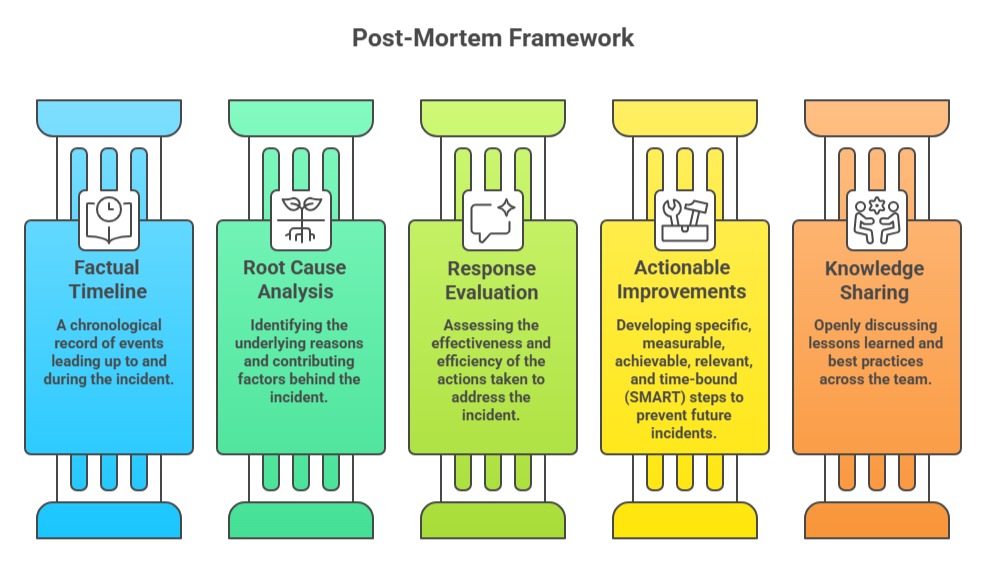
When an incident occurs, a blameless post-mortem is conducted to understand what happened, why it happened, and what can be changed to prevent recurrence.
The focus is entirely on systemic causes, process gaps, tooling limitations, unclear procedures not on individual blame. Action items from post-mortems are tracked, prioritized, and completed — not archived and forgotten.
Learning from successes: Improvement is not only reactive. Successful deployments, well-handled incidents, and effective process changes should also be reviewed — understanding what worked well so those practices can be deliberately repeated and reinforced.
Learning from everyday work: Friction in daily work- a slow pipeline, a confusing deployment process, a recurring manual task is an improvement signal. Teams with a continuous improvement mindset treat operational friction as a problem worth solving, not a reality to be accepted.
Key Practices That Drive Continuous Improvement
Retrospectives
The retrospective is the most direct expression of continuous improvement in Agile and DevOps teams.
Held at the end of each sprint or delivery cycle, retrospectives give the team structured time to reflect on what worked, what did not, and what to try differently.
A simple and effective retrospective format:
1. What went well? — Practices and decisions that should be continued.
2. What did not go well? — Problems and friction that need addressing.
3. What should we try next? — Specific experiments or changes for the next cycle.
The critical success factor for retrospectives is follow-through, action items must be tracked and completed, not simply listed and ignored.
Measuring and Tracking Improvement Metrics
Improvement that is not measured is not improvement, it is hope. Teams use specific metrics to objectively track whether their changes are making things better:
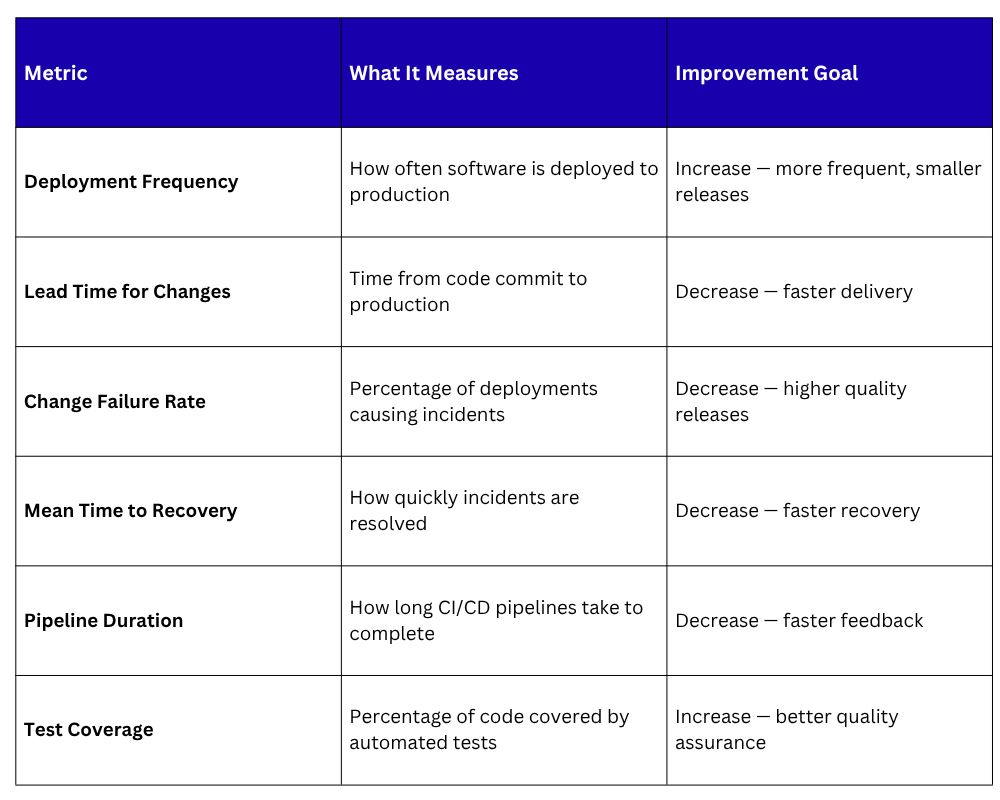
These metrics, particularly the first four, known as DORA metrics provide an objective, research-backed view of delivery performance that guides improvement efforts.
Kaizen — Small, Frequent Improvements
Rather than waiting for a major overhaul, continuous improvement favors small, frequent, low-risk changes that accumulate into significant progress over time.
Reserving a portion of every sprint for improvement work, reducing technical debt, automating a manual process, improving a runbook ensures improvement is treated as ongoing work rather than a special project.
Experimentation and A/B Testing
A continuous improvement mindset embraces experimentation, trying new approaches, measuring the results, and adopting what works. Feature flags enable controlled experiments in production.
A/B testing compares different implementations. Deployment strategies like canary releases allow new versions to be validated with a subset of users before full rollout.
Feedback Loops — Fast and Continuous
Improvement requires feedback, and feedback must be fast to be actionable. DevOps practices create multiple feedback loops that fuel continuous improvement:
1. CI pipeline results tell developers within minutes whether their code works.
2. Monitoring and alerting tell operations teams immediately when systems degrade.
3. Sprint reviews and retrospectives provide structured team-level feedback.
4. Customer analytics reveal how users actually interact with the product.
The shorter and more reliable these feedback loops are, the faster a team can learn and improve.
Psychological Safety — The Cultural Prerequisite
Continuous improvement cannot happen without psychological safety, the confidence that team members can raise problems, suggest changes, admit mistakes, and challenge the status quo without fear of negative consequences.
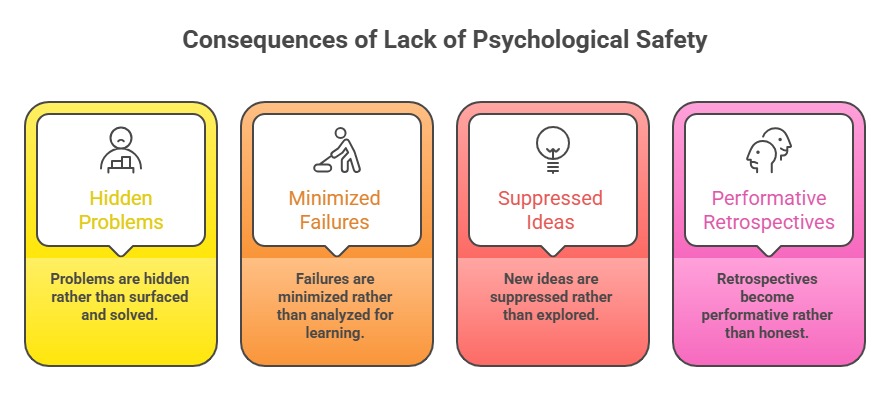
With psychological safety:
1. Engineers proactively flag risks and raise concerns early
2. Incidents are reported openly and analyzed without blame
3. Experimentation is encouraged, failure in a learning context is acceptable
4. Retrospectives produce genuine, actionable insights
Building psychological safety is a leadership responsibility, it is demonstrated through how leaders respond to mistakes, how feedback is received, and whether improvement suggestions are acted upon or ignored.
Continuous Improvement Across the DevOps Lifecycle
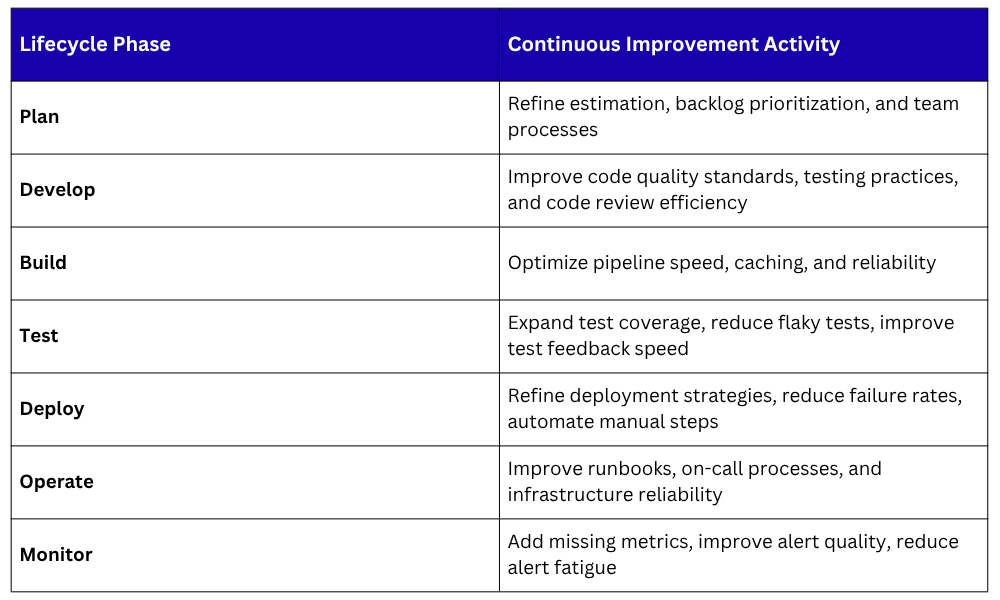
Continuous improvement touches every phase of the DevOps lifecycle, it is woven throughout, not concentrated in a single moment:
The Compound Effect of Continuous Improvement
The power of continuous improvement is not in any single change, it is in the compounding effect of many small improvements made consistently over time.
A team that improves their deployment pipeline by just 10% each month will have dramatically transformed their delivery capability within a year.
A team that reduces their incident response time by five minutes each quarter will eventually resolve incidents before most users even notice.
A team that adds ten meaningful tests to their suite every sprint will eventually have a comprehensive safety net that enables confident, fearless releases.

Class Sessions
Sales Campaign

We have a sales campaign on our promoted courses and products. You can purchase 1 products at a discounted price up to 15% discount.