Two of the most influential movements in modern software development are Agile and DevOps.
Both emerged as responses to the same fundamental problem, traditional software development was too slow, too rigid, and too disconnected from real user needs and operational reality.
While they share common values and naturally complement each other, Agile and DevOps are distinct in their focus, scope, and practices.
What is Agile?
Agile is a software development philosophy and set of practices that emphasizes iterative development, collaboration, flexibility, and continuous delivery of working software.
It emerged as a direct response to heavyweight, document-driven methodologies like Waterfall, where requirements were fixed upfront, development took months or years, and feedback came only at the very end.
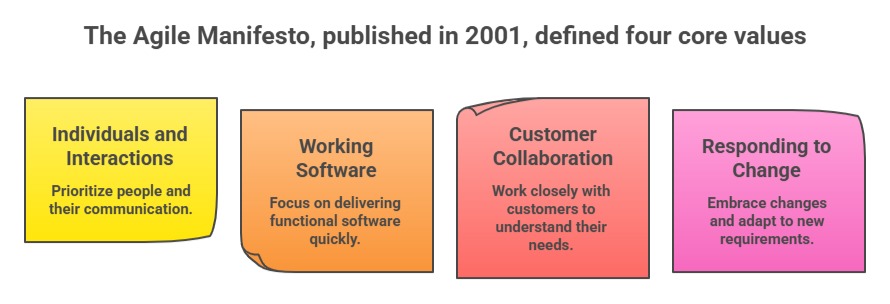
Agile is implemented through frameworks such as Scrum, which organizes work into short iterations called sprints and Kanban — which visualizes and manages continuous workflow.
Both frameworks emphasize small, cross-functional teams delivering working software in short cycles with frequent feedback.
What Agile primarily focuses on:
1. The development team's workflow and process.
2. Planning, prioritizing, and delivering features iteratively.
3. Collaboration between developers and business stakeholders.
4. Responding to changing requirements quickly.
What DevOps Adds
While Agile transformed how software is built, it left a significant gap, it did not fundamentally change how software is deployed, operated, and maintained.
A team could be highly Agile, delivering working code at the end of every two-week sprint and still take weeks to actually get that code into production due to slow, manual deployment processes and poor collaboration with operations teams.
DevOps fills this gap. It extends the Agile philosophy beyond the development team to include operations, infrastructure, security, and the entire delivery pipeline, from code commit all the way to production monitoring.
Where Agile asks: How do we build the right software iteratively and collaboratively?
DevOps asks: How do we deliver that software to users reliably, quickly, and continuously?
How Agile and DevOps Complement Each Other
Agile and DevOps share a common foundation of values, iterative delivery, collaboration, feedback, and continuous improvement. This alignment means they naturally reinforce each other:
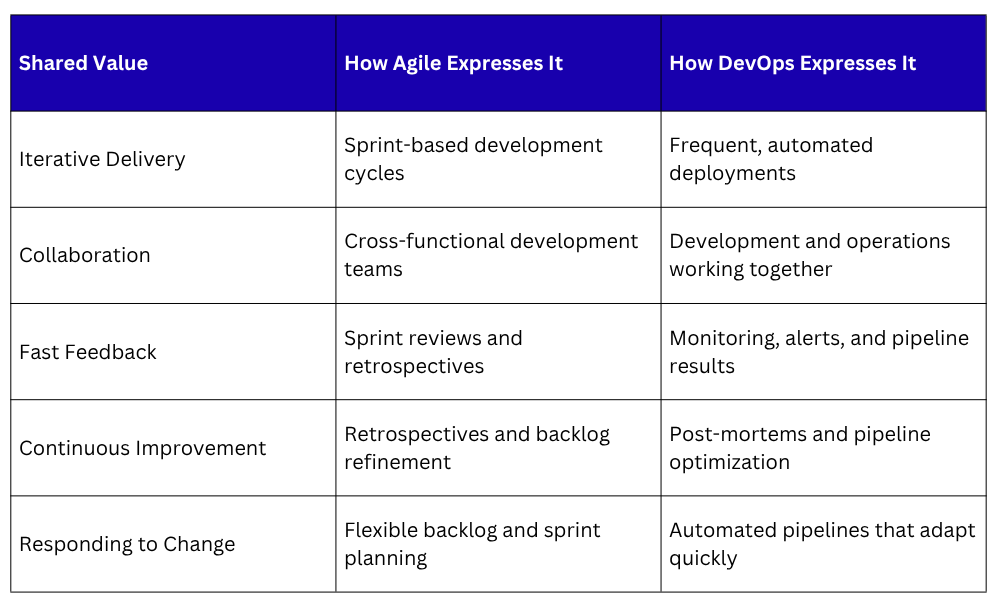
When Agile and DevOps operate together, the result is a complete delivery system, development teams build and refine software rapidly through Agile practices, and DevOps practices ensure that software reaches users continuously, reliably, and safely.
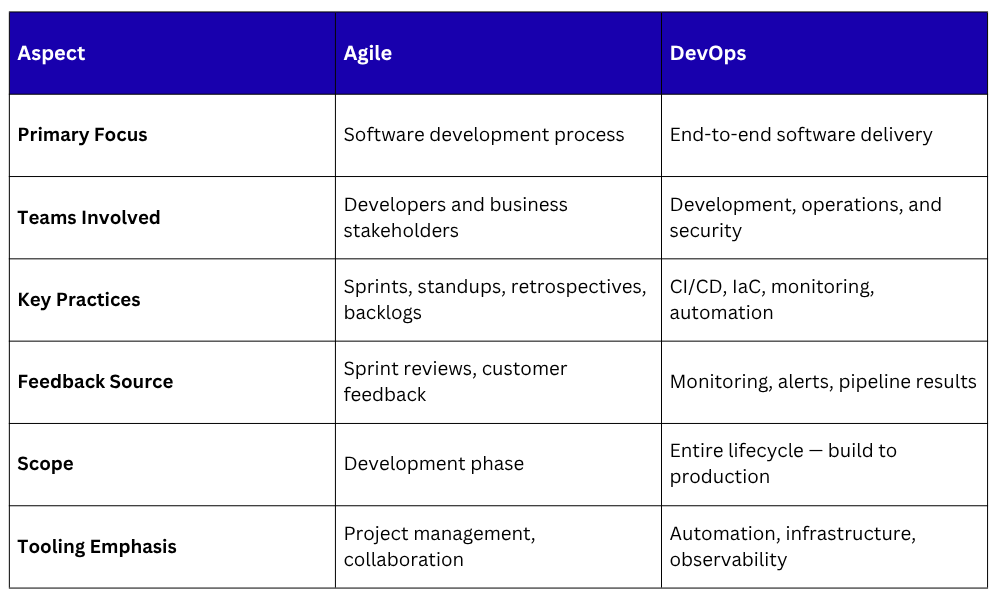
Key Differences Between Agile and DevOps
Despite their complementary nature, Agile and DevOps have distinct areas of focus and involve different teams and practices.
Agile Ceremonies in a DevOps Context
Agile ceremonies, the regular structured meetings that keep development teams aligned take on additional significance in a DevOps context, because they become opportunities to incorporate operational and delivery concerns alongside feature development.
1. Sprint Planning
In a DevOps-aligned team, sprint planning includes not just feature work but also infrastructure improvements, pipeline maintenance, monitoring enhancements, and technical debt. Operational concerns are treated as first-class work items alongside new features.
2. Daily Standup
The daily standup becomes a whole-team event that includes operations engineers. Discussions include not just "what am I coding today?" but also "are there any deployment issues, infrastructure concerns, or pipeline failures that need attention?"
3. Sprint Review
In addition to demonstrating new features, the team reviews deployment metrics, system reliability data, and pipeline performance — treating operational outcomes as part of the definition of a successful sprint.
4. Retrospective
Retrospectives address the full delivery lifecycle, not just development practices but also deployment processes, incident response, monitoring gaps, and any friction between development and operations teams.
The Combined Agile-DevOps Delivery Flow
When Agile and DevOps work together effectively, the complete delivery flow looks like this:
Plan (Agile)
│
▼
Develop (Agile sprints + DevOps version control)
│
▼
Build and Test (DevOps CI pipeline)
│
▼
Release and Deploy (DevOps CD pipeline)
│
▼
Monitor and Observe (DevOps observability)
│
▼
Feedback into next sprint (Agile retrospective + planning)
│
└──────────── (continuous loop) ────────────┘
The Agile sprint cadence drives the development rhythm, what gets built and when. DevOps automation ensures that what gets built is continuously tested, integrated, and delivered without manual bottlenecks.
Monitoring feeds real-world data back into the next planning cycle, completing the feedback loop.
Common Misconceptions
1. DevOps replaces Agile: DevOps does not replace Agile, it extends it. Agile remains the foundation for how development teams plan, prioritize, and build software. DevOps adds the operational and automation layer that Agile alone does not address.
2. Agile teams do not need DevOps: An Agile team that delivers working code every sprint but deploys to production once a month is not truly delivering value continuously. DevOps provides the automated delivery infrastructure that makes Agile's iterative promise fully realizable.
3. DevOps is just Agile for operations: DevOps is broader than this, it is a cultural and technical movement that spans development, operations, security, and the entire delivery pipeline, drawing inspiration from Agile but extending well beyond it.