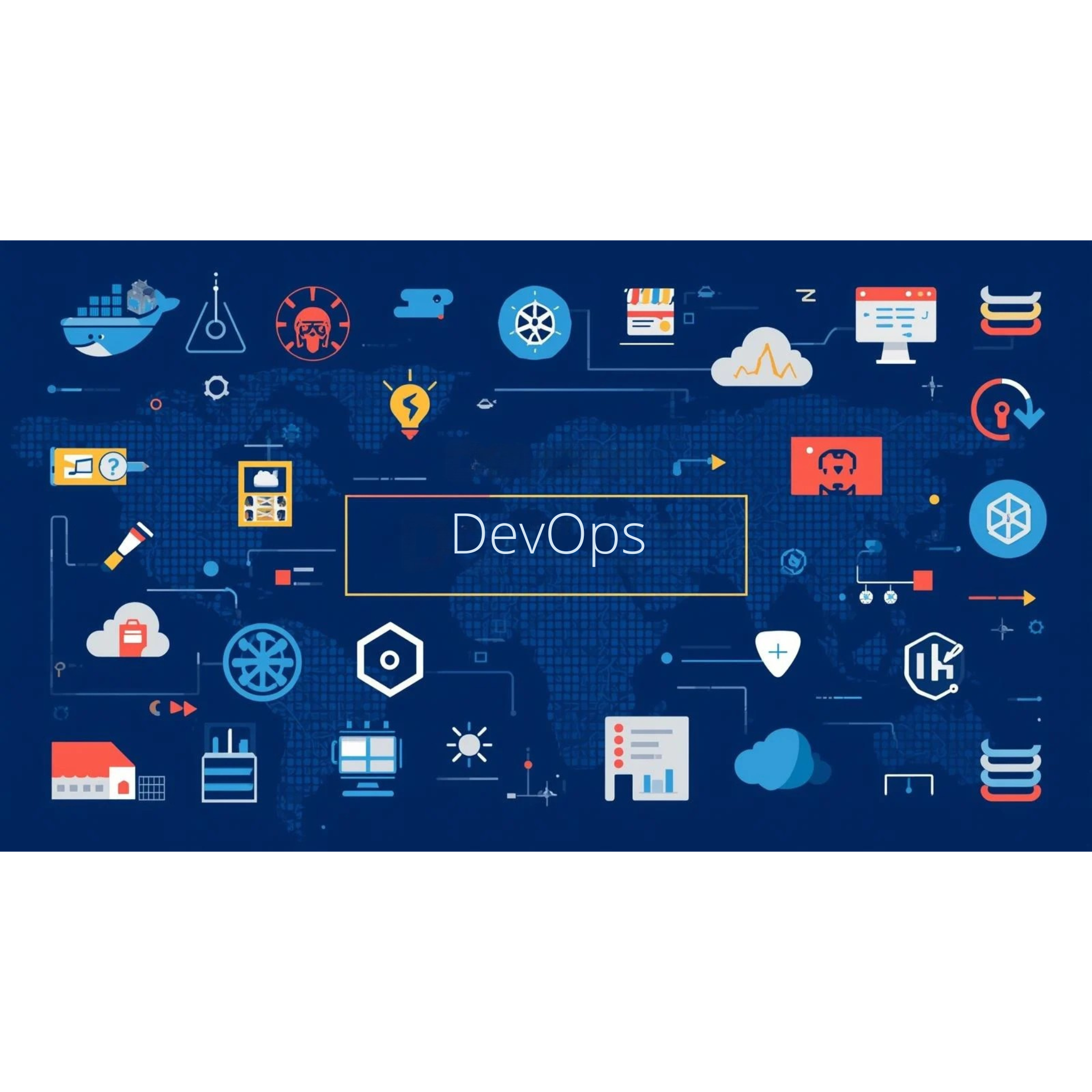
DevOps Foundations Course Online | Learn DevOps Basics
in DevOps FundamentalsWhat you will learn?
Understand DevOps principles and lifecycle.
Use Git for basic version control.
Explain and apply basic CI/CD workflows.
Understand Infrastructure as Code concepts.
Work with containers using Docker.
Describe basic Kubernetes concepts.
Understand monitoring and logging fundamentals.
Apply DevOps culture and best practices.
About this course
Did you know that 90% of tech organisations already use DevOps practices ,yet thousands of roles stay unfilled because there aren't enough qualified people?
If you've been eyeing a move into DevOps but feel overwhelmed by the tools, the terminology, and the sheer number of learning paths, you're not alone.
A structured DevOps Foundations Course can cut through that noise fast.
This blog walks you through exactly who this course suits, the career doors it opens, realistic salary expectations across the USA, UK, and India, and hard market data that shows why DevOps skills are one of the safest career bets you can make right now.
Who is This DevOps Foundations Course For and What Will You Gain From It?
Maybe you've already spotted yourself in one of these groups. If so, this DevOps foundations course was designed with you in mind.
This course is built for:
1. Complete beginners who want a clear, jargon-free introduction to DevOps fundamentals — no prior experience required.
2. IT professionals (sysadmins, support engineers, network admins) ready to transition into DevOps-focused roles.
3. Developers who ship code but want to understand the full DevOps software delivery pipeline, from commit to production.
4. Students and early-career engineers preparing for cloud engineering or DevOps beginner course certifications.
5. Professionals targeting entry-level certifications like the DevOps Foundation credential from DASA or DevOps Institute.
What You Will Gain:
A DevOps Foundations Course doesn't just hand you theory. It gives you foundational DevOps skills you can apply the very next week at work or in your next job interview.
You'll understand DevOps core concepts: why teams adopt continuous integration, how continuous delivery shortens release cycles, and what CI/CD basics look like in practice.
You'll get a DevOps tools overview covering platforms like Git, Jenkins, Docker, Kubernetes, and Terraform. And you'll grasp the cultural side — DevOps culture and collaboration isn't a buzzword; it's the reason this methodology actually works.
Honestly, the biggest thing people gain isn't a specific tool skill. It's confidence. Once you understand how all the pieces connect, the rest of the learning becomes ten times easier.
You stop feeling like you're drowning in acronyms and start seeing a clear path forward. That shift in mindset from confused to capable — is worth more than any single certification line on a résumé.
What Career Opportunities Does a DevOps Foundations Course Open Up?
Taking a DevOps foundations course can help you get a job in one of the many fields that are growing quickly. Here's what the landscape looks like:
| Job Role | What You Will Do | Average Salary (2026) |
| DevOps Engineer | Automate deployments, manage CI/CD pipelines, bridge dev and ops teams | $144,000/yr |
| Site Reliability Engineer (SRE) | Ensure system uptime, define SLOs, automate incident response | $170,855/yr |
| Cloud DevOps Engineer | Design and manage cloud infrastructure on AWS, Azure, or GCP | $156,500/yr |
| Release Manager | Coordinate software releases, manage deployment schedules | $124,000/yr |
| Platform Engineer | Build internal developer tools and infrastructure templates | $150,000–$200,000/yr |
Notice that the highest-paying role — SRE — tops $170,000 on average. That's not a ceiling either; senior SREs at large firms regularly clear $250,000+ with bonuses and equity.
The U.S. Bureau of Labor Statistics (BLS) projects that from 2024 to 2034, jobs for software developers and related fields will grow by 15%, which is much faster than average for all jobs (BLS, 2025).
LinkedIn data shows that DevOps job postings grew by 38% year-on-year. Companies aren't just hiring, they're competing for talent. That competition works in your favour as someone building DevOps practices and tools into your skillset.
How Much Can You Earn After Completing a DevOps Foundations Course?
Money matters. Let's lay out the salary data by experience level and geography so you can set realistic expectations. Remember: the cost of a DevOps training online programme is a fraction of what even your first salary bump delivers.
| Experience Level | USA Average Salary | UK Average Salary | India Average Salary |
| Entry-Level (0–1 years) | $118,271 | £30,410 | ₹4,52,793 |
| Average (all levels) | $114,661-$174,000 | £52,196 | ₹9,96,275 |
| Senior-Level | $179,000 | £65,000–£140,000 | ₹12,00,000–₹30,00,000 |
An entry-level DevOps engineer in the USA earns over $118,000 in their first year. Most DevOps courses cost between $200 and $2,000. That's a return on investment you'd struggle to find anywhere else in professional education.
Even in India and the UK, the trajectory is steep. A mid-career professional in India can triple their starting salary within five years.
DevOps for IT professionals already working in adjacent roles is one of the fastest paths to a significant pay increase, without needing to start over in a completely new field.
Why is the DevOps Foundations Course Skill in High Demand?
The numbers below tell a clear story: DevOps isn't a trend. It's infrastructure.
| Market Indicator | Data (2026) | What It Means for You |
| Global DevOps market size | $19.57 billion (2026), projected to reach $51.43 billion by 2031 | The industry is expanding at 21% CAGR — Mordor Intelligence, 2026 |
| Job growth rate (related roles) | 15% growth projected, 2024–2034 | Far above the national average — U.S. Bureau of Labor Statistics, 2025 |
| DevOps job postings growth | 38% year-on-year increase | Employers are actively expanding DevOps teams — LinkedIn, 2025 |
| Enterprise adoption rate | 70% of enterprises plan to deploy Infrastructure-as-Code by end of 2025 | Automation skills directly match what employers need — Mordor Intelligence, 2025 |
| Fastest-growing sector | Healthcare & life sciences (28.1% CAGR through 2031) | Your skills transfer across industries — Mordor Intelligence, 2026 |
| Asia-Pacific DevOps growth | 25.4% CAGR through 2031 | India-based professionals face especially strong demand — Mordor Intelligence, 2026 |
Three forces drive this demand:
1. Cloud migration still has years of runway. A huge percentage of enterprise workloads remain on-premises, and every migration project needs people who understand DevOps continuous integration and delivery pipelines.
2. Organisations that adopted DevOps report 200% higher deployment frequency and 50% faster time-to-market (Continuous Delivery Foundation, 2025). Executives see those results and invest further.
3. The talent shortage is real and that scarcity pushes salaries upward. Mordor Intelligence identifies the "shortage of skilled DevOps engineers" as one of the top market restraints. Companies want to hire, and they can't find enough qualified people.
For someone taking a DevOps for beginners course today, this is genuinely exciting timing. You're building skills during a supply shortage, which means employers meet you more than halfway.
Final Thoughts
The DevOps field in 2026 has something that is hard to find: high pay, a growing need across many industries, and a way to get in without having to have ten years of experience.
A good DevOps Foundations Course will teach you the language, the tools, and the culture you need to start making a difference right away, whether you're switching from a sysadmin job, just out of college, or ready for something new.
If this sounds like the right path for you, look into a reputable online DevOps training program that covers the basics of CI/CD, lets you practice with tools, and shows you how to use them in the real world.
Tags
DevOps Foundations Course
DevOps Practices and Tools
DevOps Fundamentals
Introduction to DevOps
DevOps Beginner Course
DevOps Training Online
DevOps Tools Overview
CI/CD Basics
DevOps for Beginners
DevOps Culture and Collaboration
DevOps Software Delivery
DevOps for IT Professionals
DevOps Core Concepts
DevOps Continuous Integration
DevOps Continuous Delivery
Foundational DevOps Skills
Related Courses

Comments (0)
DevOps is a cultural and technical movement that unites software development and IT operations teams with the goal of delivering high-quality software faster and more reliably. It is built on the principles of collaboration, automation, continuous feedback, and shared responsibility — making it an essential practice for any modern technology organization.
The DevOps lifecycle is a continuous, eight-phase loop — spanning Plan, Develop, Build, Test, Release, Deploy, Operate, and Monitor — that enables development and operations teams to deliver software rapidly, reliably, and with constant improvement. It replaces the outdated linear approach with an always-on cycle of collaboration, automation, and feedback that keeps software and teams moving forward at all times.
Collaboration, automation, and continuous feedback are the three foundational principles that give DevOps its power — collaboration breaks down silos and builds shared ownership, automation drives speed, consistency, and reliability across the delivery pipeline, and continuous feedback ensures that teams are always learning, improving, and responding to real-world insights at every stage of the software lifecycle.
DevOps delivers far-reaching benefits that go well beyond faster software releases — it transforms team culture, improves product quality, reduces costs, strengthens security, and ultimately creates a better experience for customers, making it one of the most impactful practices any technology organization can adopt.
Version control is the foundational practice of tracking, managing, and collaborating on changes to files over time, and in DevOps, it serves as the critical starting point from which all automation, collaboration, and delivery pipelines flow, making it an absolutely non-negotiable skill for every developer, operations engineer, and DevOps practitioner.
The Git workflow of committing, branching, and merging provides developers and DevOps teams with a powerful, structured way to track changes, develop features in parallel, and integrate work safely — forming the essential daily practice that keeps codebases organized, teams collaborative, and software delivery reliable and continuous.
Working with remote repositories is the foundation of collaborative software development in Git — enabling teams to share code, stay synchronized, and integrate their work through structured workflows involving cloning, pushing, pulling, and branch management, all of which connect seamlessly to the automated pipelines that power modern DevOps delivery.
GitHub and GitLab are powerful web-based platforms built on top of Git that transform individual version control into a rich, collaborative, and automated development environment — offering essential features like pull requests, code review, issue tracking, and built-in CI/CD pipelines that sit at the very heart of modern DevOps workflows and team-based software delivery.
CI/CD — Continuous Integration, Continuous Delivery, and Continuous Deployment — is the foundational DevOps practice that automates the entire journey of code from a developer's commit to production, delivering faster releases, higher quality, reduced risk, and greater business agility through a carefully orchestrated pipeline of builds, tests, and deployments that runs automatically with every code change.
Build and test automation are the operational core of every CI/CD pipeline — automating the transformation of source code into deployable artifacts and validating software quality through layered, automated tests at every stage, enabling teams to deliver software that is faster, more reliable, and consistently higher in quality than any manual process could achieve.
A basic CI/CD pipeline is a version-controlled, automated sequence of stages — source, build, test, staging deployment, and production deployment — that carries every code change through a consistent set of quality gates, ensuring that only verified, tested, and approved software reaches production while giving teams immediate visibility, fast feedback, and the confidence to release frequently and reliably.
Jenkins and GitHub Actions are two of the most important CI/CD tools in the DevOps ecosystem — Jenkins offering unmatched flexibility, a vast plugin ecosystem, and full infrastructure control as a self-hosted automation server, while GitHub Actions provides a modern, cloud-native, zero-setup alternative deeply integrated into GitHub — and together they represent the two dominant approaches to implementing automated build, test, and deployment pipelines in real-world software delivery.
Infrastructure as Code is the transformative DevOps practice of defining, provisioning, and managing all infrastructure through version-controlled configuration files rather than manual processes — delivering speed, consistency, repeatability, and auditability to infrastructure management while connecting seamlessly with CI/CD pipelines, configuration management tools, and all other modern DevOps practices.
The declarative approach defines the desired end state of infrastructure and lets the tool determine how to achieve it — offering simplicity, idempotency, and maintainability — while the imperative approach provides explicit step-by-step control over every action, offering flexibility and precision for complex or one-time tasks, and most mature DevOps teams use both approaches strategically depending on the nature of the work at hand.
Terraform is the industry-leading, cloud-agnostic Infrastructure as Code tool that enables engineers to define, provision, and manage infrastructure declaratively using HCL configuration files — following a simple write, plan, and apply workflow built around core concepts of providers, resources, variables, outputs, state, and modules that together make infrastructure management consistent, repeatable, and fully automated across any cloud platform.
Managing infrastructure through code means applying software engineering discipline — version control, peer review, automated pipelines, and consistent practices — to every infrastructure change across its full lifecycle, ensuring that environments remain consistent, changes are auditable, drift is prevented, and infrastructure scales reliably alongside the applications it supports.
Configuration management is the DevOps practice of defining system configurations as code and using automated tools to apply, enforce, and maintain those configurations consistently across all environments — eliminating manual effort, preventing drift, ensuring consistency at scale, and forming the essential bridge between infrastructure provisioning and application deployment.
Ansible is an agentless, YAML-driven tool for configuration management, using inventories, modules, and playbooks to enforce idempotent automation over SSH. It simplifies setup and scales effortlessly, making it ideal for DevOps teams focused on speed and simplicity.
Automation eliminates manual effort by executing configuration tasks consistently through code, while idempotency guarantees that those tasks are always safe to re-run — producing the same predictable result regardless of how many times they execute — and together these principles make Ansible-based configuration management reliable, scalable, and trustworthy across any DevOps environment.
Managing system configurations with Ansible uses modules for packages, files, users, and services to enforce desired states idempotently across hosts. Roles, templates, and Vault enable scalable, secure automation integrated into DevOps pipelines.
Virtual machines provide strong isolation by running a full operating system per instance through a hypervisor, making them ideal for legacy applications and security-sensitive workloads, while containers offer lightweight, fast, and highly portable application packaging by sharing the host OS kernel — and in modern DevOps environments, both technologies are frequently used together, each serving a distinct and complementary role in the infrastructure stack.
Docker images are portable, layered, read-only templates that package applications with all their dependencies, while containers are the live, isolated running instances created from those images — and together they form the foundation of modern containerized application delivery, enabling consistent, fast, and reproducible deployments across any environment.
A Dockerfile is a version-controlled text file containing layered instructions that define exactly how a Docker image is built — from the base image and dependency installation through to the application code and startup command — and writing a well-structured, efficient Dockerfile is the foundational skill that enables consistent, portable, and production-ready containerized application delivery.
Running and managing Docker containers effectively requires mastering a practical set of commands and concepts — from starting containers with the right configuration flags, inspecting logs and resource usage, persisting data with volumes, and controlling container state, to maintaining a clean Docker environment — all of which are essential operational skills for anyone working with containerized applications in a professional DevOps setting.
Container orchestration exists because manually managing containerized applications at scale — across multiple servers, with dynamic traffic, frequent deployments, and zero tolerance for downtime — is simply not feasible, and platforms like Kubernetes solve this by automating scheduling, self-healing, scaling, load balancing, and deployment coordination across entire clusters of machines.
Kubernetes is the industry-standard open-source container orchestration platform that automates the deployment, scaling, self-healing, and management of containerized applications across clusters of machines — using a desired state model, a rich set of core objects, and deep integration with the broader DevOps toolchain to make running production-grade containerized applications reliable, scalable, and manageable at any scale.
Pods, Deployments, and Services are the three foundational Kubernetes objects that work together to run containerized applications reliably — Pods provide the container runtime environment, Deployments manage replica count, self-healing, and rolling updates, and Services provide the stable network endpoint that makes Pods consistently accessible regardless of their ephemeral nature.
Monitoring is the essential DevOps practice of continuously collecting and analyzing data from applications and infrastructure to detect problems early, validate deployments, measure reliability against SLOs, and provide the visibility teams need to operate complex systems confidently — and without it, production environments become unpredictable, incidents go undetected, and the ability to continuously improve is severely undermined.
Metrics provide numerical, time-series measurements of system behavior that enable trend detection, alerting, and capacity planning, while logs provide detailed event-level records that explain what happened and why — and together, guided by frameworks like the Four Golden Signals, they form the foundational data layer of any effective DevOps monitoring and observability strategy.
Prometheus and Grafana form the most widely adopted open-source monitoring stack in the DevOps ecosystem — Prometheus continuously scraping and storing time-series metrics from applications and infrastructure using its pull model and PromQL query language, while Grafana transforms that data into rich, interactive dashboards and alerts — together providing comprehensive, reliable, and visually accessible observability for any environment from a single server to a large-scale Kubernetes cluster.
Alerts and observability complete the monitoring picture — alerts ensure teams are automatically notified when systems need attention, while observability, built on the three pillars of metrics, logs, and traces — provides the comprehensive, deep visibility needed to understand, diagnose, and continuously improve complex production systems in any DevOps environment.
Collaboration and shared responsibility are the cultural cornerstones of DevOps — breaking down silos between development, operations, and security teams, establishing collective ownership of quality and reliability across the entire delivery lifecycle, and building the trust and transparency through blameless culture that enables teams to learn from failures and continuously improve together.
Agile and DevOps are complementary methodologies that together form a complete software delivery system — Agile providing the iterative, collaborative development framework that ensures the right software is built, and DevOps providing the automation, culture, and operational practices that ensure that software is delivered to users reliably, continuously, and at speed.
DevSecOps integrates security into every phase of the DevOps lifecycle — shifting it left from a final checkpoint to a continuous, automated, shared practice — using tools like SAST, DAST, dependency scanning, and secrets management embedded directly in CI/CD pipelines, enabling teams to deliver software both rapidly and securely without treating speed and security as competing priorities.
The continuous improvement mindset is the cultural and operational commitment to making systems, processes, and practices incrementally better through structured reflection, data-driven measurement, blameless learning from failures, and consistent experimentation, and it is the defining characteristic that enables DevOps teams to compound their capabilities over time, delivering software faster, more reliably, and with greater confidence with every passing cycle.


