Technology alone does not make DevOps work. The tools, pipelines, and automation that define DevOps are only as effective as the people and culture behind them.
At the heart of DevOps culture are two deeply connected principles: collaboration and shared responsibility.
Collaboration means that development, operations, security, and quality assurance teams work together continuously — not in isolated silos that hand work over a wall.
Shared responsibility means that everyone involved in building and delivering software also owns its quality, reliability, and security, not just the team whose name is on the ticket.
These principles fundamentally change how teams communicate, make decisions, and respond when things go wrong. Without them, even the most sophisticated DevOps toolchain will fail to deliver its promise.
The Problem These Principles Solve
In traditional IT environments, teams were structured around specialization and separation. Developers wrote code. Operations deployed and maintained it.
Security reviewed it at the end. QA tested it before release. Each team had its own goals, metrics, and incentives, and very little visibility into what the others were doing.
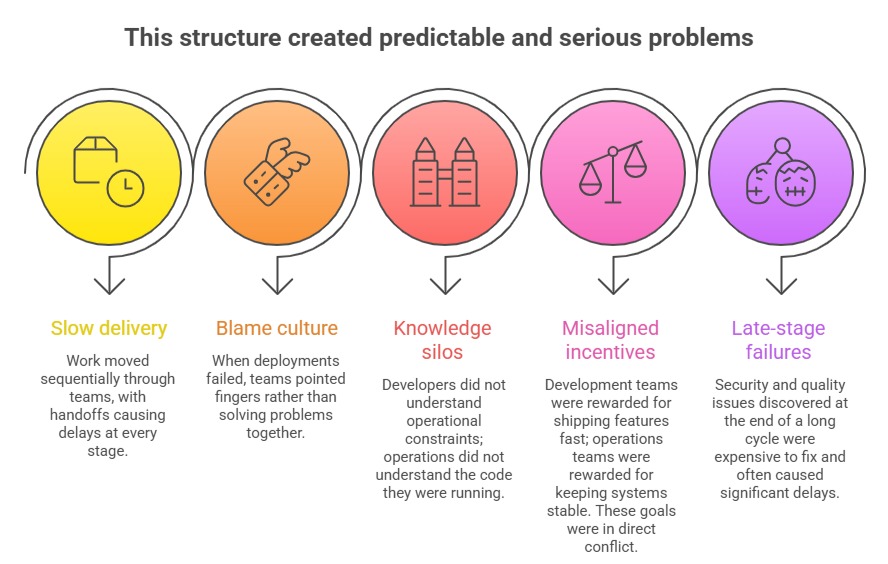
Collaboration and shared responsibility directly dismantle each of these problems.
What Collaboration Means in DevOps
In a DevOps culture, collaboration is not a one-time meeting or an occasional check-in, it is a continuous, structured way of working that spans the entire software delivery lifecycle.
Collaboration in practice looks like:
1. Development and operations engineers planning together from the very beginning of a feature — discussing deployment requirements, operational constraints, and infrastructure needs before a single line of code is written.
2. Cross-functional teams where developers, operations engineers, security professionals, and QA work side by side — rather than in separate departments toward shared goals.
3. Joint on-call responsibilities — Developers share responsibility for the operational health of the software they write, participating in on-call rotations alongside operations engineers.
4. Open communication channels — Teams use shared Slack channels, project boards, and documentation platforms so everyone has visibility into what is being built, deployed, and changed.
5. Code reviews as a collaboration tool — Pull requests are not just quality gates; they are structured conversations where knowledge is shared, context is built, and standards are maintained collectively.
What Shared Responsibility Means in DevOps
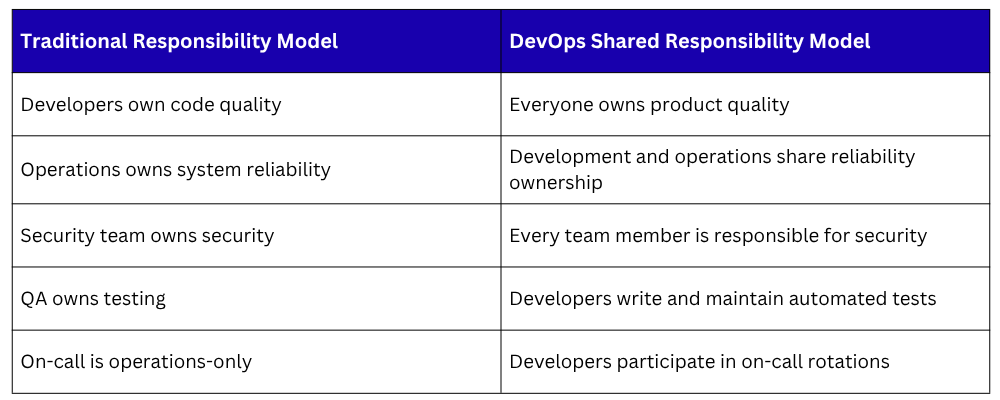
Shared responsibility is the principle that all team members are accountable for the full outcome, not just for their individual contribution. A developer is not done when code is merged; they share responsibility for how it behaves in production.
An operations engineer is not solely responsible for uptime; developers share that responsibility through the quality of the code they write.
This shift has profound implications:
1. Quality is everyone's concern: Developers write tests, monitor deployments, and respond to production issues. Quality is not delegated to a separate QA team.
2. Security is built in: Security is the responsibility of every team member — not a gate managed by a separate security team at the end of the pipeline. This is the foundation of DevSecOps.
3. Operational excellence is shared: Infrastructure health, deployment reliability, and system performance are owned collectively by the entire team.
Blameless Culture
One of the most important expressions of shared responsibility is blameless culture.
In a blameless culture, when something goes wrong, a deployment fails, a service goes down, an incident occurs — the team's response is focused entirely on understanding what happened and how to prevent it, not on identifying who is at fault.
This matters for several deeply practical reasons:
1. When people fear blame, they hide mistakes, avoid taking risks, and resist transparency — all of which make systems less safe and teams less effective.
2. Most failures in complex systems are the result of systemic issues, inadequate tooling, unclear processes, insufficient testing, or accumulated technical debt — not individual incompetence or negligence.
3. Blameless post-mortems that honestly document what happened, what contributed to the failure, and what will be done differently produce lasting improvements that protect against recurrence.
A blameless post-mortem typically includes:
1. A timeline of events leading to and during the incident.
2. The root cause and contributing factors, focusing on systems and processes, not people.
3. What went well in the response.
4. Action items to prevent recurrence, with clear owners and timelines.
5. Lessons shared openly with the entire team.
Tools That Enable Collaboration and Shared Responsibility
Collaboration is supported and reinforced by the right tooling. DevOps teams rely on a shared set of platforms that give everyone visibility, context, and communication:
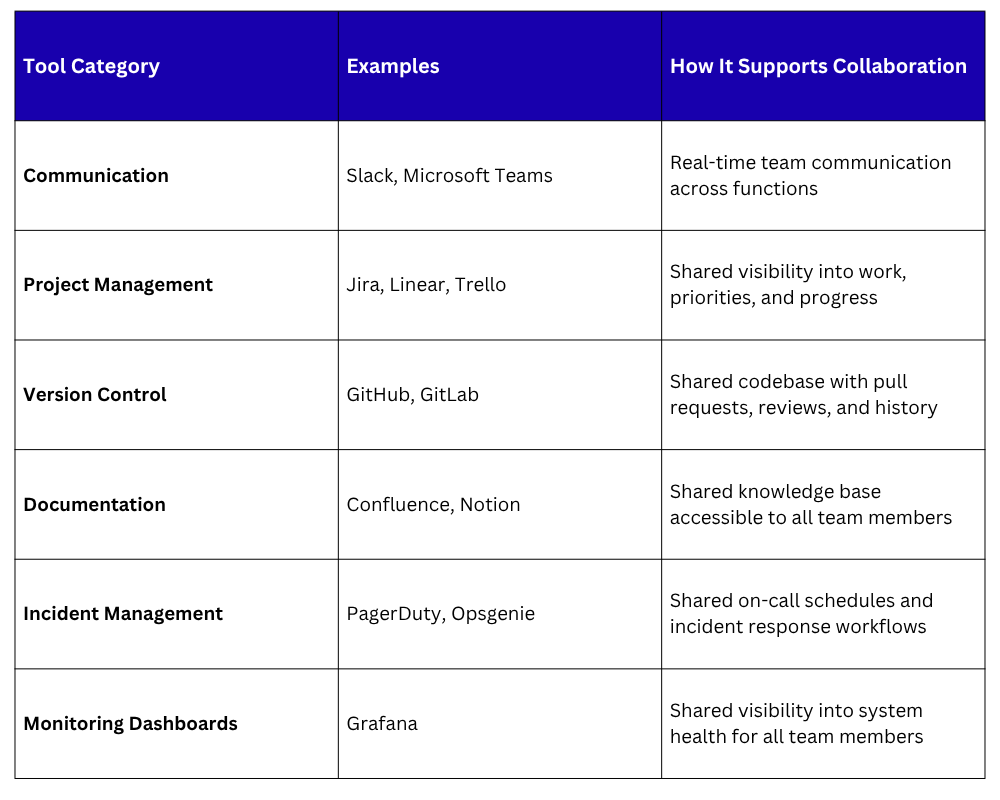
The key word across all of these is shared, every tool listed above is most valuable when it is used by the entire team, not just one function.
Collaboration and Shared Responsibility in the DevOps Lifecycle
These are not abstract values, they manifest in concrete practices throughout the DevOps lifecycle:
1. Planning: Developers, operations, and security participate together in sprint planning. Operational requirements — monitoring, scaling, security are defined as part of the feature specification, not added later.
2. Development: Developers write code with operational awareness, including logging, error handling, health endpoints, and automated tests. Code reviews involve cross-functional feedback.
3. CI/CD Pipelines: Pipelines are owned and maintained by the whole team. Security scans, performance tests, and deployment scripts are collective responsibilities, not owned by a single person or team.
4. Incident Response: When an alert fires, the response is a team effort. Developers and operations engineers diagnose together. Communication is transparent — stakeholders are kept informed through shared channels.
5. Post-Incident Review: The entire team participates in reviewing what happened. Action items are shared and prioritized collectively. Learnings are documented and made accessible to everyone.
Measuring Collaboration and Shared Responsibility
The effectiveness of collaboration and shared responsibility can be measured through both cultural indicators and technical metrics:
Cultural Indicators
1. Post-mortems are conducted blamlessly and action items are completed.
2. On-call rotations include both developers and operations engineers.
3. Security and quality discussions happen in planning, not just at release time.
4. Team members proactively communicate blockers and share knowledge.
Technical Metrics (DORA Metrics)
The DORA (DevOps Research and Assessment) metrics provide research-backed measures of DevOps performance that reflect the effectiveness of collaboration:
.png)
High-performing teams, those with strong collaboration and shared responsibility — consistently demonstrate higher deployment frequency, shorter lead times, lower failure rates, and faster recovery.

Class Sessions
Sales Campaign

We have a sales campaign on our promoted courses and products. You can purchase 1 products at a discounted price up to 15% discount.