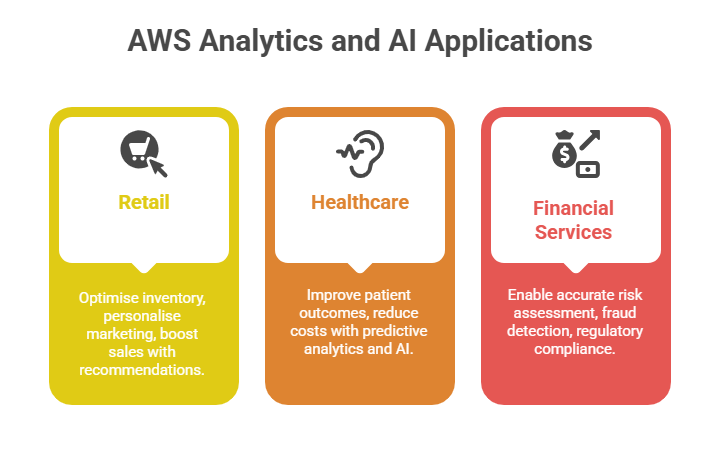
Advanced analytics and artificial intelligence (AI) services are transforming the way businesses gather insights and make decisions.
On AWS, organizations can leverage scalable, integrated tools to collect, store, analyze, and visualize data from across their operations, enabling faster, more informed, and data-driven decision-making.
By adopting AWS analytics and AI services, companies can unlock hidden value in their data, automate complex tasks, and enhance strategic outcomes in competitive markets.
AWS Analytics Services: Empowering Actionable Insight
AWS offers a comprehensive suite of analytics services designed to handle every stage of the data lifecycle—from data ingestion to visualisation.
1. Amazon Redshift: A fully managed data warehousing service that enables fast querying and analysis of large datasets for business intelligence.
2. Amazon Athena: An interactive query service allowing users to analyse data directly in Amazon S3 using SQL—ideal for quick analytics without setting up infrastructure.
3. Amazon EMR: Supports big data processing using open-source frameworks like Apache Spark and Hadoop, helping organisations analyse massive datasets.
4. Amazon Kinesis: Provides real-time data streaming and analytics for rapid response to live business events.
5. Amazon QuickSight: Delivers intuitive, AI-powered data visualisation and business intelligence, making it easy for users across the organisation to explore data.
With these services, businesses can efficiently prepare, transform, process, and visualise data, leading to faster insights and better decision-making.
AWS AI Services: From Data to Intelligent Action
AWS enables organisations to incorporate machine learning and AI-driven systems at any level of expertise, automating processes and enriching business intelligence.
1. Amazon SageMaker: Simplifies building, training, and deploying machine learning models to solve complex challenges such as demand forecasting or customer segmentation.
2. Amazon Forecast: Uses machine learning to provide accurate time-series forecasts, improving planning and resource management.
3. Amazon Kendra: Delivers AI-powered search across enterprise information, enhancing data discovery and usage.
4. Amazon Rekognition: Leverages computer vision for image and video analysis, supporting tasks like object detection and sentiment analysis.
5. Amazon Comprehend: Uses natural language processing to analyse unstructured text for sentiment, key phrases, and topic exploration.
These services enable automation, smart recommendations, fraud detection, predictive maintenance, and advanced analytics—all vital for proactive decision-making and competitive advantage.