In today’s fast-evolving digital world, cloud computing has emerged as a critical enabler of business transformation and sustained competitive advantage. It allows organizations to rethink how they operate, innovate, and deliver value to customers.
By leveraging cloud technologies, businesses can rapidly adapt to market changes, streamline operations, and invest more strategically in innovation.
Cloud computing is no longer just an IT utility; it is a strategic asset that underpins agility, growth, and differentiation.
How Cloud Computing Drives Business Transformation
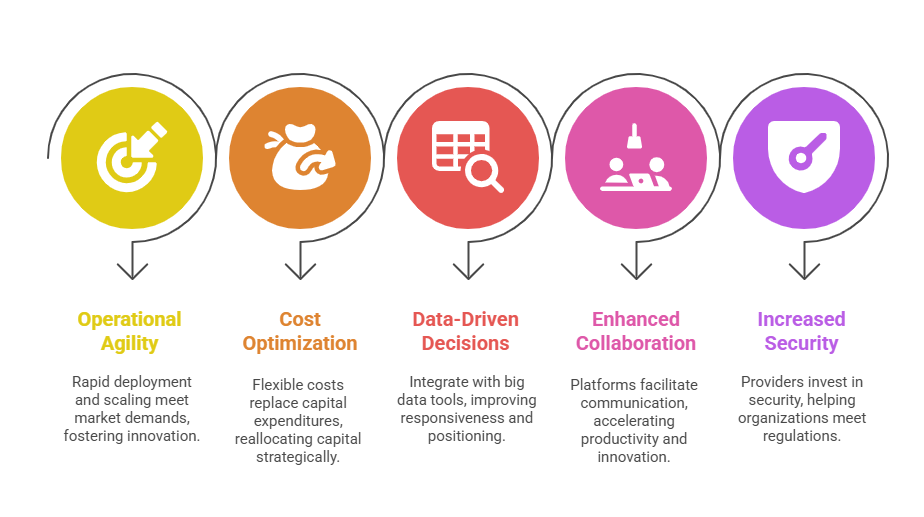 Cloud computing supports business transformation by fundamentally changing how organizations manage resources, processes, and customer engagement. It helps businesses become more digital, data-driven, and customer-centric by providing:
1. Operational Agility: Cloud enables rapid deployment of new services and scaling of operations to meet market demands without the delays and costs associated with traditional infrastructure. This agility fosters innovation, allowing businesses to test and launch new ideas faster.
2. Cost Optimization: Eliminating large upfront capital expenditures and replacing them with flexible operational costs allows businesses to reallocate capital towards strategic initiatives. Cloud’s pay-as-you-go model also reduces waste by matching resources to actual needs.
3. Data-Driven Decision Making: The cloud’s ability to integrate with big data and analytics tools empowers organizations to harness insights from vast data volumes, improving responsiveness and competitive positioning.
4. Enhanced Collaboration: Cloud platforms facilitate seamless communication and collaboration across teams and geographies, accelerating productivity and innovation.
5. Increased Security and Compliance: Modern cloud providers invest heavily in security measures and certifications, helping organizations meet stringent regulatory requirements with confidence.
Building Competitive Advantage with Cloud Computing
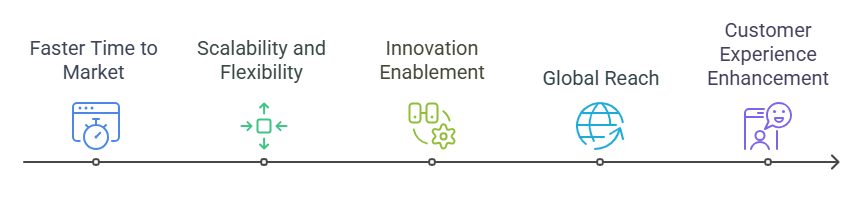 Cloud computing enables businesses to differentiate themselves in increasingly crowded markets through:
1. Faster Time to Market: Organizations can rapidly launch products and services, respond to customer feedback, and adapt offerings, ensuring they stay ahead of competitors.
2. Scalability and Flexibility: The ability to instantly scale services up or down enables businesses to handle fluctuating demand efficiently and capitalize on market opportunities.
3. Innovation Enablement: Cloud platforms provide access to cutting-edge technologies like artificial intelligence, machine learning, and the Internet of Things, which foster the development of innovative products and services.
4. Global Reach: Cloud infrastructure supports global expansion by providing consistent performance and compliance across multiple regions.
5. Customer Experience Enhancement: Cloud-based tools allow businesses to deliver personalized, reliable, and fast services, elevating customer satisfaction and loyalty.