Amazon Web Services (AWS) empowers businesses to achieve critical outcomes that drive growth, competitiveness, and sustainability.
By leveraging AWS's extensive cloud infrastructure and services, organisations can accelerate product development, enhance customer interactions, and build operationally resilient systems.
These outcomes translate directly into improved business performance and the ability to thrive in dynamic market environments.
Speed to Market
One of the most significant benefits AWS offers is the ability for businesses to innovate and deliver new products or services much faster than with traditional IT infrastructure.
AWS provides scalable computing power, ready-to-use platforms, and development tools that enable agile software development and deployment.
Organisations can quickly prototype, test, and release applications, shortening innovation cycles and gaining a competitive edge.
1. On-Demand Resources: Instant access to compute, storage, and databases removes the delay of bidding for hardware or waiting for IT provisioning.
2. Automation and DevOps Tools: AWS offers tools like AWS CloudFormation, CodePipeline, and Elastic Beanstalk that streamline infrastructure automation, continuous integration, and continuous deployment.
3. Global Reach: AWS's worldwide presence means businesses can launch products closer to customers, reducing latency and speeding the delivery process.
Improved Customer Experience
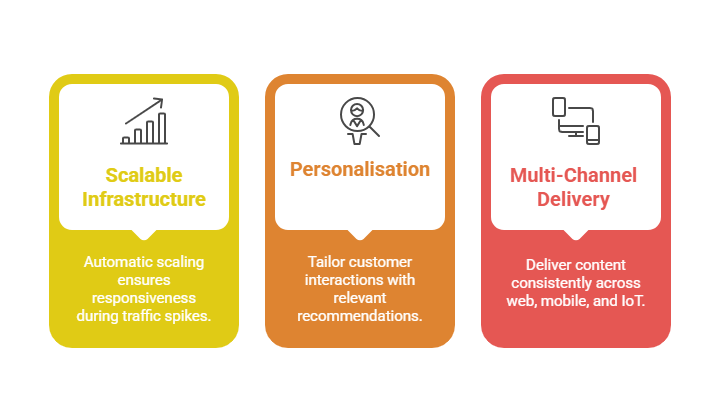
AWS enables businesses to offer faster, more reliable, and personalised experiences to their customers. This is achieved through scalable infrastructure, analytics, and AI-powered services that help understand customer needs and behaviours deeply.
Cloud services improve service availability and responsiveness, leading to higher customer satisfaction and loyalty.
Operational Resilience
Operational resilience is critical for minimising downtime, protecting data, and maintaining business continuity.
AWS offers high availability and disaster recovery options across its global infrastructure to ensure systems remain online through disruptions. Businesses achieve resilience by using multiple Availability Zones and Regions to build fault-tolerant architectures.
1. Fault Isolation: Deploying applications across multiple Availability Zones protects against data centre failures.
2. Backup and Disaster Recovery: AWS provides tools such as AWS Backup and AWS Disaster Recovery to automate data protection and recovery processes.
3. Security and Compliance: Built-in security controls, encryption, and compliance certifications help safeguard operations and data privacy while meeting regulatory requirements.

Class Sessions
Sales Campaign

We have a sales campaign on our promoted courses and products. You can purchase 1 products at a discounted price up to 15% discount.