Amazon Web Services (AWS) is a comprehensive and widely adopted cloud platform offered by Amazon. It provides a broad set of on-demand services such as computing power, storage, databases, networking, analytics, and artificial intelligence delivered through the internet.
AWS enables businesses of all sizes to scale and innovate quickly by accessing reliable and secure cloud resources without investing heavily in physical infrastructure.
As a pioneer in cloud services, AWS has become synonymous with cloud computing, powering thousands of enterprises and government agencies worldwide.
What is AWS?
AWS is a cloud computing platform that provides infrastructure as a service (IaaS), platform as a service (PaaS), and software as a service (SaaS).
It allows organisations to rent virtual servers, storage space, and numerous specialised services that enable building and deploying applications efficiently.
AWS offers flexibility, scalability, and a pay-as-you-go pricing model, making it accessible for startups to large enterprises.
History of AWS
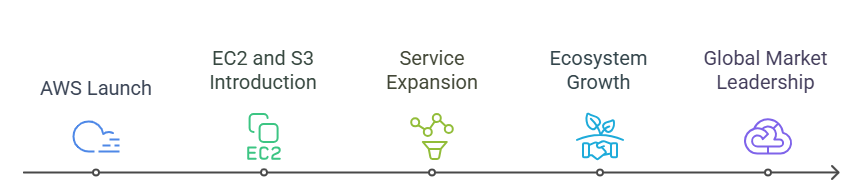
AWS was launched in 2006 as one of the first cloud computing platforms. Amazon initially built AWS to support its own retail operations but quickly realised the broader potential of cloud services.
With the introduction of Amazon Elastic Compute Cloud (EC2) and Simple Storage Service (S3), AWS revolutionised how IT resources were accessed and consumed, shifting the industry’s focus toward utility-based cloud infrastructure.
Over the years, AWS has continually expanded its services, regions, and partner ecosystems, leading the cloud market globally.
Scale of AWS
AWS is known for its massive scale and capacity. It powers millions of active customers across 190+ countries, ranging from small startups to large enterprises.
AWS’s growth in service offerings exceeds 200 fully featured services, including computing, storage, databases, analytics, machine learning, IoT, and security.
This scale allows customers to deploy applications in minutes anywhere in the world, reducing latency and improving user experience.
Global Infrastructure
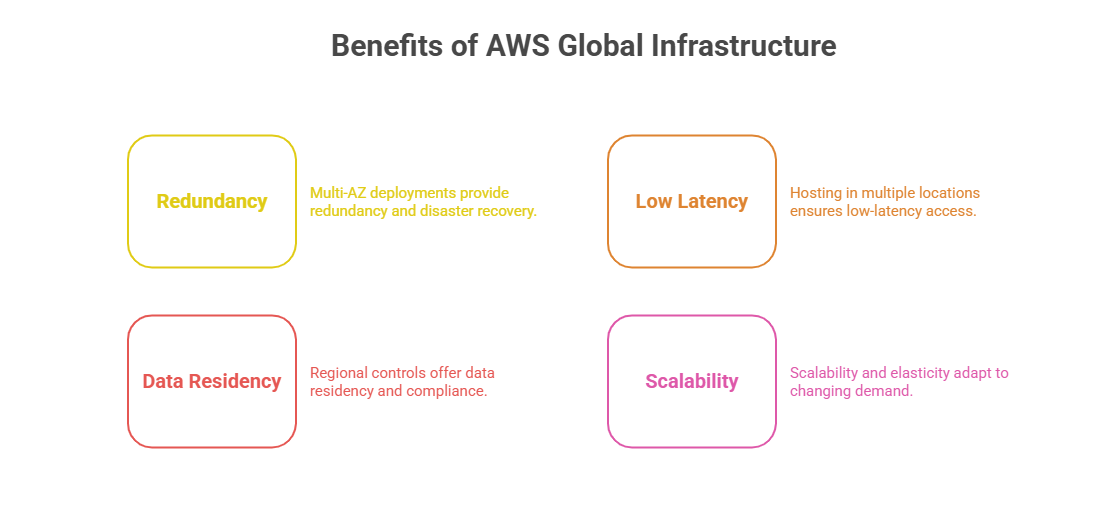
AWS’s global infrastructure is designed for high availability, fault tolerance, and low latency. It is organised into several key components:
Regions: AWS infrastructure is divided into geographic regions, each isolated and independent from the others. A region is a physical location in the world where AWS hosts data centres.
As of now, AWS operates over 30 geographic regions worldwide, including North America, Europe, Asia Pacific, South America, and the Middle East.
Availability Zones (AZs): Each AWS region contains multiple Availability Zones, which are physically separate data centres with independent power, cooling, and networking.
AZs provide fault isolation and enable applications to run in highly available and resilient architectures. On average, each region includes 2 to 6 AZs, and AZs within a region are connected with high-speed, redundant networking.
Edge Locations: AWS has a network of edge locations around the globe that support services like Amazon CloudFront (content delivery network).
These edge locations cache content closer to end-users to reduce latency and improve performance for applications, streaming, and APIs. AWS currently has over 400 edge locations globally.