In the cloud computing landscape, compute and storage are fundamental components that enable businesses to run applications, store data, and support digital operations.
Amazon Web Services (AWS) provides highly scalable, reliable, and cost-effective compute and storage services—chief among them are Amazon Elastic Compute Cloud (EC2), Simple Storage Service (S3), and a family of managed database services.
These services empower businesses to efficiently manage workloads, secure data, and support innovation in a flexible and agile environment.
Amazon EC2 (Elastic Compute Cloud): Scalable Virtual Servers
Amazon EC2 provides resizable compute capacity in the cloud, allowing businesses to run virtual servers on demand. This flexibility helps organisations avoid investing in physical hardware and manage varying workload demands efficiently.
EC2 supports multiple instance types optimised for different needs, including general-purpose, compute-optimised, memory-optimised, and GPU-powered instances.
Key Business Benefits of Amazon EC2
| Key Business Benefit | Description |
| Elasticity | Businesses can quickly scale capacity up or down to match workload spikes or lulls, ensuring performance while optimizing costs. |
| Speed | New instances can be launched within minutes, accelerating development and deployment cycles. |
| Variety | Multiple instance types enable tailored solutions for specific applications, whether web hosting, big data analytics, or machine learning. |
| Integration | EC2 integrates seamlessly with other AWS services for security, monitoring, and networking, simplifying overall cloud infrastructure management. |
Amazon S3 (Simple Storage Service): Object Storage for Business Data
Amazon S3 is a highly durable, scalable object storage service designed to store and retrieve any amount of data from anywhere on the web. It enables businesses to securely store files, backups, archival data, and large sets of unstructured data like multimedia and logs.
Key Business Benefits of Amazon S3
1. Durability and Availability: S3 offers 99.999999999% (11 nines) durability and automatic data replication across multiple Availability Zones, reducing the risk of data loss.
2. Scalability: Businesses can store virtually unlimited data and easily scale as storage needs grow without disruption.
3. Security: Features such as data encryption, access management policies, and logging ensure data protection and compliance.
4. Cost-Effectiveness: Pay-as-you-go pricing with multiple storage tiers allows costs to be optimised based on data access frequency.
5. Integration: Supports integration with analytics, machine learning, and content delivery services, enhancing business insights and user experience.
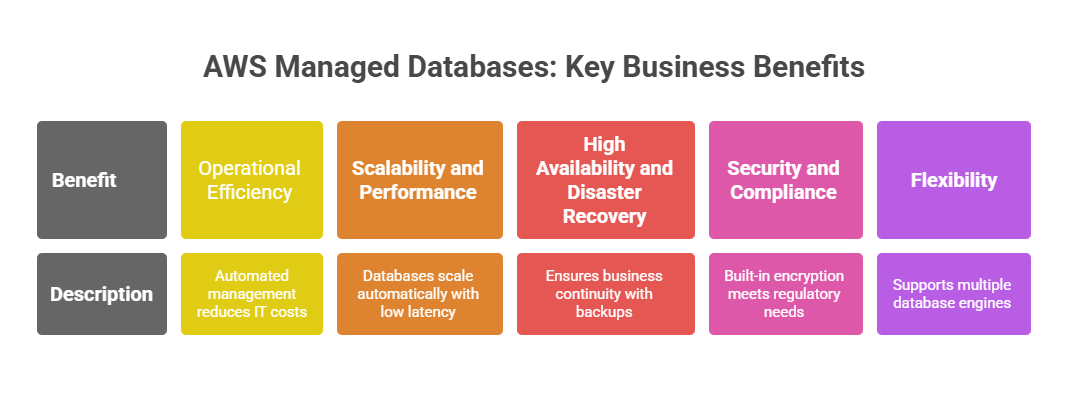
AWS Managed Databases: Simplified Data Management
AWS offers a suite of managed database services that relieve the operational burden of database management, such as provisioning, patching, backup, and scaling.
Key offerings include Amazon RDS (Relational Database Service), Amazon DynamoDB (NoSQL), and Amazon Aurora (high-performance relational database).