Cloud computing is a transformative technology that allows on-demand access to computing resources over the internet, such as servers, storage, databases, networking, software, and analytics.
Instead of owning and managing physical data centers or computing infrastructure, organizations can leverage cloud services provided by third-party vendors.
This approach enhances scalability, flexibility, and cost-efficiency. Cloud computing delivers resources as a utility, similar to electricity or water, where users pay for what they consume without large upfront investments.
Essential Characteristics of Cloud Computing
Cloud computing is defined by several key characteristics that distinguish it from traditional IT approaches:
1. On-Demand Self-Service: Users can provision computing resources automatically as needed without human intervention from the service provider.
2. Broad Network Access: Resources are available over the internet and accessed through various devices like laptops, tablets, and smartphones.
3. Resource Pooling: Computing resources are pooled to serve multiple customers dynamically using a multi-tenant model, enabling resource sharing and efficiency.
4. Rapid Elasticity: Resources can be rapidly scaled up or down to accommodate changing demand, giving a sense of unlimited capacity.
5. Measured Service: Cloud systems automatically control and optimize resource usage by metering services, allowing for transparent usage-based billing.
Deployment Models of Cloud Computing 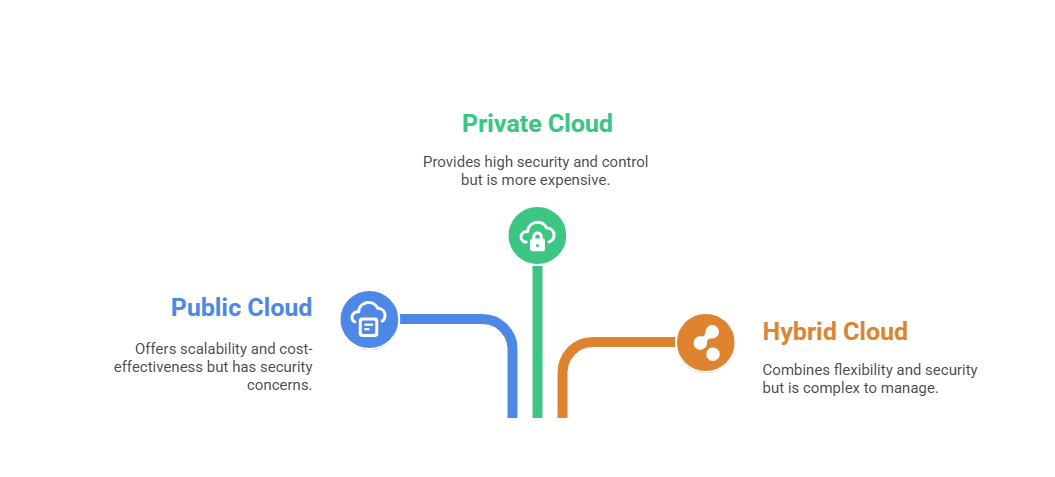
Deployment models define how the cloud infrastructure is owned, managed, and accessed. The choice of deployment model depends on factors like privacy, control, scalability, and cost considerations. The three main models are:
1. Public Cloud
In a public cloud, resources like servers and storage are owned, managed, and operated by a third-party cloud service provider and shared among multiple organizations or users over the internet.
Examples include Amazon Web Services (AWS), Microsoft Azure, and Google Cloud Platform.
Advantages: No need to invest in hardware, highly scalable, pay-as-you-go pricing, managed maintenance by the provider, and global accessibility.
Disadvantages: Less control over infrastructure, potential security and privacy concerns due to multi-tenancy, and dependency on provider reliability.
2. Private Cloud
A private cloud is a cloud infrastructure operated solely for a single organization, either managed internally or by a third party, and hosted on-premises or externally. It offers dedicated resources and greater control over security and compliance.
Advantages: High security and privacy, customizable infrastructure, control over data and compliance, and predictable performance.
Disadvantages: Higher costs associated with setup and maintenance, requires skilled IT staff, less elastic than public clouds.
3. Hybrid Cloud
A hybrid cloud combines public and private clouds, allowing data and applications to be shared between them.
This model provides greater flexibility and optimization by enabling workloads to move between private and public clouds based on business needs, such as cost, security, or performance demands.
Advantages: Flexibility to keep sensitive data private while leveraging public cloud scale, cost optimization, improved disaster recovery, and scalable bursting to public cloud during peak loads.
Disadvantages: Complexity in management and integration, requires robust networking and security monitoring, and potential latency issues.