Updating the Information Security Management System (ISMS) and its related documentation to comply with ISO/IEC 27001:2022 is essential for organizations aiming to align with the latest requirements and maintain certification.
This process ensures that the ISMS reflects current security controls, risk assessments, and management practices while demonstrating ongoing commitment to information security.
A methodical approach to updating your ISMS and documentation supports efficient transition and mitigates risks of non-compliance.
Steps to Update ISMS and Documentation
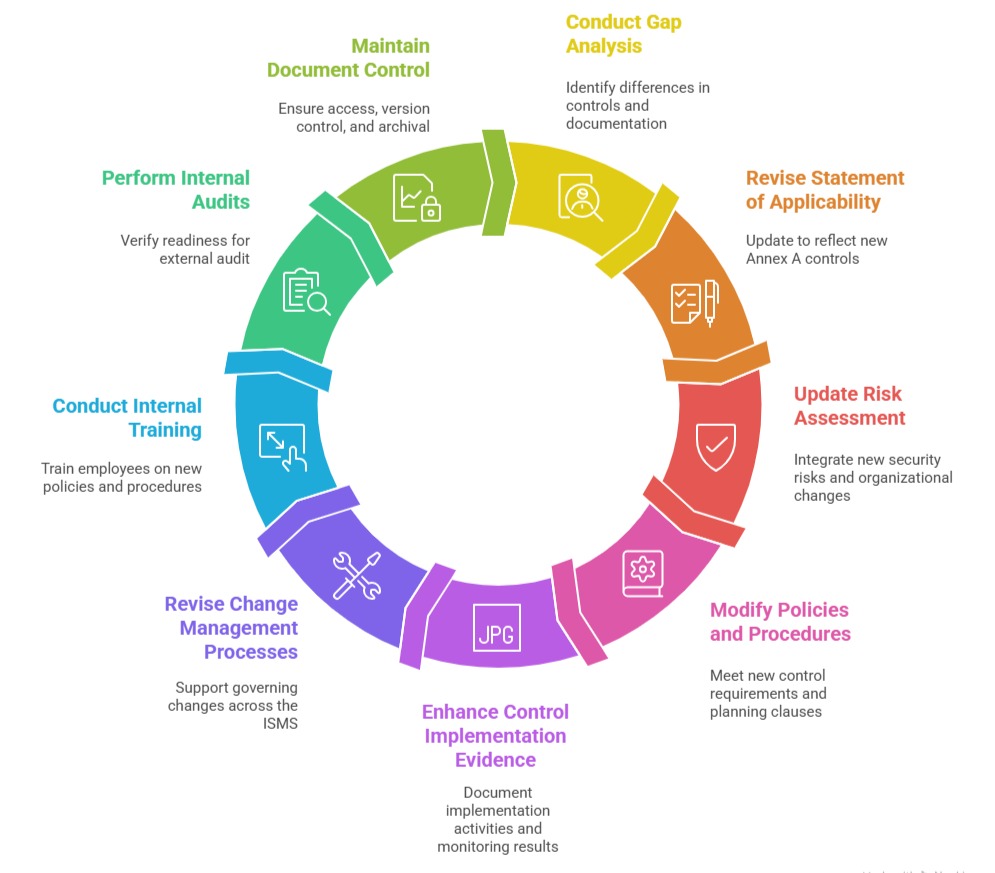
To ensure compliance with ISO/IEC 27001:2022, organizations must update documents, controls, and procedures in a structured way. Below are the essential steps to revise and maintain ISMS documentation effectively.
1. Conduct a Gap Analysis: Begin by assessing your current ISMS against the 2022 standard to identify differences in controls, clauses, and documentation requirements. This reveals areas needing updates, new controls to implement, and obsolete content to remove.
2. Revise the Statement of Applicability (SoA): Update the SoA to reflect the new Annex A controls—removing deprecated controls, incorporating new ones, and providing justification for included or excluded controls aligned with your risk context.
3. Update Risk Assessment and Treatment Plans: Revise risk assessments to integrate new or modified security risks associated with the updated controls and organizational changes. Adjust risk treatment plans accordingly to maintain effective risk mitigation.
4. Modify Policies and Procedures: Review and amend ISMS policies, operational procedures, and work instructions to meet new control requirements and enhanced planning clauses such as Clause 6.3 (Planning for Changes).
5. Enhance Control Implementation Evidence: Document implementation activities, monitoring results, and controls effectiveness concerning newly introduced areas like threat intelligence, cloud services, and secure coding.
6. Revise Change Management Processes: Ensure change management documentation is updated to support governing changes across the ISMS systematically, evaluating impacts and approvals aligned with the new standard.
7. Conduct Internal Training and Communication: Train relevant employees and management on the changes in policies, controls, and procedures. Communicate transition progress and expectations to maintain awareness and involvement.
8. Perform Internal Audits: Conduct internal audits focusing on updated controls and processes to verify readiness for the external transition audit, identifying nonconformities and improvement opportunities.
9. Maintain Document Control: Apply ISO document control principles rigorously to revised ISMS documentation, ensuring access, version control, and archival meet standard requirements.

Class Sessions
Sales Campaign

We have a sales campaign on our promoted courses and products. You can purchase 1 products at a discounted price up to 15% discount.