ISO/IEC 27001 is the world’s leading standard for information security management systems (ISMS).
Developed jointly by the International Organization for Standardization (ISO) and the International Electrotechnical Commission (IEC), its purpose is to provide organizations with a framework to establish, implement, maintain, and continuously improve information security.
The standard helps businesses protect their information assets by managing risks and ensuring the confidentiality, integrity, and availability of data.
Historical Background
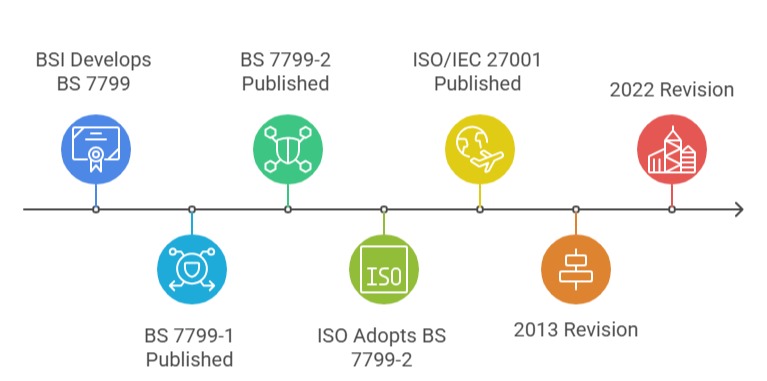
The journey of ISO/IEC 27001 began in the mid-1990s with the British Standards Institution’s (BSI) development of BS 7799. Initially published in 1995, BS 7799 consisted of guidelines for best practices in information security.
Its first part (BS 7799-1) outlined a set of controls and objectives, which later evolved into what we know today as ISO/IEC 27002.
The second part (BS 7799-2), published in 1998, focused specifically on requirements for implementing an ISMS, laying the foundation for ISO/IEC 27001.
In 2005, the ISO adopted BS 7799-2 and published it internationally as ISO/IEC 27001, formalizing the standard for ISMS requirements.
Since then, the standard has undergone multiple revisions: in 2013 to align with new management system structures and in 2022, its most recent update, to address modern cybersecurity challenges such as cloud computing, remote work, and evolving threats.
The 2022 revision also streamlined controls from 114 to 93, categorizing them into Organizational, People, Physical, and Technological domains.
Purpose and Significance
-Picsart-CropImage.png)
The prime purpose of ISO/IEC 27001 is to help organizations build a strong information security posture by systematically identifying risks and implementing appropriate controls.
It emphasizes protecting information assets not just from external cyberattacks but also from internal threats, human errors, and disasters.
By adopting ISO/IEC 27001, organizations demonstrate their commitment to safeguarding sensitive information, thereby gaining trust from customers, partners, and regulators.
Moreover, ISO/IEC 27001 provides a risk-based approach, encouraging organizations to evaluate their own unique security needs and contexts instead of applying a one-size-fits-all solution.
Its internationally recognized framework supports compliance with legal, regulatory, and contractual obligations worldwide.

Class Sessions
Sales Campaign

We have a sales campaign on our promoted courses and products. You can purchase 1 products at a discounted price up to 15% discount.