The transition from ISO/IEC 27001:2013 to the 2022 version was driven by several key reasons aimed at modernizing and improving the standard to better address today's complex information security environment.
Cybersecurity threats, technology advancements, and organizational needs have evolved significantly since 2013, necessitating an update that reflects current realities while simplifying and strengthening the overall framework.
The 2022 revision enhances flexibility, clarity, and usability, ensuring organizations globally can continue to maintain robust information security management systems (ISMS) that meet contemporary challenges.
Key Reasons for Changes from 2013 to 2022
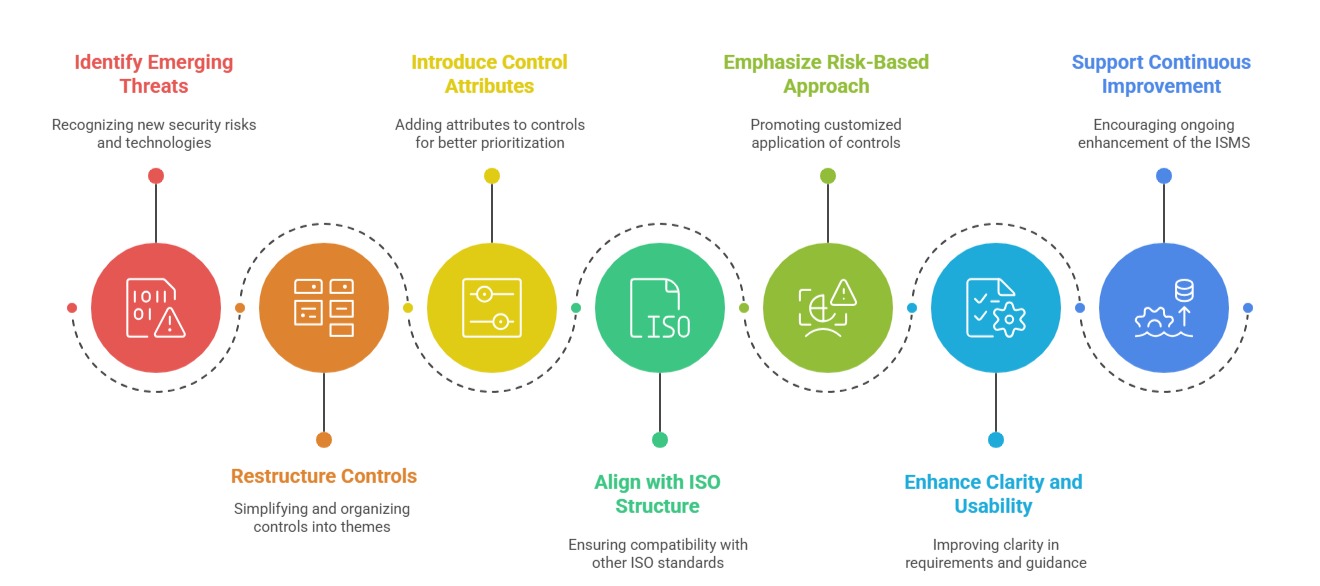
Significant updates in the 2022 edition ensure the standard remains relevant, simplified, and adaptable to today’s security environment. The following points highlight the main reasons for these revisions.
1. Address Emerging Threats and Technologies: The 2022 update incorporates controls for rising risks such as threat intelligence, data masking, secure software development, cloud security, and physical security monitoring, which were not adequately covered in the 2013 version. This helps organizations better respond to evolving cyber attack techniques and technology trends.
2. Control Restructuring and Simplification: The Annex A controls were reduced from 114 to 93 through merging, renaming, and removing redundancies. Controls are now organized into four clear themes—Organizational, People, Physical, and Technological—making them easier to understand and apply across diverse industries and business sizes.
3. Introduction of Control Attributes: Each control now includes attributes classifying its type and security property, facilitating better prioritization, filtering, and implementation based on specific organizational risks and contexts.
4. Alignment with ISO High-Level Structure: Minor updates in clause language improve alignment with other ISO management system standards, streamlining integration for organizations using multiple standards such as ISO 9001 or ISO 14001.
5. Emphasis on Risk-Based Approach: The new version promotes a more contextual, customized application of controls tailored to each organization’s business environment and risk appetite rather than a checklist approach. This drives efficiency and audit readiness.
6. Enhanced Clarity and Usability: Rewording and restructuring of clauses and controls improve clarity in requirements and guidance, reducing ambiguities and audit inconsistencies.
7. Support for Continuous Improvement: Updates introduce explicit requirements for planning changes and understanding process interactions, encouraging continual enhancement of the ISMS.

Class Sessions
Sales Campaign

We have a sales campaign on our promoted courses and products. You can purchase 1 products at a discounted price up to 15% discount.