The ISO/IEC 27001:2022 revision represents a significant update to the internationally recognized framework for Information Security Management Systems (ISMS). Published in October 2022, this update aims to address the evolving cybersecurity landscape, simplify implementation, and enhance alignment with modern risk management approaches.
The changes affect both the main body of the standard (clauses) and Annex A controls, ensuring organizations are better equipped to handle current and future information security challenges effectively.
High-Level Overview of Major Updates
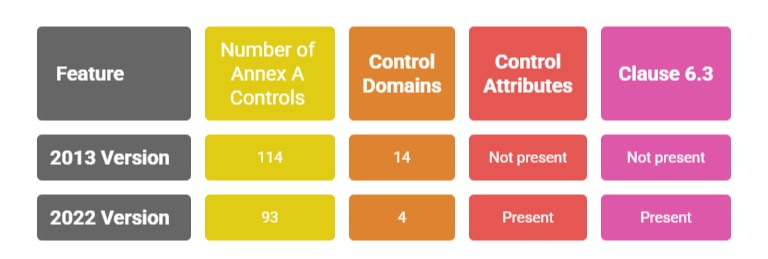
The new version of ISO/IEC 27001 modernizes the framework for current risks and technologies. Here are the principal updates and structural changes introduced in the 2022 edition.
1. Reduction and Restructuring of Controls: The number of Annex A controls has been reduced from 114 in the 2013 version to 93 in 2022. This reduction was achieved by merging 57 controls into 24, removing redundancies, and introducing 11 new controls designed to cover emerging security areas.
2. The 11 New Controls: New controls address critical topics, including threat intelligence, information security for cloud services, ICT readiness for business continuity, physical security monitoring, configuration management, information deletion, data masking, data leakage prevention, monitoring activities, web filtering, and secure coding.
3. Control Categorization into Four Domains: The previous 14 control domains have been consolidated into four broader themes: Organizational, People, Physical, and Technological. This reorganization improves clarity and helps organizations focus on key areas aligned with risk profiles.
4. Introduction of Control Attributes: To facilitate better understanding and prioritization, controls are now associated with attributes such as control type (preventive, detective, corrective), information security properties (confidentiality, integrity, availability), cybersecurity properties (identify, protect, detect, respond, recover), operational capabilities, and security domains.
5. Clause Updates for ISMS Requirements: Clauses 4 to 10 of the standard have undergone minor editorial and structural revisions to improve clarity. Notably, Clause 6.3 (Planning for Changes) is newly introduced, emphasizing the need for structured planning around ISMS changes considering their scope, impact, and resource allocation.
6. Alignment with ISO High-Level Structure: The standard maintains alignment with ISO's High-Level Structure (HLS), consistent with other ISO management system standards, facilitating easier integration for organizations with multiple certifications.
7. Enhanced Focus on Risk-Based Approach and Continuous Improvement: Emphasis is placed on tailoring controls based on organizational context and risks, with updated guidance supporting ongoing improvement of ISMS processes.

Class Sessions
Sales Campaign

We have a sales campaign on our promoted courses and products. You can purchase 1 products at a discounted price up to 15% discount.