The update to ISO/IEC 27001:2022 has significant implications for audit checklists and documentation, requiring organizations and auditors to revise and enhance these tools to align with the new standard.
Accurate and comprehensive audit checklists are critical to effectively evaluate the implementation and effectiveness of information security controls, while well-maintained documentation serves as evidence of compliance and continuous improvement.
Adjusting these aspects ensures audits remain rigorous, relevant, and reflective of the latest security requirements and risk management practices.
Adjusting Audit Checklists
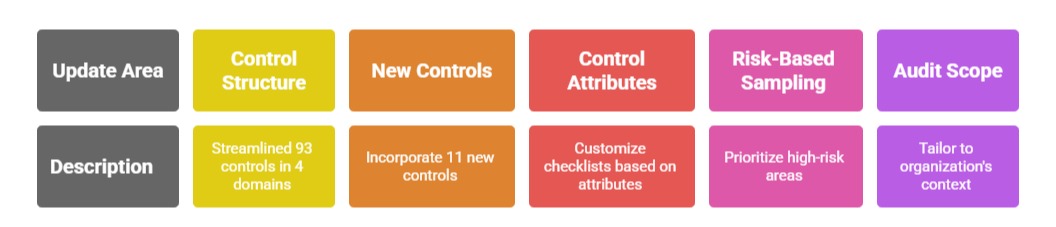
Maintaining relevance and precision in audits depends on tailoring checklists to the standard’s new structure and risk orientation. The list below highlights important updates required for modern audit checklists.
1. Reflect New Control Structure: Audit checklists must be updated to cover the streamlined 93 controls organized into four domains (Organizational, People, Physical, Technological) instead of the previous 114 controls in 14 domains. This involves redefining control categories and revising audit questions to match the new control wording and intent.
2. Include New Controls: Eleven new controls introduced by the 2022 revision, such as threat intelligence and cloud security, need to be incorporated into checklists with tailored audit criteria emphasizing emerging risks and technologies.
3. Control Attributes Utilization: Leveraging control attributes (control type, security objectives, cybersecurity functions) allows auditors to customize checklists based on control focus, risk levels, and organizational context, enhancing audit efficiency.
4. Risk-Based Sampling: Updated checklists should enable risk-based sampling to prioritize high-risk areas, reflecting the standard’s increased emphasis on contextual risk management.
5. Audit Scope and Focus: Tailoring checklists to the organization’s size, complexity, and industry ensures relevant and focused audits, avoiding generic or overly broad assessments.
Adjusting Documentation
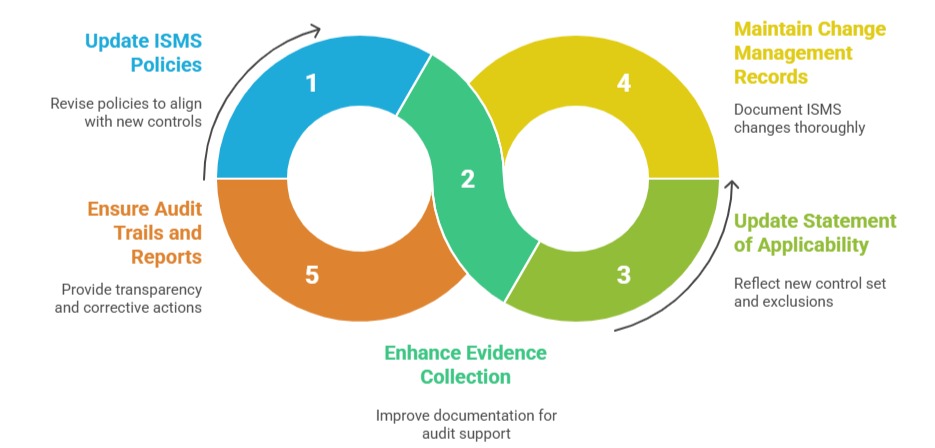
Comprehensive documentation updates are essential to reflect the new control structure, planning requirements, and evidence expectations. Below are the main documentation adjustments organizations should make.
1. Update ISMS Documentation: Organizations must revise policies, procedures, and records to incorporate new and merged controls, ensuring alignment with updated requirements. This includes integrating new clauses such as planning for changes (Clause 6.3).
2. Enhanced Evidence Collection: Documentation should clearly demonstrate control implementation, monitoring, and continual improvement activities, supporting the audit process.
3. Statement of Applicability (SoA): The SoA requires updating to reflect the new control set, documenting applicable controls, justifications for exclusions, and control status.
4. Change Management Records: Given the new focus on formal change management, documentation related to planning, impact analysis, approval, and communication of ISMS changes must be complete and accessible.
5. Audit Trails and Reports: Maintaining thorough audit trails and reports ensures transparency and facilitates corrective actions, important under the revised standard’s improvement requirements.

Class Sessions
Sales Campaign

We have a sales campaign on our promoted courses and products. You can purchase 1 products at a discounted price up to 15% discount.