The revisions introduced in ISO/IEC 27001:2022 have substantial implications for audit planning and execution processes. Auditors must adjust their methodologies to align with the updated structure, expanded controls, and new requirements.
Effective audit planning now demands a deeper understanding of the revised Annex A controls, risk-based approaches, and additional documentation needs.
These changes ensure audits remain rigorous, comprehensive, and capable of accurately assessing an organization’s continued compliance and security posture under the new standard.
Impact on Audit Planning
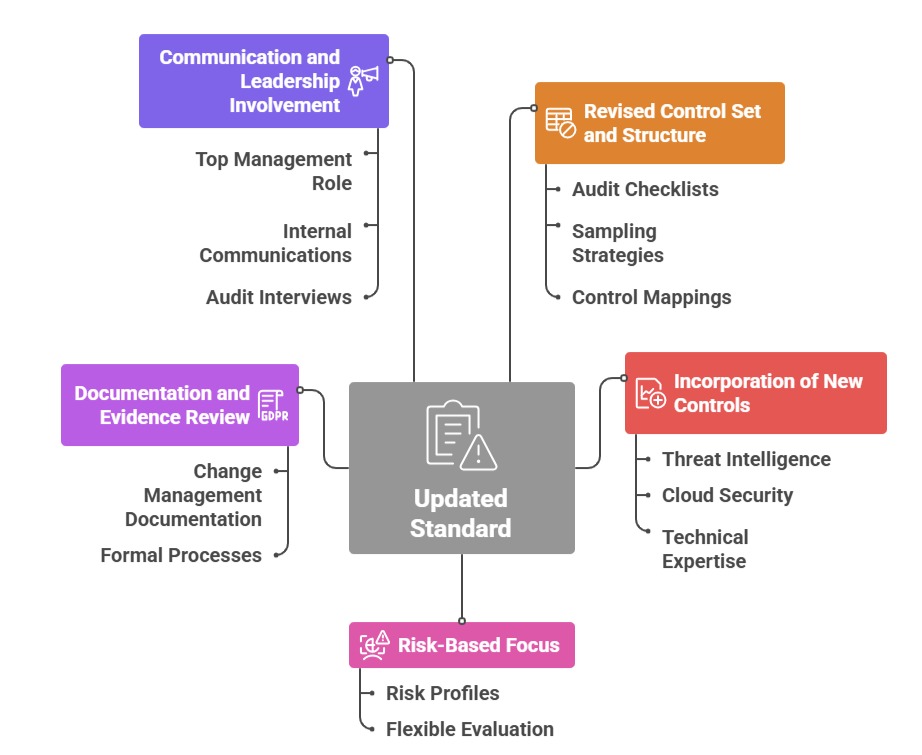
Changes in the standard’s controls, clauses, and focus demand a more contextual, risk-aligned audit approach. Here are the primary implications for audit planning under ISO/IEC 27001:2022.
1. Revised Control Set and Structure
Auditors must familiarize themselves with the reduced and reorganized 93 controls spread across four domains (Organizational, People, Physical, Technological), replacing the previous 114 controls in 14 categories. This requires updating audit checklists, sampling strategies, and control mappings to reflect the new taxonomy.
2. Incorporation of New Controls: Eleven new controls, such as threat intelligence and cloud security, mandate auditors to develop specific audit techniques and criteria addressing these areas, increasing the scope and necessity for technical expertise within audit teams.
3. Risk-Based Focus: The updated standard’s stronger emphasis on contextual risk assessments means auditors need to evaluate the organization’s tailoring of controls based on risk profiles. This can create variability in audit scope and require more flexible, judgment-based evaluation.
4. Documentation and Evidence Review: Audits must consider new planning requirements, like Clause 6.3 (Planning for Change), which involve reviewing change management documentation. Auditors must verify that organizations have formal processes to manage ISMS modifications systematically.
5. Communication and Leadership Involvement: Enhanced leadership and communication clauses necessitate auditors to evaluate top management’s role and internal communications effectiveness, increasing the breadth of audit interviews and evidence collection.
Impact on Audit Execution
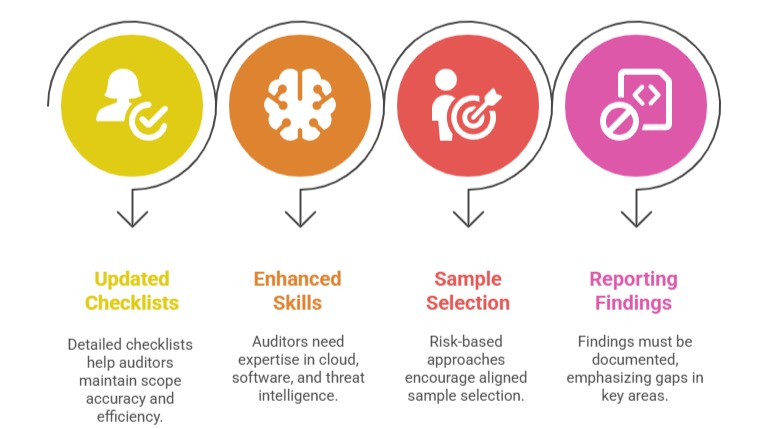
To align with the new structure and controls, auditors must adapt their techniques, documentation, and testing methods. The following points outline the main impacts on audit execution.
1. Updated Audit Checklists: Detailed checklists reflecting revised control attributes and groupings help auditors maintain scope accuracy and efficiency.
2. Enhanced Technical Auditing Skills: Auditors may require additional expertise to assess controls related to areas like cloud infrastructure, secure software development, and threat intelligence.
3. Selection and Testing: Flexible risk-based approaches encourage auditors to select audit samples aligned with perceived risk priorities, as defined by organizations’ ISMS.
4. Reporting and Nonconformities: Findings related to new controls and clauses must be clearly documented, with an emphasis on gaps in change management, control implementation, and leadership involvement.

Class Sessions
Sales Campaign

We have a sales campaign on our promoted courses and products. You can purchase 1 products at a discounted price up to 15% discount.