Establishing a dedicated incident response team is a critical step for any organization aiming to manage information security incidents effectively.
This team serves as the frontline defense, responsible for detecting, analyzing, containing, and recovering from security incidents while minimizing damage and ensuring business continuity.
A well-structured team with clearly defined roles and responsibilities better equips an organization to respond rapidly and efficiently, aligning with industry best practices and standards such as ISO/IEC 27035.
Key Considerations for Establishing an Incident Response Team
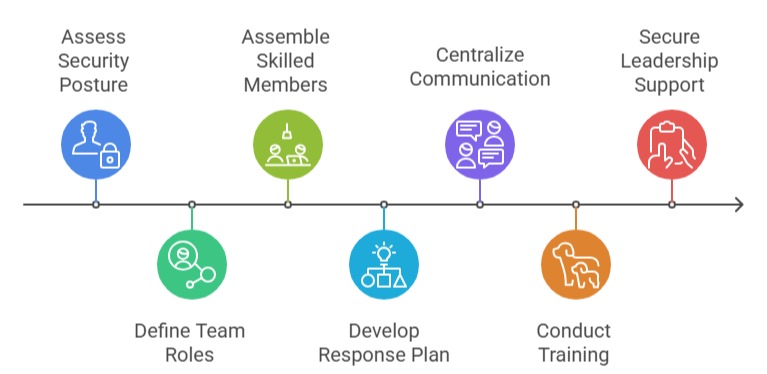
Here are the critical aspects to consider when creating an Incident Response Team to ensure it is skilled, well-coordinated, and ready to handle incidents effectively.
1. Assess Security Posture and Identify Needs
Begin by evaluating the organization’s current security environment, identifying vulnerabilities, potential threats, and gaps in existing incident response capabilities. This ensures the team addresses real risks relevant to the business context.
2. Define Team Roles and Responsibilities
Clearly specify roles such as Incident Manager, Security Analysts, Incident Handlers, Forensics Experts, Communications Officers, Legal Advisors, and Executive Sponsors.
These assignments help distribute workload and ensure accountability during high-pressure incident scenarios.
3. Assemble Skilled and Diverse Members
Select members with a mix of skills and expertise in areas like network security, malware analysis, forensic investigation, legal compliance, and communication. Cross-functional cooperation contributes to comprehensive incident handling.
4. Develop an Incident Response Plan
The team should work together to craft and maintain a detailed incident response plan comprising procedures, escalation paths, communication protocols, and recovery strategies customized to the organization's needs.
5. Centralize Communication and Collaboration Tools
Use centralized platforms for real-time communication, documentation, and coordination to streamline team interactions and ensure information consistency.
6. Ongoing Training and Simulation Exercises
Regular training sessions, tabletop exercises, and operational drills help maintain and enhance team preparedness, ensuring smooth and effective responses to incidents even under pressure.
7. Leadership Support and Resource Allocation
Secure executive sponsorship to access necessary resources, authorize decisions during crises, and drive continuous improvement in incident management processes.

Class Sessions
Sales Campaign

We have a sales campaign on our promoted courses and products. You can purchase 1 products at a discounted price up to 15% discount.