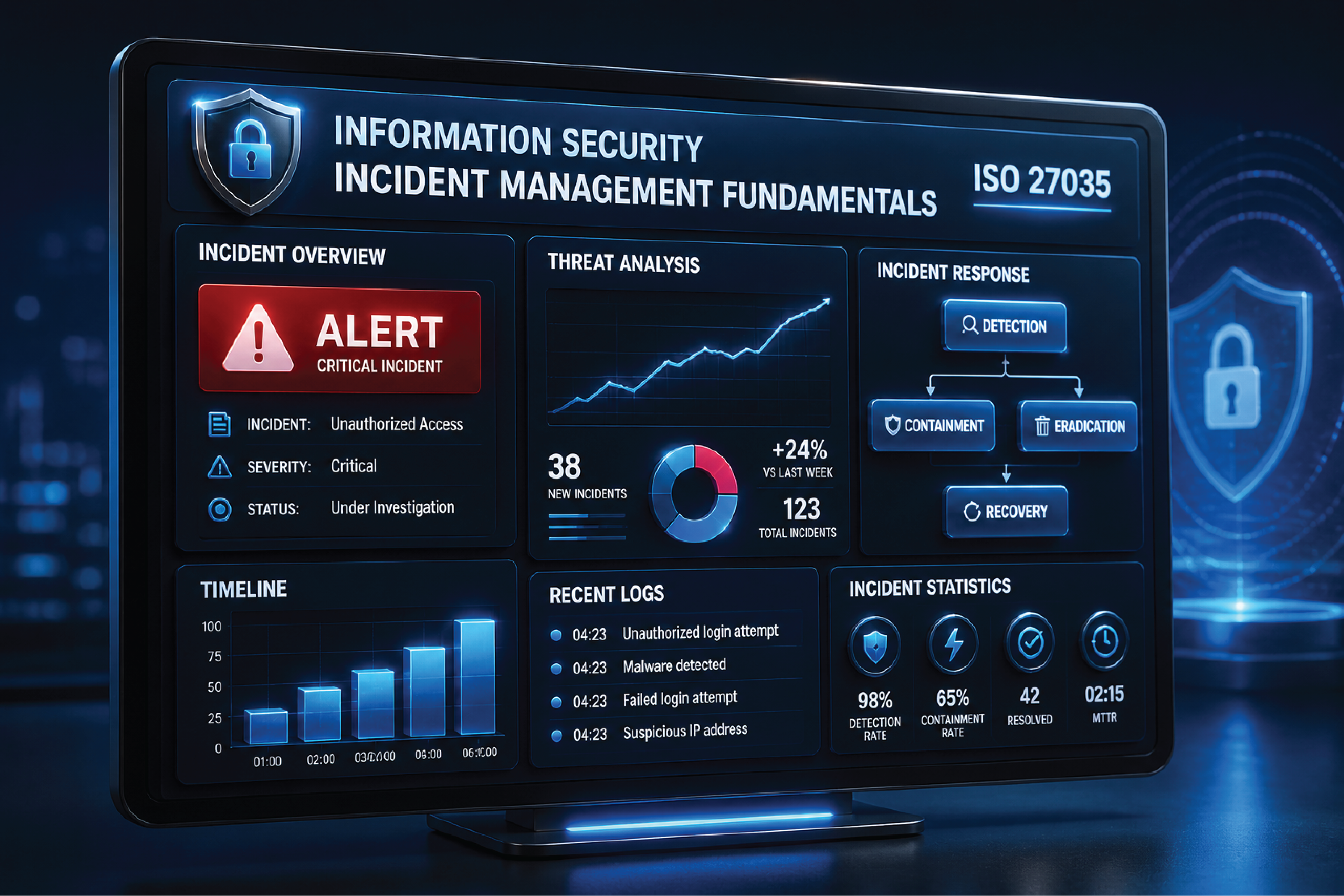
ISO 27035 Incident Management Fundamental Course Online
in Incident ManagementWhat you will learn?
Understand the fundamental concepts and importance of information security incident management as per ISO 27035.
Recognize the components and structure of the ISO/IEC 27035 standard and its interaction with other standards.
Identify roles, responsibilities, and coordination mechanisms required for effective incident management.
Develop and implement preparation and planning measures including policies, procedures, and teams for incident management.
Detect, analyze, classify, and prioritize information security incidents using effective methodologies.
Execute appropriate incident response actions including containment, eradication, and recovery.
Conduct post-incident reviews to derive lessons learned and implement continual improvements to the incident management process.
Enhance the organization’s overall information security posture and resilience through a systematic incident management approach.
About this course
Every 11 seconds, a cyber attack occurs somewhere in the world. The professionals who know how to respond are in short supply — and very high demand.
Organizations face data breaches, system failures, and cyber strikes every single day. Knowing how to manage those incidents isn't a nice-to-have anymore — it's a core business requirement. That's exactly what the ISO 27035 fundamental course delivers.
Built on the internationally recognized ISO/IEC 27035 incident management standard, this course teaches you a clear, repeatable process for handling security events from first detection to final resolution. It's available online, self-paced, and structured for real-world application.
Ideal Candidates for the ISO 27035 Fundamental Course and Key Learning Outcomes
ISO 27035 fundamental course is built for a broad range of professionals. You don't need advanced technical skills to begin, just a desire to work in one of the world's fastest-growing industries.
1. IT professionals who want stronger incident response skills.
2. Security analysts handling threats and alerts day-to-day.
3. Risk managers look at and lower the risk that their organization faces.
4. Compliance officers make sure that companies follow security rules.
5. System administrators who take care of networks and infrastructure.
6. People who are changing careers or just graduated and want to work in cybersecurity.
ISO 27035 Fundamental Course defines the full five-phase incident management lifecycle. When you graduate, you'll have skills that employers can use right away:
1. The ISO/IEC 27035 standard, including its five phases, structure, and principles.
2. How to identify, classify, and report security incidents.
3. Techniques for analyzing the impact and severity of a breach.
4. How to respond swiftly, contain damage, and restore operations.
5. Closing incidents properly and documenting lessons learned.
6. Building and leading an incident response team with defined roles.
By the end of the course, you'll know how to apply the ISO/IEC 27035 event response guidelines in real work environments — a structured, professional approach that sets you apart from self-taught candidates.
Career Paths After the ISO 27035 Fundamental Course
Cybersecurity is hiring aggressively across every sector. Here are the roles ISO 27035-trained professionals step into:
| ROLE | WHAT YOU'LL DO |
| Information Security Analyst | Monitor systems, detect threats, respond to incidents |
| Incident Response Specialist | Lead the response when a security event occurs |
| Cybersecurity Consultant | Advise organizations on incident management strategy |
| IT Risk Manager | Identify, assess, and reduce security-related risks |
| Compliance Analyst | Ensure companies meet security standards and laws |
| SOC Analyst | Monitor alerts and investigate potential threats |
| IT Auditor | Review and evaluate protection systems and records |
| Data Protection Officer | Oversee how organizations safeguard sensitive data |
Many of these roles are accessible at the entry and mid-level. Because the ISO/IEC 27035 standard is recognized globally, your certification is transferable across borders, opening doors in banking, healthcare, government, and technology worldwide.
Earning Opportunities After the ISO 27035 Fundamental Course
Incident management professionals command salaries well above average for IT roles. Below are 2025–2026 figures across four major markets:
| ROLE | USA | UK | INDIA | UAE |
| Information Security Analyst | $102,000 | £52,000 | ₹8,50,000 | AED 180,000 |
| Incident Response Specialist | $110,000 | £58,000 | ₹10,00,000 | AED 200,000 |
| Cybersecurity Consultant | $120,000 | £65,000 | ₹12,00,000 | AED 220,000 |
| IT Risk Manager | $115,000 | £60,000 | ₹11,00,000 | AED 210,000 |
| SOC Analyst | $85,000 | £44,000 | ₹7,00,000 | AED 150,000 |
| Compliance Analyst | $90,000 | £46,000 | ₹7,50,000 | AED 160,000 |
In the US, entry-level professionals typically start between $70,000–$85,000. Mid-level specialists in the UK (3–5 years experience) earn £55,000–£70,000. In India and the UAE, demand for certified professionals is rising sharply, pushing salaries higher each year.
Source: Glassdoor, Indeed, LinkedIn Salary Insights, 2025–2026.
Job Market Opportunities for ISO 27035 Fundamental Course Graduates
4.8 million cybersecurity jobs sit unfilled globally. The talent gap isn't closing — it's widening.
Several forces are compounding this demand simultaneously. The shift to remote work expanded attack surfaces dramatically — more endpoints, more vulnerabilities, more incidents.
Regulatory frameworks like GDPR, HIPAA, and PDPA now legally require organizations to manage and report security incidents, making ISO 27035-literate staff a compliance necessity.
And small and mid-sized businesses, once reluctant to invest, now recognize that prevention costs a fraction of a breach.
The job market for incident management professionals isn't just open, it's one of the fastest growing in all of technology.
Sources: ISC2 Cybersecurity Workforce Study 2024; IBM Cost of a Data Breach Report 2024; Cybersecurity Ventures 2025; Ponemon Institute 2024; ISO Survey 2023.
Final Thoughts
Cybersecurity is no longer optional for organizations — it's as fundamental as legal or finance.
And at the center of every serious cybersecurity program sits incident management: the structured ability to detect, respond to, and learn from security events.
The ISO 27035 fundamental course gives you a globally recognized credential, practical workplace-ready skills, and a direct path into one of the most resilient, recession-resistant career fields available.
Tags
ISO 27035 Information Security Incident Management Fundamentals Course
ISO/IEC 27035 Course
ISO 27035 Fundamentals Course
ISO 27035 incident response fundamentals
ISO 27035 online course
ISIM fundamentals course
ISO 27035 course for beginners
ISO 27035 course for incident managers
Information security incident response course
Related Courses
.png)

Comments (0)
Information security incidents are diverse events that threaten an organization's data and systems, requiring rapid detection and effective management. Proper classification and response help reduce risks and ensure organizational resilience.
Incident management is vital for minimizing the impact of security breaches and ensuring swift recovery. A structured approach enhances security, compliance, and organizational confidence.
ISO/IEC 27035 provides a well-structured and adaptable framework for information security incident management, designed to help organizations prepare, detect, respond to, and learn from incidents effectively. Its comprehensive clauses cover all stages of incident management, ensuring organizations enhance their resilience against evolving cyber threats.
Events are observable occurrences that may indicate security issues, while incidents are confirmed breaches affecting information security. Vulnerabilities are weaknesses that threats, such as hackers or malware, can exploit to cause harm. Proper understanding and management of these terms are essential for effective information security incident management.
ISO/IEC 27035 works synergistically with ISO/IEC 27001, 27002, 27005, and 22301 to deliver a unified approach to managing information security and business resilience. Understanding these relationships enables organizations to implement cohesive security, risk, and continuity management systems that effectively protect and sustain business operations.
The Incident Management Life Cycle provides a clear, repeatable process for organizations to prepare for, detect, assess, respond to, and learn from information security incidents. This structured approach minimizes impact, strengthens security posture, and drives continuous improvement in incident handling.
The principles of incident management guide organizations to develop a prepared, timely, and structured approach to managing information security incidents. Emphasizing accountability, communication, risk awareness, and continuous improvement ensures effective incident handling and organizational resilience.
Clearly defined roles and responsibilities ensure that information security incidents are managed effectively and efficiently. Collaboration among specialized team members enhances an organization's ability to respond quickly, mitigate damage, and comply with regulatory requirements. Establishing these roles aligned with ISO/IEC 27035 empowers organizations with a structured incident management capability.
Coordination and communication are vital pillars in the effective management of information security incidents. Seamless interaction among teams, leadership, stakeholders, and external parties during an incident ensures swift response, reduces confusion, and protects the organization's reputation. ISO/IEC 27035 emphasizes clear communication channels and structured coordination to align efforts, facilitate decision-making, and maintain transparency throughout the incident lifecycle.
Legal and regulatory considerations are essential pillars of incident management, guiding organizations to meet mandatory reporting, privacy, and compliance requirements. Embedding these requirements in incident response processes safeguards against legal repercussions and supports organizational accountability and stakeholder trust.
Developing a comprehensive incident management policy and clear procedures is essential for structured and effective handling of security incidents. These documents provide guidance on scope, roles, classification, response, communication, and continuous improvement, ensuring readiness and resilience aligned with ISO/IEC 27035 standards.
Establishing a capable incident response team involves strategic planning, role allocation, skillful recruitment, and continuous training. Supported by clear communication tools and leadership commitment, such a team forms the organizational backbone for resilient and effective incident management, consistent with ISO/IEC 27035 standards.
Effective incident management requires continuous training, widespread awareness, and well-defined role assignments. Together, these components foster a prepared, responsive, and coordinated organizational environment aligned with ISO/IEC 27035 standards.
Utilizing an integrated suite of incident detection and response tools substantially improves an organization’s security posture by enabling early threat identification, rapid containment, and informed decision-making. These technologies underpin effective incident management aligned with ISO/IEC 27035 standards and help organizations adapt to increasingly sophisticated cyber threats.
A well-structured escalation and communication plan is essential for effective incident response. It ensures timely alerts, clear messaging, and coordinated efforts among internal and external stakeholders, ultimately reducing incident impact and supporting organizational resilience.
Effective incident detection combines multiple methods such as log analysis, threat intelligence, behavioral analytics, automated network and endpoint monitoring, and human reporting. Employing a layered detection strategy, as recommended by ISO/IEC 27035, improves the likelihood of early identification and effective response to security incidents.
Monitoring and alerting systems provide continuous oversight and rapid notification of security issues, supporting early detection and swift incident response. Integration, tuning, and prioritization are vital for maximizing their effectiveness and aligning with best practices in information security management.
Incident classification assesses the severity to guide prioritization, while categorization organizes incidents by type or source for tailored responses. Utilizing structured classification and categorization as per ISO/IEC 27035 improves consistency, communication, and response effectiveness.
Incident impact assessment evaluates the breadth and depth of harm caused by security incidents across multiple dimensions, including confidentiality, integrity, availability, financial loss, reputation, and compliance. A systematic and context-aware assessment is vital for guiding effective response and recovery, consistent with ISO/IEC 27035 standards.
Effective documentation and reporting of incidents lay the groundwork for transparent, accountable, and continuous improvement-oriented incident management. Detailed records support compliance, stakeholder communication, and forensic analysis, key to minimizing impact and strengthening organizational security aligned with ISO/IEC 27035 standards.
Containment strategies are essential for controlling security incidents and mitigating their impact. Combining rapid short-term actions with well-planned long-term measures preserves business continuity, supports investigations, and strengthens defenses against future incidents, as outlined in ISO/IEC 27035.
Eradication of threats is the systematic removal of malicious artifacts and vulnerabilities to restore system integrity and prevent recurrence. It requires root cause analysis, comprehensive clean-up, patching, validation, and documentation, balancing security with minimal operational disruption as prescribed in ISO/IEC 27035.
Recovery methods involve restoring systems and services to normal operation by using backups, reimaging, patching, and testing, complemented by post-recovery monitoring and communication. This balanced strategy helps organizations focus on quick restoration while safeguarding against recurring threats, aligning with ISO/IEC 27035 best practices.
Effective communication during incident response is essential for coordination, transparency, and managing stakeholder expectations. Structured channels, a dedicated communication lead, tailored messaging, timely updates, and strict confidentiality measures form the backbone of successful incident communication aligned with ISO/IEC 27035.
Coordinating effectively with internal and external stakeholders is vital for efficient incident response and recovery. Clear role definition, timely communication, legal compliance, and managed external relations help organizations minimize impact, ensure transparency, and uphold trust during incident management, consistent with ISO/IEC 27035 standards.
Comprehensive incident documentation, coupled with rigorous lessons learned activities, enables organizations to enhance their incident response capabilities continuously. By recording detailed incident data and translating experiences into actionable improvements, organizations strengthen their security posture and reduce future risks, in line with ISO/IEC 27035 guidelines.
Post-incident review and root cause analysis are complementary processes that help organizations understand incident details, assess response quality, and identify fundamental causes. Together, they enable informed decision-making and continuous enhancements in security capabilities, aligned with ISO/IEC 27035 principles.
Updating policies, procedures, and controls is essential for keeping incident management programs relevant, effective, and compliant. Through regular reviews, stakeholder involvement, clear documentation, and training, organizations can implement continuous improvements that align with ISO/IEC 27035 principles.
Monitoring and reporting on incident management metrics enable organizations to evaluate performance, uncover bottlenecks, and drive continual improvement. Using relevant KPIs aligned with ISO/IEC 27035 standards ensures effective, timely incident handling that supports business resilience and stakeholder confidence.
Building organizational resilience is a continuous, multi-faceted effort requiring risk management, updated policies, empowered employees, advanced technologies, effective communication, and regular testing. These elements collectively enable organizations to withstand, adapt to, and quickly recover from the increasingly sophisticated cyber threat environment.