The Incident Management Life Cycle is a systematic and structured approach that organizations use to manage information security incidents efficiently from preparation to learning.
Following a life cycle helps ensure that incidents are detected early, handled appropriately, and lessons are learned to improve future responses.
Phases of the Incident Management Life Cycle
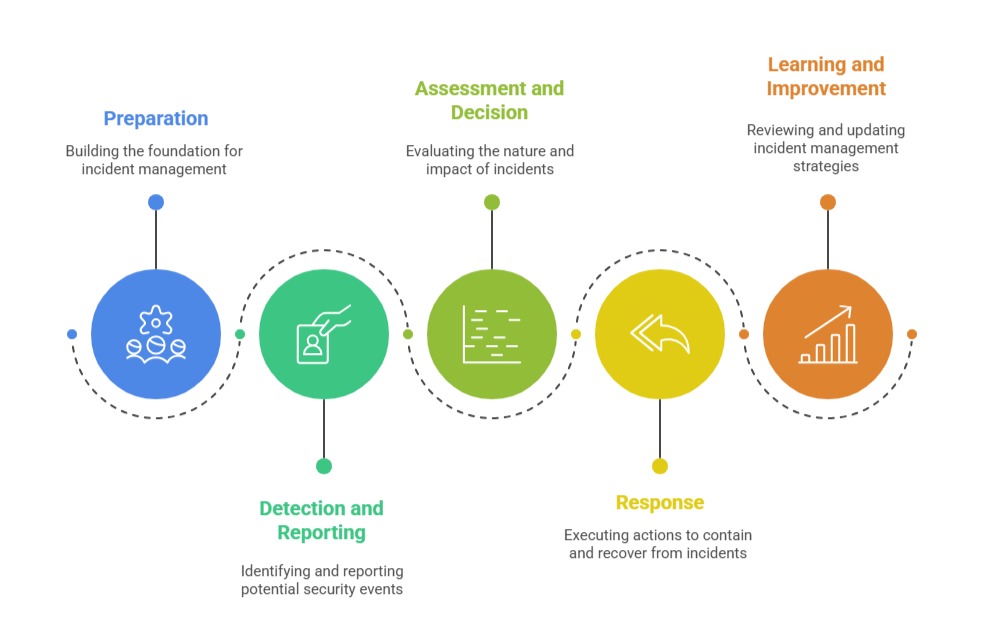
The life cycle outlined in ISO/IEC 27035 comprises five key phases, each playing a vital role in protecting organizational information assets and minimizing the impact of security breaches.
1. Preparation
This initial phase focuses on building the foundation for effective incident management. Organizations develop incident management policies, allocate resources, establish incident response teams, and conduct training and awareness programs.
Preparation also includes implementing monitoring tools and communication plans to ensure readiness for potential incidents.
2. Detection and Reporting
In this phase, organizations monitor systems and networks to identify potential security events that could escalate into incidents. Detection can occur through automated security tools, log analysis, user reports, or external notifications.
Prompt and accurate reporting mechanisms are essential to ensure that incidents are logged, assessed, and quickly brought to the attention of response teams.
3. Assessment and Decision
After detecting a potential incident, security teams assess its nature, severity, and potential impact.
This assessment determines whether the event qualifies as a security incident and guides decisions on escalation, prioritization, and appropriate response strategies.
Proper assessment is critical to avoid misclassification and ensure resources are focused on the most significant threats.
4. Response
The response phase involves executing actions to contain, eradicate, and recover from the incident. Containment may include isolating affected systems, while eradication aims to remove threats or vulnerabilities.
Recovery restores normal operations and services. Throughout this phase, effective communication and coordination are essential to manage the incident successfully and limit damage.
5. Learning and Improvement
The final phase focuses on reviewing the incident and response to identify lessons learned. Organizations document findings, evaluate the effectiveness of their response, and update policies, procedures, and controls accordingly.
Continuous improvement ensures that incident management capabilities evolve to address emerging threats and reduce the likelihood of recurrence.

Class Sessions
Sales Campaign

We have a sales campaign on our promoted courses and products. You can purchase 1 products at a discounted price up to 15% discount.