Virtual Private Networks (VPNs) are essential tools for securing remote access to enterprise networks, ensuring encrypted communication between users and internal resources over untrusted networks like the internet. Two leading VPN solutions in Linux environments are OpenVPN and WireGuard. Both provide strong security but differ in architecture, performance, and ease of deployment.
VPN Technology
A VPN creates an encrypted tunnel between a client and server, protecting data confidentiality and integrity. It enables secure access to private network resources regardless of the user’s location. Commonly used for remote work, secure site-to-site connections, and bypassing network restrictions.
OpenVPN: Feature-Rich and Flexible
For administrators seeking a robust VPN solution, OpenVPN offers extensive configuration capabilities and strong encryption. The key points below outline installation, configuration, and its typical applications.
Key Characteristics
1. Mature, widely supported, and highly configurable VPN solution.
2. Supports SSL/TLS for authentication and encryption with strong cipher suites.
3. Can operate over TCP or UDP, supporting dynamic configurations behind NAT and firewalls.
4. Supports client certificates, username/password authentication, and multi-factor authentication.
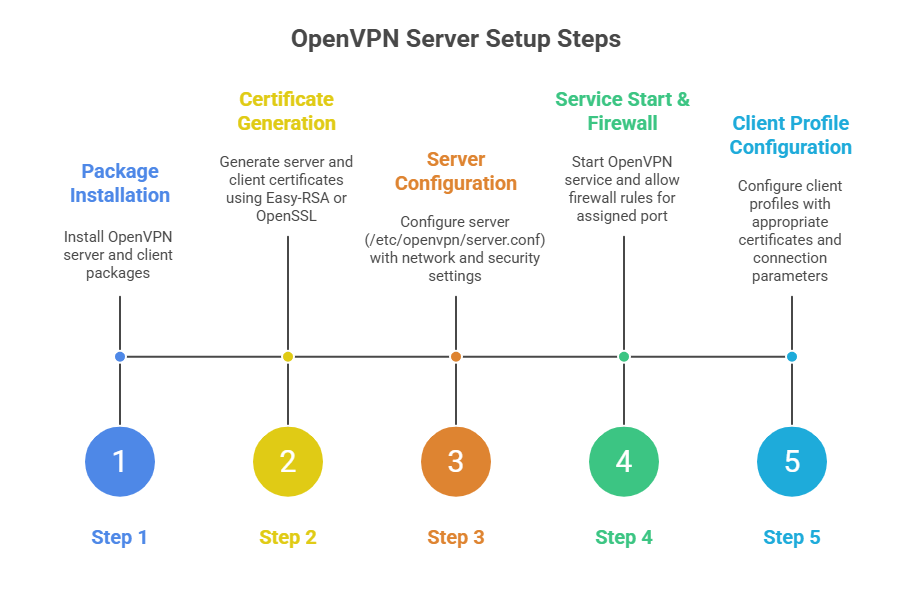
Advantages and Use Cases: Well-suited for complex network environments where customizable options are required. It supports legacy systems and a variety of authentication methods, making it versatile for diverse infrastructures. Additionally, it offers rich logging and monitoring capabilities, enabling administrators to track activity and maintain security oversight effectively.
WireGuard: Modern and High-Performance
Known for its lightweight design and fast operation, WireGuard leverages state-of-the-art cryptography and minimal configuration.The key points below cover installation, configuration, and use cases.
Key Characteristics
1. Lightweight VPN protocol designed for simplicity, speed, and strong cryptography.
2. Uses state-of-the-art cryptographic primitives like Curve25519 and ChaCha20.
3. Integrated into the Linux kernel for enhanced performance and low latency.
4. Minimal configuration files with quick setup.
.png)
Advantages and Use Cases: Suitable for high-performance environments where speed and simplicity are critical. It works effectively on lightweight devices, embedded systems, and for easily manageable VPN deployments. With a growing ecosystem and increasing adoption in enterprise settings, it offers both versatility and scalability for modern networking needs.