Introduction to Robotics and Automation in AI
Robotics and automation in artificial intelligence refer to the design, construction, and deployment of intelligent machines capable of performing tasks that would traditionally require human intervention. Robotics involves building physical systems—robots—that can sense, plan, and act in the environment, while automation focuses on designing processes that enable these systems to operate independently with minimal human supervision. When integrated with AI, these systems gain the ability to perceive their surroundings using sensors, interpret data using machine learning algorithms, make intelligent decisions, and execute actions autonomously or semi-autonomously.
AI-powered robotics and automation combine multiple fields, including computer vision, natural language processing, machine learning, and control systems, to create machines that can adapt to dynamic and unstructured environments. For instance, autonomous robots can navigate complex spaces, avoid obstacles, recognize objects, and manipulate tools or materials efficiently. Automation ensures that repetitive or dangerous tasks are carried out reliably and consistently, enhancing productivity, safety, and efficiency in industries ranging from manufacturing and logistics to healthcare and service robotics.
Robotics in AI is not limited to physical machines; it also includes software-based agents or virtual robots capable of automating digital tasks such as data entry, monitoring systems, and decision support. These intelligent agents leverage AI algorithms to learn from experience, optimize performance, and interact with humans and other systems seamlessly. By combining perception, cognition, and actuation, robotics and automation in AI enable machines to perform complex tasks that require precision, speed, and adaptability, ultimately transforming industries and improving human life.
The integration of AI into robotics and automation allows systems to learn from data, adapt to new scenarios, and make decisions in real time. Unlike traditional programmable machines that follow rigid instructions, AI-enabled robots can generalize knowledge, handle uncertainty, and improve over time through experience. This capability has led to the development of self-driving vehicles, autonomous drones, collaborative industrial robots (cobots), and intelligent service robots, demonstrating the transformative potential of robotics and automation when combined with artificial intelligence.
Importance of Robotics and Automation in AI
Robotics and Automation in AI combine artificial intelligence, machine learning, and engineering principles to create intelligent machines capable of performing tasks autonomously or with minimal human intervention. AI-powered robots can perceive their environment, make decisions, and execute actions in real time. Automation leverages AI to optimize processes, reduce human error, and improve efficiency across industries. The integration of AI with robotics has revolutionized areas such as manufacturing, healthcare, logistics, and research, providing both scalability and precision in operations.
1. Enhanced Efficiency and Productivity
AI-driven robotics and automation enable machines to perform repetitive, tedious, or hazardous tasks with consistent accuracy and speed, reducing the need for human labor in certain operations. This leads to increased production rates, minimized downtime, and optimal resource utilization. Industries such as automotive manufacturing, electronics assembly, and packaging rely heavily on AI-powered robots to maintain high throughput and quality standards. Python libraries like PyRobot and ROS (Robot Operating System) allow developers to simulate and program efficient robotic workflows, further improving operational efficiency.
2. Improved Safety and Risk Reduction
Robotics combined with AI enhances safety by handling tasks that are dangerous for humans, such as working in extreme temperatures, toxic environments, or hazardous machinery areas. AI algorithms allow robots to perceive risks in real time, detect obstacles, and make informed decisions to prevent accidents. In industrial and chemical plants, AI-powered automation minimizes human exposure to harmful conditions, reducing workplace injuries and ensuring compliance with safety standards.
3. Precision and Accuracy
Robots integrated with AI can perform tasks with high precision and repeatability, which is particularly valuable in sectors like healthcare, electronics, and pharmaceuticals. Surgical robots, for instance, use AI for accurate movement and control during complex procedures, reducing errors and improving patient outcomes. In manufacturing, AI-powered robotic arms ensure precise assembly and quality control, maintaining consistent standards across production batches. Python frameworks like OpenCV, TensorFlow, and PyTorch help implement vision-based AI control systems for precision tasks.
4. Cost Reduction
AI-driven automation reduces operational costs by minimizing manual labor, optimizing energy usage, and reducing material waste. Although initial investment in robotics can be significant, the long-term benefits include lower production costs, fewer errors, and reduced maintenance expenses. Industries such as logistics, warehousing, and supply chain management benefit from AI-enabled autonomous robots, which streamline processes such as sorting, packaging, and inventory management efficiently.
5. Real-Time Decision Making
AI allows robots to analyze sensor data, adapt to changing environments, and make decisions in real time, enhancing their autonomy. Self-driving vehicles, warehouse robots, and drones leverage AI to navigate complex scenarios, avoid obstacles, and complete tasks without human intervention. Python-based libraries such as ROS, OpenAI Gym, and PyRobot provide tools for building real-time decision-making algorithms and simulating dynamic environments for testing robotic behavior.
6. Scalability of Operations
AI-powered automation enables businesses to scale operations quickly without proportional increases in human workforce. Robots can work 24/7 without fatigue, allowing continuous operation in industries like manufacturing, logistics, and agriculture. Python-based AI frameworks allow developers to design scalable robotic architectures and control algorithms that can handle large volumes of tasks simultaneously, making operations flexible and future-proof.
7. Innovation and Advanced Applications
Robotics and automation powered by AI drive innovation in multiple domains, including autonomous vehicles, drone delivery systems, smart factories, medical robotics, and space exploration. AI enables robots to learn from experience, improve performance, and adapt to new scenarios, which enhances problem-solving capabilities. Python libraries like TensorFlow, PyTorch, Keras, and ROS make it easier to develop and experiment with intelligent robotics applications, accelerating research and deployment of advanced AI systems.
8. Better Customer Experience and Service
AI-powered robots are used in service industries to enhance customer experience, such as in hotels, airports, retail stores, and healthcare. Robots can perform tasks like guiding visitors, delivering items, answering queries, and providing personalized assistance. AI enables natural interaction through speech recognition, computer vision, and decision-making algorithms, improving service quality and customer satisfaction.
9. Data Collection and Analysis
Robots integrated with AI can collect, process, and analyze large volumes of real-time data from their environment, providing actionable insights for industries. For instance, agricultural robots analyze soil and crop conditions, manufacturing robots monitor production lines, and logistics robots track inventory efficiently. Python frameworks such as Pandas, NumPy, OpenCV, and TensorFlow allow processing and analysis of robotic sensor data for better decision-making and process optimization.
AI-powered Robotics and Automation enhance efficiency, safety, precision, cost-effectiveness, scalability, and innovation across multiple domains. Python provides the tools to implement, simulate, and optimize robotic systems, making intelligent automation accessible for industries ranging from healthcare and manufacturing to logistics, service, and research applications. The combination of AI and robotics is central to the future of intelligent, autonomous systems capable of transforming modern workflows.
Uses of Robotics and Automation in AI
Robotics and Automation integrated with Artificial Intelligence enable machines to perform tasks that range from simple repetitive operations to complex decision-making processes. The combination of AI algorithms and robotic hardware allows for autonomous, intelligent, and precise actions, making these systems widely applicable across industries. Python and its libraries like PyRobot, ROS, OpenCV, TensorFlow, and PyTorch provide developers with tools to implement, simulate, and optimize robotic applications efficiently.
1. Industrial Automation and Manufacturing
AI-powered robots are extensively used in factories and production lines to automate repetitive, time-consuming, and physically demanding tasks. Robots perform operations such as assembly, welding, painting, packaging, and quality inspection with high accuracy and speed. Automation reduces human errors, enhances productivity, and ensures consistent product quality. Python-based AI systems integrate with robotic arms and vision systems to monitor assembly lines and optimize production workflows.
2. Autonomous Vehicles and Transportation
Robotics combined with AI powers self-driving cars, drones, and autonomous delivery systems. These systems use sensors, cameras, and AI algorithms to perceive the environment, avoid obstacles, navigate safely, and make real-time driving decisions. AI enables efficient route optimization, traffic prediction, and adaptive control, reducing human dependency and improving safety. Python libraries like OpenCV, PyTorch, and ROS facilitate the development of perception, navigation, and control modules for autonomous vehicles.
3. Healthcare and Medical Robotics
AI-driven robots are increasingly used in healthcare for tasks such as surgical assistance, patient monitoring, rehabilitation, and telemedicine. Surgical robots leverage AI for precise movements, error reduction, and minimally invasive procedures, while automated delivery robots transport medications and supplies in hospitals. Python frameworks enable integration of computer vision, reinforcement learning, and deep learning models to enhance the capabilities of medical robots, ensuring better patient care and improved outcomes.
4. Logistics and Warehousing
Robotic automation is critical in warehouses, distribution centers, and supply chains, performing tasks such as sorting, packaging, inventory management, and transportation of goods. AI-powered robots analyze real-time data to optimize workflows, reduce operational costs, and improve delivery speed. Python-based libraries allow developers to implement path planning, object recognition, and scheduling algorithms to manage warehouse robotics efficiently.
5. Agriculture and Farming
Robots equipped with AI are transforming agriculture by performing tasks such as crop monitoring, soil analysis, precision planting, harvesting, and pest detection. AI enables real-time analysis of environmental conditions, disease detection, and yield prediction, improving productivity and reducing resource wastage. Python libraries such as OpenCV for image analysis and TensorFlow for predictive modeling are commonly used to develop intelligent agricultural robots.
6. Service Industry and Customer Assistance
AI-powered robots are deployed in hotels, airports, retail stores, and restaurants to improve customer service. They can guide visitors, deliver items, provide information, and perform repetitive service tasks. These robots use AI for speech recognition, natural language processing, and computer vision to interact naturally with humans. Python frameworks like Keras, PyTorch, and Hugging Face Transformers facilitate the implementation of AI-driven customer service robots.
7. Hazardous Environment Operations
Robotics and AI are essential for performing tasks in dangerous or inaccessible environments, such as mining, nuclear plants, deep-sea exploration, and space missions. Robots can handle toxic materials, extreme temperatures, or high-pressure environments without risking human safety. Python-based AI systems enable sensor integration, path planning, and autonomous decision-making, allowing robots to operate safely in hazardous conditions.
8. Research and Scientific Exploration
AI-enabled robots are increasingly used in research and exploration tasks, including oceanography, astronomy, and environmental monitoring. Robots collect and analyze data autonomously in environments that are difficult for humans to reach. Python libraries like NumPy, Pandas, Matplotlib, and ROS allow scientists to process sensor data, visualize results, and develop autonomous exploration algorithms.
9. Education and Training
Robots integrated with AI are used for educational purposes, teaching coding, robotics, and AI concepts to students. They provide interactive learning environments where students can experiment with programming, automation, and AI models. Python is the primary language used to program educational robots, making learning accessible, engaging, and hands-on.
AI-powered Robotics and Automation find uses across industrial manufacturing, autonomous vehicles, healthcare, logistics, agriculture, service industries, hazardous operations, research, and education. Python provides the tools to design, simulate, and deploy these intelligent systems, enabling robots to perform tasks autonomously, efficiently, and safely while improving productivity, safety, and decision-making in real-world applications.
Need for Robotics and Automation in AI
The integration of Robotics and Automation with Artificial Intelligence addresses the increasing demand for efficiency, accuracy, and intelligent decision-making across industries. As tasks become more complex and the need for precision and speed rises, human capabilities alone are often insufficient. AI-powered robotics provides solutions that enhance productivity, reduce errors, and optimize resources while performing both routine and complex tasks. Python and its libraries like ROS, PyRobot, OpenCV, TensorFlow, and PyTorch offer tools to implement intelligent, autonomous systems that can adapt to dynamic environments.
1. Handling Repetitive and Tedious Tasks
Many industrial and operational processes involve repetitive, time-consuming, or physically demanding tasks. Manual execution of such tasks is prone to errors, fatigue, and inconsistency, which can reduce productivity. AI-powered robots automate these processes, performing tasks with consistent accuracy and high speed, freeing humans to focus on creative, supervisory, or complex problem-solving work. Python frameworks facilitate automation by providing control algorithms, robotic simulations, and task scheduling utilities.
2. Enhancing Safety and Risk Management
Certain environments, such as nuclear plants, chemical factories, deep-sea exploration, and disaster zones, pose significant risks to human life. AI-enabled robots can operate in these hazardous conditions, reducing human exposure to danger while completing critical tasks. The need for robotics and automation arises from the imperative to ensure safety, prevent accidents, and maintain operational continuity. Python-based AI systems integrate sensor data, real-time monitoring, and autonomous decision-making to make robots reliable in high-risk environments.
3. Improving Accuracy and Precision
Tasks in sectors like healthcare, electronics, aerospace, and pharmaceuticals demand high levels of precision. Human limitations in performing repetitive precision-based operations can lead to errors. Robotics and AI enable micrometer-level accuracy, repeatable precision, and consistent quality across production or service tasks. Python libraries such as OpenCV for computer vision and PyTorch/TensorFlow for control algorithms help build intelligent robotic systems capable of precise movement and analysis.
4. Reducing Operational Costs
Manual labor, human error, and inefficient processes increase operational costs. AI-powered robotics reduces labor dependency, material waste, and production errors, leading to significant cost savings over time. Although initial investment in automation may be high, long-term benefits include lower maintenance, higher productivity, and optimized energy use. Python’s ecosystem allows developers to design efficient automation workflows that maximize return on investment through intelligent scheduling and task execution.
5. Meeting Industrial and Technological Demands
Modern industries face high demand for faster production, improved quality, and scalability. Human workforce alone cannot meet these requirements efficiently. Robotics and AI fill this gap by enabling 24/7 operation, flexible manufacturing, and adaptive control, meeting industry expectations and global standards. Python-based frameworks allow simulation, testing, and deployment of scalable robotic solutions to satisfy dynamic market and production demands.
6. Enabling Real-Time Decision Making
Complex systems and dynamic environments require real-time perception, analysis, and action. Humans may not always respond quickly or accurately to rapidly changing scenarios. AI-integrated robotics can process sensor data, analyze environmental inputs, and make decisions in real time, ensuring efficient and safe task execution. Python libraries like ROS, OpenCV, and PyTorch allow developers to build intelligent robots capable of dynamic decision-making and adaptive behavior.
7. Supporting Innovation and Advanced Applications
There is a growing need to push the boundaries of technology in areas like autonomous vehicles, space exploration, medical robotics, drone operations, and smart factories. Robotics and AI provide the capability to experiment, innovate, and implement intelligent solutions that are not possible manually. Python facilitates prototyping and deployment of advanced algorithms, including machine learning, deep learning, and reinforcement learning, enabling innovative applications of robotics in real-world scenarios.
8. Optimizing Resource Utilization
Efficient use of resources such as energy, materials, and human labor is critical for sustainable operations. AI-powered robotics optimizes workflows, reduces waste, and improves overall operational efficiency. By integrating predictive analytics, sensor data processing, and autonomous task allocation, robotics ensures that resources are used intelligently. Python libraries like NumPy, Pandas, and TensorFlow provide the computational tools necessary to analyze and optimize these systems effectively.
9. Addressing Labor Shortages
Many industries face shortages of skilled human labor for complex, hazardous, or highly repetitive tasks. Robotics and automation fill this gap by providing intelligent systems that can perform tasks reliably without requiring breaks or extensive training. AI enhances these systems with the ability to learn from data, adapt to new tasks, and interact with humans or other machines efficiently, ensuring continuity of operations.
AI-powered Robotics and Automation are increasingly necessary to meet efficiency, safety, precision, innovation, and scalability demands in modern industries. Python provides the tools to implement, simulate, and optimize these intelligent systems, allowing them to adapt to complex environments, reduce human dependency, and perform tasks autonomously. The need for such systems is evident across sectors including manufacturing, healthcare, logistics, agriculture, research, and service industries, making them an integral part of the future of intelligent automation.
Python Libraries for Robotics and AI
Python provides a rich ecosystem of libraries that simplify the development, simulation, and deployment of intelligent robotic systems. These libraries help with robot control, sensor integration, computer vision, machine learning, reinforcement learning, and data processing, enabling developers to build autonomous and AI-driven robots efficiently. By combining Python’s simplicity with these specialized libraries, robotics and AI applications can be implemented rapidly across industries, research, and education.
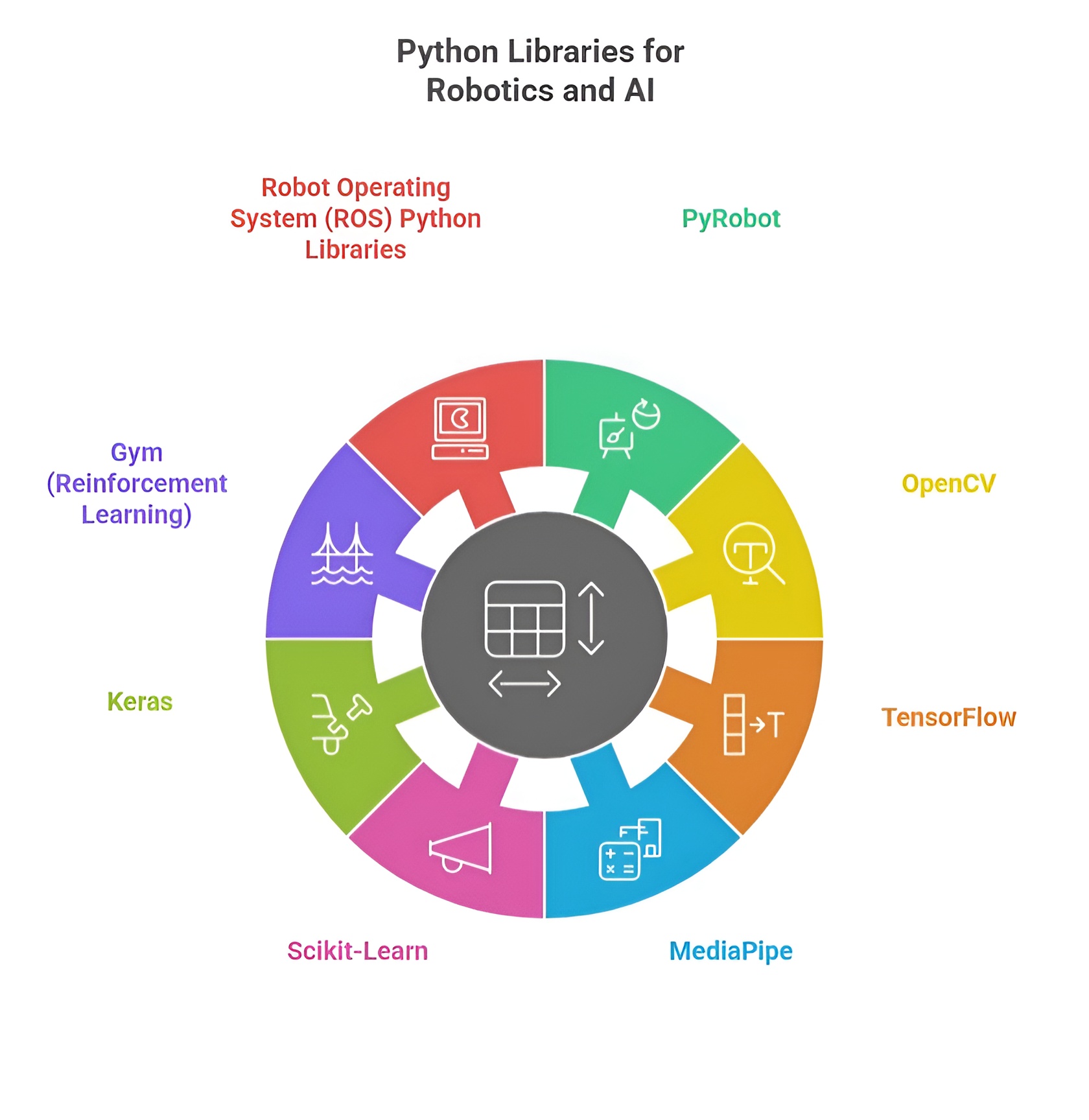
1. Robot Operating System (ROS) and ROSPy
The Robot Operating System (ROS) is a flexible framework for writing robot software, providing tools, libraries, and conventions to manage hardware abstraction, device control, message passing, and package management. ROSPy is the Python client library for ROS, enabling developers to write ROS nodes in Python. ROS allows integration of multiple sensors, actuators, and communication protocols, making it ideal for robot simulation, navigation, mapping, and autonomous control. It is widely used in research labs, industrial automation, and autonomous vehicle development.
2. PyRobot
PyRobot is a high-level Python library designed to simplify programming of robots. It provides a unified API for controlling different robotic platforms without requiring deep expertise in low-level hardware or control algorithms. PyRobot supports robot kinematics, motion planning, and sensor integration, and is compatible with simulators like Gazebo. It is used in academia and research for prototyping AI-driven robotics applications such as robotic arms, mobile robots, and navigation tasks.
3. OpenCV
OpenCV (Open Source Computer Vision Library) is a powerful library for computer vision and image processing. In robotics, OpenCV is used for object detection, image recognition, motion tracking, and environment perception. Robots rely on vision to interact with the world, and OpenCV provides Python APIs for real-time image processing, feature extraction, and camera calibration. It is widely applied in autonomous navigation, industrial inspection, and drone vision systems.
4. TensorFlow
TensorFlow is a comprehensive library for machine learning and deep learning, and it is extensively used in robotics for perception, decision-making, and control. Robots leverage TensorFlow to implement neural networks for image classification, object recognition, path planning, and reinforcement learning. TensorFlow also supports deployment on edge devices and GPU/TPU acceleration, enabling robots to perform real-time inference and autonomous decision-making efficiently.
5. PyTorch
PyTorch is an open-source deep learning framework known for dynamic computation graphs and flexibility in research applications. In robotics, PyTorch is used for training and deploying neural networks for sensor fusion, computer vision, reinforcement learning, and sequence prediction. Its modular design allows developers to experiment with novel architectures and integrate AI models into robotic control systems. Libraries like TorchVision and TorchRL complement PyTorch for vision and reinforcement learning tasks in robotics.
6. NumPy
NumPy is a fundamental library for numerical computing in Python, providing multidimensional array support and mathematical functions. In robotics and AI, NumPy is used for matrix calculations, vector operations, and sensor data preprocessing. Robotics algorithms often require linear algebra operations for kinematics, transformations, and control, and NumPy provides the tools to perform these calculations efficiently.
7. SciPy
SciPy builds on NumPy to provide advanced scientific and engineering computation capabilities. It is used in robotics for optimization, integration, interpolation, and signal processing. Applications include trajectory planning, control system design, and sensor data filtering, making SciPy essential for developing precise and responsive robotic systems.
8. Pandas
Pandas is a Python library for data manipulation and analysis, providing data structures like DataFrames. In robotics and AI, Pandas is used to process sensor logs, analyze experimental results, and manage datasets for machine learning tasks. It simplifies feature extraction, cleaning, and statistical analysis, which is critical for training AI models used in autonomous robots.
9. Matplotlib and Seaborn
Matplotlib and Seaborn are Python libraries for data visualization. Robotics developers use these libraries to plot sensor readings, visualize trajectories, track training progress, and debug AI models. Visualizing data allows for better understanding of robotic behavior, analysis of performance metrics, and identification of anomalies in real-world deployment.
10. Gym and Stable Baselines
OpenAI Gym is a Python library for reinforcement learning environments, enabling developers to simulate and train AI agents in controlled scenarios. Stable Baselines builds on Gym to provide pre-implemented RL algorithms for faster experimentation. In robotics, these libraries are used for training robots to perform autonomous navigation, manipulation, and decision-making tasks in simulated environments before deploying them in the real world.
11. ROSSimulators (Gazebo, Webots)
Gazebo and Webots are simulation platforms integrated with ROS that allow developers to test robotic algorithms in virtual environments. Using Python APIs, developers can control robots, simulate sensors, and evaluate AI models without the risk or cost of real-world deployment. Simulators are crucial for autonomous navigation, path planning, and reinforcement learning applications in robotics.
Python libraries provide the foundation for intelligent robotics development, covering areas such as control, perception, machine learning, simulation, data processing, and visualization. Combining these libraries allows developers to build, simulate, train, and deploy AI-powered robots for applications ranging from industrial automation and healthcare to autonomous vehicles, drones, and research experiments. Python’s ecosystem ensures flexibility, scalability, and accessibility for both beginners and advanced developers in the field of robotics and AI.
AI Techniques for Robotics
Artificial Intelligence techniques form the backbone of modern robotics, enabling machines to perceive their environment, make intelligent decisions, and act autonomously. By integrating AI, robots can handle complex tasks, adapt to dynamic environments, and improve performance over time. Python and its libraries such as TensorFlow, PyTorch, OpenCV, and ROS provide tools to implement AI algorithms for perception, learning, control, and decision-making in robotic systems.
1. Machine Learning for Perception and Decision-Making
Machine Learning (ML) equips robots with the ability to learn from data and improve performance without explicit programming. In robotics, ML is widely used for perception tasks, such as object detection, image recognition, environment mapping, sensor fusion, and anomaly detection. ML models enable robots to analyze sensor inputs from cameras, LiDAR, and other devices, allowing them to understand surroundings and make informed decisions. Supervised learning helps robots classify objects or predict outcomes, while unsupervised learning allows them to discover patterns in unstructured data. Python libraries such as scikit-learn, TensorFlow, and PyTorch provide tools to train, evaluate, and deploy machine learning models in robotic applications.
2. Reinforcement Learning for Autonomous Behavior
Reinforcement Learning (RL) is a type of AI where robots learn to make sequential decisions by interacting with their environment and receiving feedback in the form of rewards or penalties. RL enables robots to perform autonomous behavior, such as navigating unknown terrain, optimizing movement, or completing complex manipulation tasks. Techniques like Q-Learning, Deep Q-Networks (DQN), Policy Gradients, and Proximal Policy Optimization (PPO) allow robots to learn optimal strategies through trial and error. Python frameworks like OpenAI Gym, Stable Baselines, and PyTorch RL libraries facilitate simulation and training of reinforcement learning agents, enabling robots to achieve adaptable and intelligent autonomy in real-world environments.
3. Neural Networks for Prediction and Control
Neural Networks are used in robotics to model complex relationships between inputs and outputs, enabling prediction, control, and decision-making. Deep neural networks allow robots to predict sensor readings, actuator responses, or environmental dynamics, which is essential for trajectory planning, motion control, and obstacle avoidance. Convolutional Neural Networks (CNNs) help robots interpret visual data for object recognition and scene understanding, while Recurrent Neural Networks (RNNs) and Long Short-Term Memory (LSTM) networks are used for sequence prediction and time-dependent decision-making. Python libraries such as TensorFlow, Keras, and PyTorch provide tools to design, train, and deploy neural network architectures in robotic systems for intelligent perception and precise control.
4. Integration of AI Techniques in Robotics
Modern robotics often combines multiple AI techniques to achieve robust and adaptive behavior. For example, a self-driving car may use CNNs for road and object perception, reinforcement learning for decision-making, and ML regression models for trajectory prediction. Combining machine learning, reinforcement learning, and neural networks enables robots to perceive their environment accurately, plan optimal actions, and adapt to new situations dynamically. Python libraries like ROS, OpenCV, PyRobot, TensorFlow, and PyTorch provide the infrastructure to integrate these AI techniques seamlessly, ensuring the robot operates intelligently in diverse real-world scenarios.
AI techniques for robotics—machine learning, reinforcement learning, and neural networks—enable machines to perceive, learn, predict, and act autonomously, transforming robotics from manual or pre-programmed systems into intelligent, adaptive, and efficient autonomous agents. Python’s rich ecosystem of AI and robotics libraries allows developers to prototype, train, simulate, and deploy these AI-driven robotic systems, making intelligent robotics accessible across research, industry, and education.