1.1 Python in Artificial Intelligence (AI)
Python plays a major and dominant role in the field of Artificial Intelligence because of its simplicity, flexibility, and the huge ecosystem of libraries specially designed for AI development. Python is considered the most preferred programming language for AI because it allows developers, researchers, and students to write complex algorithms with less code and more clarity. Since AI requires tasks like mathematical computation, data processing, model training, visualization, deep learning, and automation, Python provides built-in support and specialized libraries that make these tasks significantly easier and faster. Python’s readable syntax makes understanding AI logic easier, while its wide community support ensures continuous improvement, pre-trained models, tools, frameworks, and documentation that help both beginners and professionals.
Python is used in AI because it can handle massive datasets, create machine learning models, write neural networks, develop natural language applications, perform computer vision tasks, and deploy AI applications in real-world environments. The speed and efficiency of Python come from optimized libraries written in C, C++, CUDA, and Fortran, which allow heavy AI computations to run extremely fast while Python acts as a simple interface.
Importance of Python in AI
Artificial Intelligence (AI) is a field of computer science that aims to create machines capable of performing tasks that require human intelligence, such as learning, reasoning, problem-solving, perception, and language understanding. Python has emerged as the most popular programming language for AI development due to its simplicity, efficiency, and versatility. Its easy-to-understand syntax, combined with a rich ecosystem of libraries and frameworks, makes it ideal for designing, testing, and deploying AI solutions. Python’s ability to support rapid prototyping and its strong community support further enhance its suitability for AI applications.
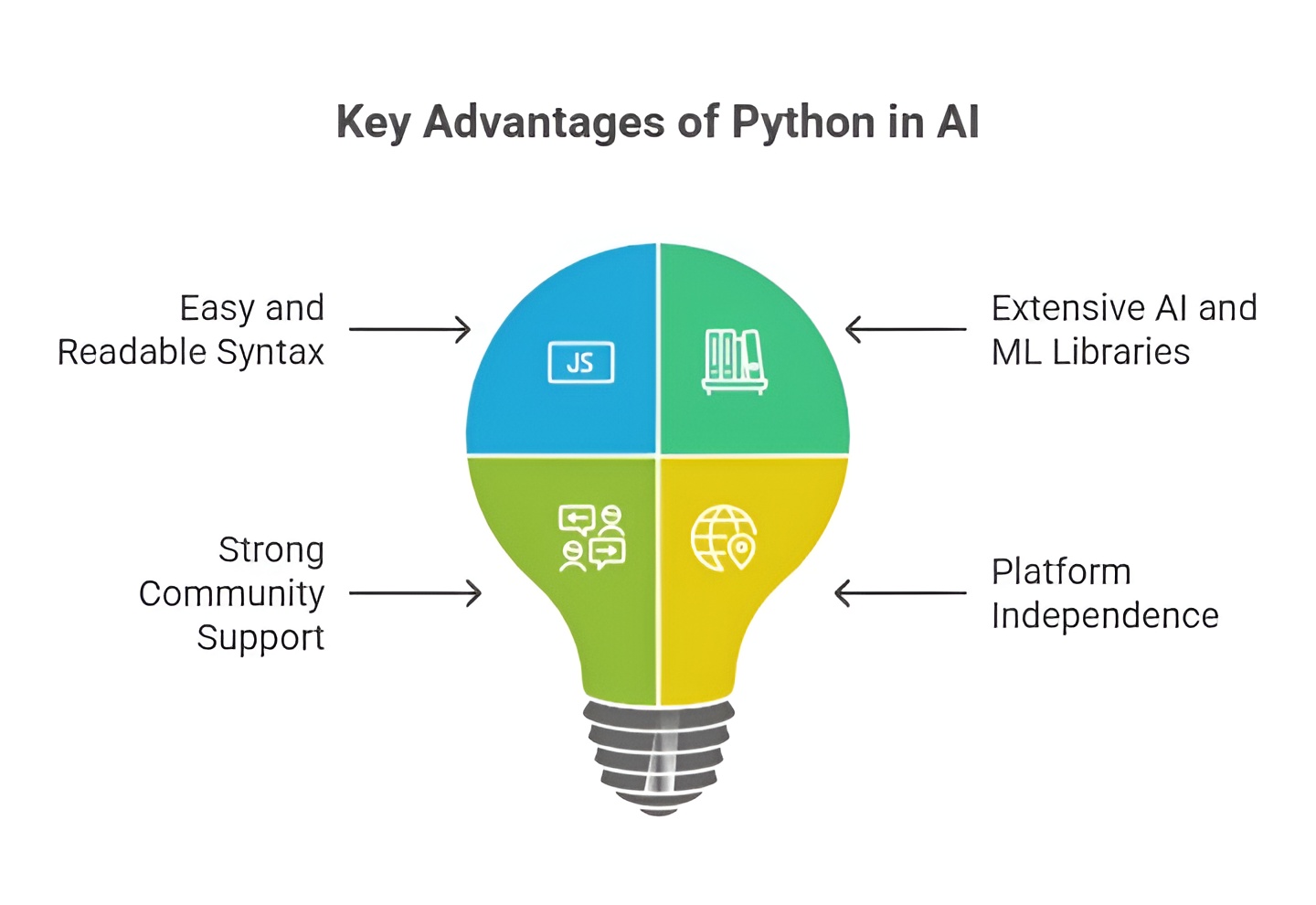
1) Easy to Learn and Use
Python’s syntax is simple, clear, and closely resembles natural language. This readability allows developers to focus more on solving AI problems rather than dealing with complicated programming structures. Easy-to-learn syntax reduces the learning curve for beginners entering AI and data science, enabling them to quickly implement algorithms and analyze results. Python’s interpretive nature allows for immediate execution of code without complex compilation steps, which is particularly useful when experimenting with AI models. The simplicity of Python contributes to faster development and debugging, making AI projects more manageable and reducing the chance of errors.
2)Extensive Libraries and Frameworks
Python provides an extensive collection of libraries and frameworks specifically designed for AI development. These tools simplify the process of implementing machine learning algorithms, neural networks, natural language processing, and data analysis. Libraries such as TensorFlow, PyTorch, Keras, and Scikit-learn provide pre-built functions and modules that allow developers to focus on designing intelligent systems instead of implementing low-level algorithms from scratch. For example, neural network layers, optimization techniques, and data preprocessing functions are readily available in these libraries, which significantly reduces development time and increases efficiency. The presence of such libraries also ensures that Python stays at the forefront of AI research and application development.
3)Strong Community Support
Python has a large and active developer community, which continuously contributes to the improvement of its libraries and frameworks. Community support plays a crucial role in AI because it provides access to tutorials, documentation, open-source tools, and forums for troubleshooting. Developers can learn from shared knowledge, collaborate on projects, and adopt best practices from experienced professionals. The active community ensures that AI developers can find solutions to challenges quickly, stay updated with the latest advancements, and maintain efficient development workflows. Strong community support also encourages innovation and fosters collaboration across AI research and development teams.
4)Flexibility and Integration
Python supports multiple programming paradigms, including procedural, object-oriented, and functional programming. This flexibility allows AI developers to choose the best approach for a particular problem. Python can integrate seamlessly with other programming languages such as C, C++, and Java, allowing developers to combine performance-critical components with Python’s ease of use. In AI development, flexibility ensures that algorithms, models, and systems can be adapted to evolving requirements and that different technologies can be combined efficiently. It allows researchers to experiment with new AI techniques without being constrained by rigid programming structures, enabling innovation in problem-solving approaches.
5)Data Visualization Capabilities
Data visualization is a key part of AI because it helps in understanding datasets, identifying patterns, and evaluating model performance. Python provides powerful visualization libraries like Matplotlib, Seaborn, and Plotly, which allow developers to create graphs, charts, and interactive plots. These visualizations are crucial for interpreting machine learning model predictions, detecting anomalies, and communicating insights effectively. The ability to visually represent complex data and model outcomes enhances the development of AI solutions by providing intuitive feedback and supporting data-driven decision-making.
6)Cross-Platform Compatibility
Python is compatible with multiple operating systems, including Windows, macOS, and Linux. This cross-platform nature ensures that AI applications can be developed and deployed across different environments without significant modifications. Cross-platform compatibility allows AI developers to work in diverse technological ecosystems and ensures that solutions can reach a wide audience regardless of hardware or software limitations. This portability is particularly important for AI applications that need to be deployed in real-world systems or across cloud-based platforms.
7)Rapid Prototyping and Experimentation
Python’s simplicity, combined with its rich libraries and interpretive nature, allows for rapid prototyping and experimentation. AI development often involves testing multiple algorithms, adjusting hyperparameters, and iterating over models to achieve optimal results. Python enables developers to quickly implement prototypes, run experiments, and analyze results without lengthy development cycles. Rapid prototyping accelerates research, reduces time to market for AI solutions, and encourages exploration of innovative approaches. It ensures that AI developers can adapt and refine models efficiently, which is essential in a field where experimentation and iteration drive progress.
Python’s importance in AI stems from its simplicity, readability, flexibility, and extensive ecosystem of libraries and frameworks. Its ability to support rapid prototyping, cross-platform deployment, and integration with other languages makes it an indispensable tool for AI developers. Strong community support ensures continuous innovation and knowledge sharing, while powerful visualization capabilities enhance data interpretation and model evaluation. Python empowers researchers and developers to focus on solving complex AI problems efficiently, making it the preferred language for AI research, development, and application.
Why Python is important in AI?
Python is widely regarded as the most important programming language for AI development. Its popularity in AI comes from a combination of simplicity, flexibility, and the availability of powerful tools that make designing and implementing AI systems faster and more efficient. AI involves complex tasks such as machine learning, deep learning, natural language processing, and computer vision. Python’s features allow developers and researchers to focus on solving AI problems rather than dealing with the intricacies of programming, which makes it essential for AI applications.
1)Simplicity and Readability
Python’s syntax is straightforward, clear, and closely resembles human language. This readability allows developers to write AI programs without unnecessary complexity, making it easier to understand and maintain code. Because AI development often involves experimenting with algorithms and analyzing results, the simplicity of Python allows researchers to focus on the logic of the problem rather than the mechanics of the language. This reduces the learning curve for beginners and accelerates the development process, which is critical in AI research and application.
2)Extensive Libraries for AI
Python provides a vast ecosystem of libraries that are specifically designed for AI development. Libraries like TensorFlow, PyTorch, Keras, Scikit-learn, and OpenCV provide pre-built functions and models for machine learning, deep learning, and computer vision tasks. These libraries save significant time and effort because developers do not need to implement complex algorithms from scratch. They allow AI developers to experiment, test, and deploy models efficiently, making Python highly productive for AI applications.
3)Strong Community Support
Python has a large and active community of developers and researchers who contribute to AI libraries, frameworks, tutorials, and forums. Community support is vital in AI because it provides guidance, documentation, and problem-solving resources that help developers overcome challenges. The continuous contributions from the community ensure that Python stays updated with the latest AI technologies and trends. This collaborative environment accelerates innovation and helps beginners and experts alike to learn, troubleshoot, and implement AI solutions effectively.
4)Flexibility in Programming
Python supports multiple programming paradigms, including object-oriented, procedural, and functional programming. This flexibility allows AI developers to choose the most appropriate approach for solving a problem. Python can also integrate with other languages like C, C++, and Java, which makes it easier to optimize performance-critical parts of AI applications. Flexibility ensures that Python can adapt to diverse AI tasks, whether it involves building neural networks, implementing reinforcement learning, or performing data preprocessing.
5)Data Handling and Visualization
Handling and interpreting large amounts of data is essential in AI. Python provides powerful libraries such as Pandas, NumPy, Matplotlib, Seaborn, and Plotly that allow efficient data manipulation, analysis, and visualization. Visualization helps developers understand patterns, trends, and anomalies in datasets, which is critical for training AI models and evaluating their performance. Python’s data handling capabilities make it easier to prepare, process, and analyze data, which directly contributes to the effectiveness of AI solutions.
6)Cross-Platform Compatibility
Python can run on multiple operating systems, including Windows, macOS, and Linux. This cross-platform compatibility ensures that AI applications developed in Python can be deployed and executed in various environments without significant modification. It allows AI projects to be scalable, portable, and accessible, which is important when deploying AI solutions to real-world systems, cloud platforms, or edge devices.
7)Rapid Prototyping and Experimentation
AI development often requires testing multiple algorithms, fine-tuning models, and iterating over different approaches. Python’s interpretive nature, combined with its libraries, makes rapid prototyping possible. Developers can quickly implement ideas, experiment with models, and analyze results without lengthy development cycles. This iterative process is crucial in AI because it enables researchers to discover the most effective algorithms and optimize performance efficiently.
Python’s importance in AI comes from its simplicity, extensive libraries, community support, flexibility, data handling and visualization capabilities, cross-platform compatibility, and ability to support rapid prototyping. These features allow developers to focus on solving AI problems efficiently and innovatively. Python empowers both beginners and experts to design, implement, and deploy AI solutions across various domains, making it an indispensable language in the field of artificial intelligence.
Applications of Python in AI
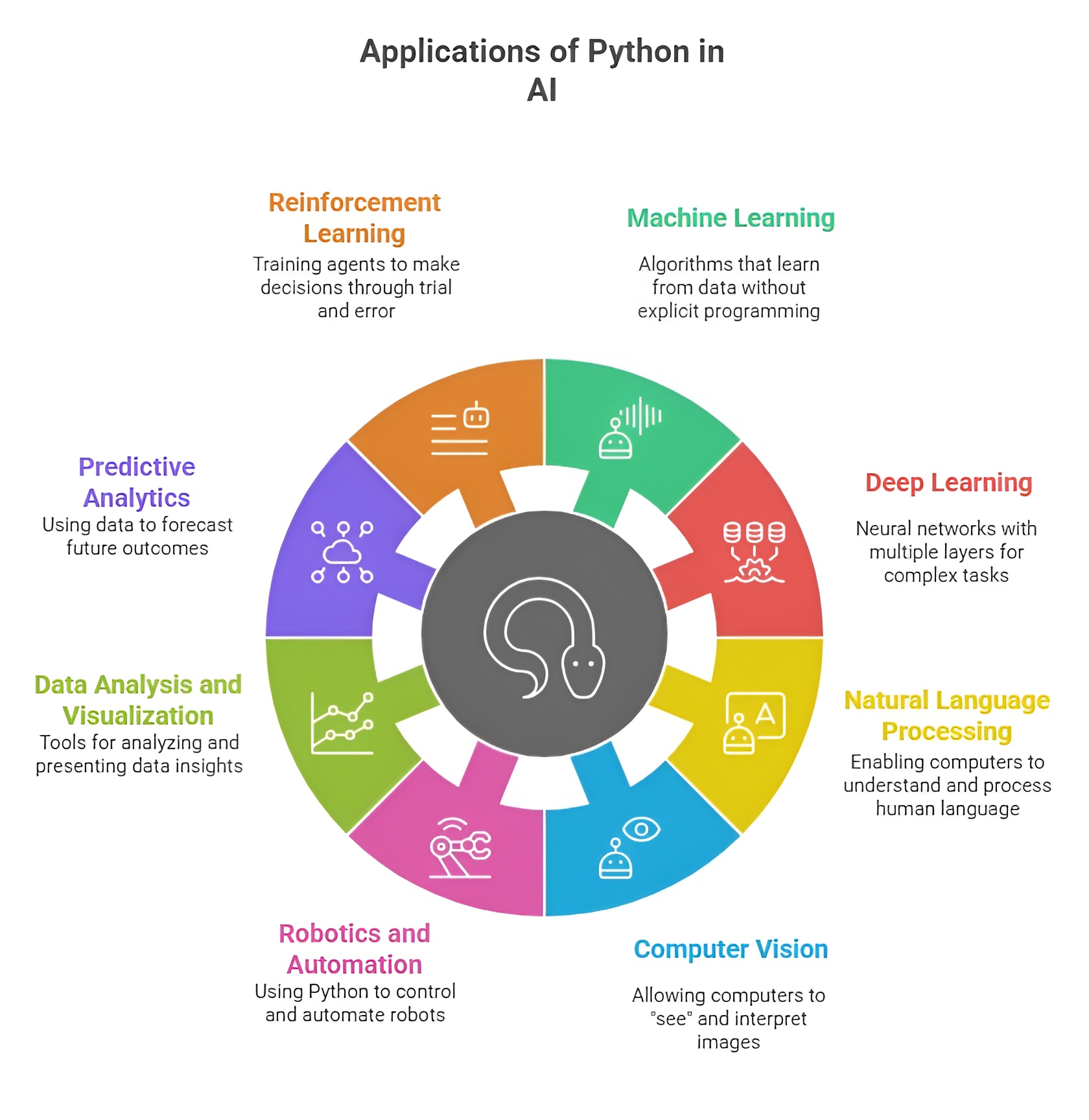
Python has become the primary programming language for developing AI applications due to its simplicity, versatility, and rich ecosystem of libraries. AI encompasses a wide range of technologies such as machine learning, deep learning, natural language processing, computer vision, robotics, and data analytics. Python’s features make it easy to implement these technologies efficiently and effectively. Its widespread adoption in AI is reflected in real-world applications across industries including healthcare, finance, education, entertainment, and autonomous systems.
1)Machine Learning Applications
Machine learning (ML) is a subset of AI that allows systems to learn from data and improve their performance without explicit programming. Python is extensively used in ML because of libraries like Scikit-learn, TensorFlow, and PyTorch, which provide pre-built functions and algorithms for classification, regression, clustering, and prediction tasks. In practice, Python enables developers to build recommendation systems, fraud detection systems, predictive maintenance tools, and personalized marketing models. The simplicity and readability of Python make it easier to train models, test hypotheses, and analyze performance effectively.
2)Deep Learning Applications
Deep learning, a specialized form of machine learning, involves artificial neural networks with multiple layers that can learn complex patterns from large datasets. Python supports deep learning through libraries like TensorFlow, Keras, and PyTorch. These libraries simplify the creation, training, and deployment of deep neural networks. Python is widely used in applications such as image recognition, speech recognition, natural language translation, autonomous vehicles, and facial recognition. Its ability to handle large datasets, integrate with GPUs, and provide visualization tools makes Python ideal for implementing deep learning models efficiently.
3)Natural Language Processing Applications
Natural Language Processing (NLP) focuses on enabling machines to understand, interpret, and generate human language. Python offers libraries such as NLTK, spaCy, and Hugging Face Transformers that allow developers to process text data, extract meaning, and perform sentiment analysis, chatbots, language translation, and text summarization. Python’s simplicity and flexibility allow developers to pre-process large volumes of text, apply machine learning algorithms, and evaluate model performance without dealing with complex low-level coding. This makes it a primary choice for NLP applications in AI.
4)Computer Vision Applications
Computer vision is an AI field that enables machines to interpret and understand visual information from the world. Python supports computer vision tasks using libraries like OpenCV, PIL, and TensorFlow. Developers can use Python to implement applications such as object detection, facial recognition, medical image analysis, video surveillance, and autonomous driving systems. Python’s extensive libraries and ease of integration with deep learning frameworks allow developers to build high-performance computer vision systems that can analyze and act upon visual data accurately.
5)Robotics and Automation Applications
Python is widely used in robotics and automation for AI-based control systems and intelligent behavior modeling. Libraries such as ROS (Robot Operating System) and PyRobot allow developers to implement AI algorithms for autonomous navigation, object manipulation, and human-robot interaction. Python’s readability and ability to interface with sensors, actuators, and machine learning models make it suitable for robotics applications where precise control and adaptability are required.
6)Data Analytics and Predictive Modeling
AI applications rely heavily on data analysis and predictive modeling. Python provides libraries like Pandas, NumPy, and Matplotlib for data manipulation, analysis, and visualization, which are essential for AI workflows. Predictive modeling using Python allows businesses and researchers to forecast trends, optimize operations, and make data-driven decisions. Python’s tools enable developers to preprocess data, train AI models, and interpret predictions in an efficient and comprehensible manner.
7)Healthcare and Medical Applications
In healthcare, Python is used for AI applications such as disease diagnosis, medical image analysis, drug discovery, and personalized treatment recommendations. Python’s libraries for machine learning and deep learning facilitate the development of models that can detect patterns in complex medical data, such as MRI scans, X-rays, or patient records. Its simplicity allows healthcare AI developers to focus on improving accuracy and efficiency of diagnosis and treatment planning.
8)Finance and Business Applications
Python is widely used in finance for AI applications such as fraud detection, credit scoring, algorithmic trading, and risk management. Python’s libraries allow financial institutions to analyze large datasets, detect anomalies, and build predictive models. AI applications in business leverage Python to optimize customer experiences, forecast demand, and automate decision-making processes, providing a competitive advantage in data-driven industries.
Python is indispensable in AI due to its versatility, simplicity, and powerful libraries. Its applications span multiple domains including machine learning, deep learning, natural language processing, computer vision, robotics, healthcare, finance, and data analytics. Python allows developers to efficiently implement AI algorithms, handle large datasets, visualize results, and deploy solutions across industries. Its combination of readability, flexibility, and rich ecosystem makes Python the preferred language for creating intelligent systems and innovative AI applications.

Class Sessions
Sales Campaign

We have a sales campaign on our promoted courses and products. You can purchase 1 products at a discounted price up to 15% discount.