USD ($)
$
United States Dollar
Euro Member Countries
India Rupee
د.إ
United Arab Emirates dirham
ر.س
Saudi Arabia Riyal

Relationship Management: Managing Stakeholders and Suppliers

Lesson 11/28 | Study Time: 20 Min

Relationship management is a vital principle in ISO 9001 that focuses on strategically managing and nurturing positive relationships with all relevant stakeholders, especially suppliers.

It recognizes that organizations do not operate in isolation but are intrinsically linked to a network of partners, customers, investors, employees, and the broader society.

Effective relationship management ensures that these interdependencies are leveraged to create mutual value, sustain business success, and drive continuous quality improvements.

Managing relationships under ISO 9001 involves clear communication, setting expectations, and fostering collaboration. Organizations need to establish transparent channels with suppliers and stakeholders to align on quality expectations, performance goals, and shared responsibilities.

This process includes risk-based supplier selection and evaluation, ongoing performance monitoring, and joint problem-solving initiatives that enhance product quality, reduce risks, and optimize supply chain efficiency.

Regular business reviews, audits, feedback mechanisms, and improvement programs underpin these efforts, ensuring that relationships adapt to changes and continuously contribute to organizational objectives.

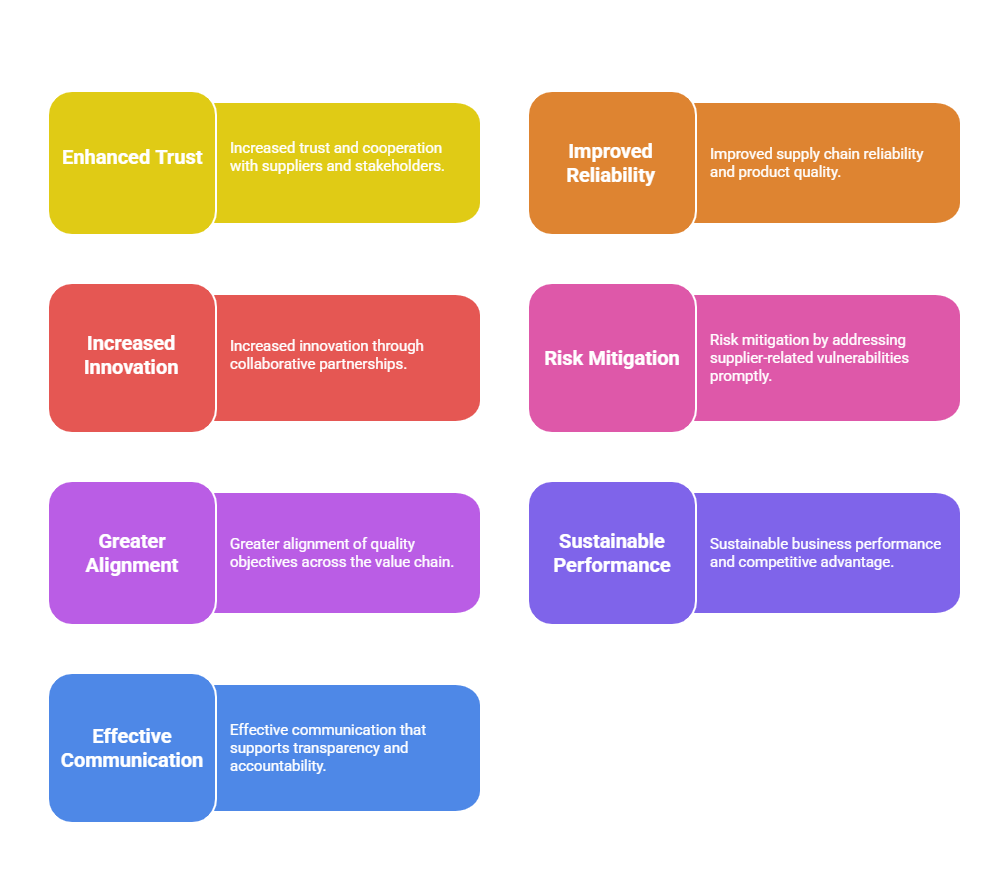
Pros of Strong Relationship Management 

Building and maintaining effective relationships with stakeholders and suppliers leads to long-term success. Below are the major pros of strong relationship management.

Robert Jennings

Robert Jennings

Product Designer
Profile

Class Sessions

1- What is Quality? Why It Matters in Organizations 2- Types and Benefits of a Quality Management System (QMS) 3- Overview and Purpose of the ISO and the ISO 9001 Standard 4- Context: Who Uses ISO 9001 and Why? 5- Customer Focus: Meeting and Exceeding Needs 6- Leadership: Roles and Responsibilities of Top Management 7- Engagement of People: Why Everyone's Involvement is Crucial 8- Process Approach: Managing Interrelated Activities 9- Improvement: Pursuing Continual Betterment 10- Evidence-Based Decision Making: Using Data for Choices 11- Relationship Management: Managing Stakeholders and Suppliers 12- The High-Level Structure (Annex SL) 13- Clause-by-Clause Summary (Context, Leadership, Planning, Support, Operation, Evaluation, Improvement) 14- Key QMS Documentation: Quality policy, Quality Manual, Procedures, and Records 15- Determining Organizational Context and Interested Parties 16- Defining Scope, Processes, and Objectives for the QMS 17- Risk-Based Thinking and the Plan-Do-Check-Act (PDCA) Model 18- Documentation Essentials: What Must Be Documented and Why 19- Communication, Training, and Awareness 20- Process Management and Control 21- Managing Nonconformities and Corrective Actions 22- Monitoring, Measuring, and Analyzing Performance 23- Introduction to Internal Audits: Purpose, Basic Steps 24- Management Review: Keeping the QMS Effective 25- Continual Improvement (Methods and Examples) 26- Using Corrective and Preventive Actions 27- How External Certification Works 28- Benefits of Certification for Organizations