Text editing and file creation are fundamental activities in Linux environments, whether for writing code, configuring systems, or managing documentation. Linux offers a suite of powerful text editors — ranging from user-friendly options to highly versatile command-line tools — that enable efficient creation and modification of text files.
Creating Files in Linux
Files can be created in Linux in several ways:
1. Using the touch command: Creates a new empty file if it does not exist or updates the timestamp if it exists.
Example:
touch example.txt2. Using redirection operators: Create and write to a file by redirecting output.
Examples:
echo "Hello, Linux!" > hello.txtCreates a file with the string "Hello, Linux!" or overwrites it if it exists.
cat > notes.txtAllows interactive input to populate the file; press Ctrl+D to save and exit.
3. Using text editors: Editors will create the file if it doesn’t exist upon saving.
Text Editors in Linux
Linux offers many text editors, each serving different user preferences and complexity levels.
Graphical Editors (GUI)
1. Gedit: Default GNOME text editor, simple and intuitive.
2. Kate: KDE’s advanced, feature-rich editor.
3. Mousepad, Leafpad: Lightweight, minimal graphical editors.
These are commonly used for casual editing and desktop environments.
Command-Line Editors
1. Nano: Simple, user-friendly CLI editor, and controls displayed at the bottom; useful for beginners.
Open/create files with:
nano filename.txtSave with Ctrl+O, exit with Ctrl+X.
2. Vi / Vim: Highly powerful and ubiquitous CLI editor.
Modes: insert (edit text), normal (navigate), command (ex commands).
Basic usage:
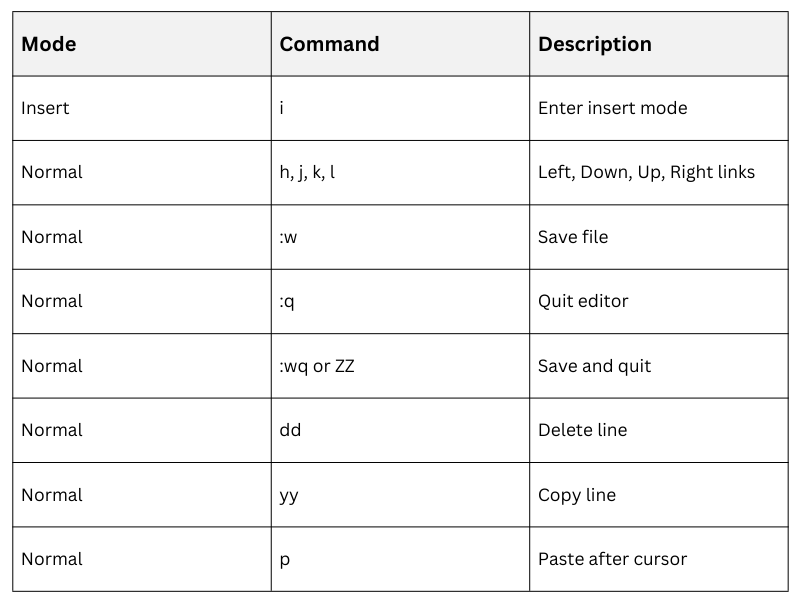
vi filename.txtPress i to insert, Esc to switch modes, :w to save, :q to quit, :wq to save and quit.
3. Emacs: Feature-rich and extensible editor popular with programmers, and customizable with complex scripting capabilities.
Basic Editing Commands in Nano
1. Navigation by arrow keys.
2. Copy (Ctrl+K) and paste (Ctrl+U) lines.
3. Search with Ctrl+W.
4. Undo last action with Alt+U.
Basic Vi/Vim Commands
Saving Files and Exiting
1. Always save your work with appropriate commands depending on the editor.
2. Use appropriate quit commands to avoid losing unsaved changes.
3. Command-line editors typically warn about unsaved changes when you attempt to exit.